Friday, October 30, 2026
Science
No Result
View All Result
  • Login
  • HOME
  • SCIENCE NEWS
  • CONTACT US
  • HOME
  • SCIENCE NEWS
  • CONTACT US
No Result
View All Result
Scienmag
No Result
View All Result
Home Science News Medicine

Screw-Anchored Stencil Guides Responsive Neurostimulation Craniectomy in Bench Study

October 29, 2026
in Medicine
Ophelia Keating
By Ophelia Keating Scienmag Editorial Profile - Health Services Research
Reading Time: 2 mins read
0
Screw-Anchored Stencil Guides Responsive Neurostimulation Craniectomy in Bench Study

Screw-Anchored Stencil Guides Responsive Neurostimulation Craniectomy in Bench Study

65
SHARES
587
VIEWS
Share on FacebookShare on Twitter
ADVERTISEMENT

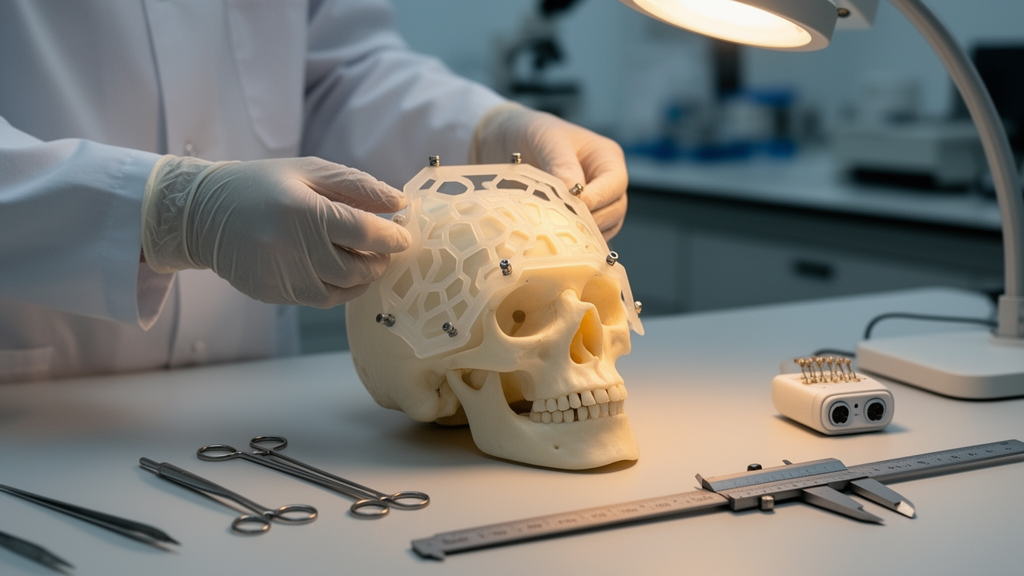
A 3D-printed stencil fixed to the skull with a single screw dramatically outperformed the standard hand-held template when surgeons-in-training marked out craniectomies for responsive neurostimulation implants, according to a randomized crossover bench study published in Acta Neurochirurgica. In the model, the ferrule of the device seated flush on the first attempt in every craniectomy marked with the stencil, compared with only a quarter of those marked freehand.

The generator sits in a craniectomy, a shallow well of removed bone, that must precisely match the device’s ferrule. Surgeons currently trace the outline using a hand-held template that moves freely across the curved surface of the skull. Any error in that traced outline usually remains hidden until after the bone has been removed, when the ferrule simply fails to fit. The research team, led by Mokshal H. Porwal and Alexander C. Whiting, designed a 3D-printed stencil that is anchored during marking with one screw placed in the bone that is about to be removed, eliminating the movement that makes freehand tracing unreliable.

To test the device, the researchers ran a randomized crossover bench study in which eight surgical residents each performed four craniectomies on 3D-printed skulls: two marked with the new stencil and two with the conventional template. The primary outcome was first-pass fit, defined as flush seating of the ferrule at the first attempt. Secondary outcomes included the number of attempts required, operative time, craniectomy size, and operator confidence, analyzed with exact within-operator randomization tests.

The results favored the stencil on every measure. The ferrule seated at the first attempt in 16 of 16 stencil-marked craniectomies versus 4 of 16 template-marked ones, a 100 percent versus 25 percent difference that was statistically significant. Operative time was shorter with the stencil, at 99.7 seconds versus 136.9 seconds, and the resulting craniectomies were smaller, measuring 22.5 square centimeters versus 23.8 square centimeters. Operators also reported higher confidence, averaging 6.6 out of 10 with the stencil compared with 4.1 with the template. Every individual operator needed fewer attempts, worked faster, and produced a smaller craniectomy with the stencil, regardless of seniority.

The authors conclude that, in a bench model, a marking stencil anchored to bone destined for removal achieved first-pass fit of the RNS ferrule in every craniectomy, without enlarging the craniectomy or leaving a screw hole in the retained skull. Because the anchoring screw sits within the bone that is subsequently removed, the technique leaves no permanent hardware behind. The findings are limited to a simulated bench setting with resident operators and printed skulls, and the study is a technical report of a device concept rather than evidence from clinical use; the article was published as open access on October 13, 2026.

Subject of Research: A bench study testing a screw-anchored 3D-printed stencil for marking craniectomies for responsive neurostimulation implants

Article Title: A screw-anchored stencil for responsive neurostimulation craniectomy: a randomized crossover bench study

Article References: Porwal, M. H., Jaffee, S., Lamsam, L., & Whiting, A. C. (2026). A screw-anchored stencil for responsive neurostimulation craniectomy: a randomized crossover bench study. Acta Neurochirurgica. https://doi.org/10.1007/s00701-026-07063-3

Image Credits: AI Generated

DOI: 10.1007/s00701-026-07063-3

Keywords: responsive neurostimulation, craniectomy, 3D-printed stencil, surgical technique, epilepsy, bench study, randomized crossover, neurosurgery, ferrule fit, surgical residents, medical device, screw-anchored

Cite Scienmag News

Ophelia Keating. (October 29, 2026). Screw-Anchored Stencil Guides Responsive Neurostimulation Craniectomy in Bench Study. Scienmag. https://scienmag.com/screw-anchored-stencil-guides-responsive-neurostimulation-craniectomy-in-bench-study/


Ophelia Keating. "Screw-Anchored Stencil Guides Responsive Neurostimulation Craniectomy in Bench Study." Scienmag, 29 October 2026, https://scienmag.com/screw-anchored-stencil-guides-responsive-neurostimulation-craniectomy-in-bench-study/. Accessed 30 October 2026.

Ophelia Keating. "Screw-Anchored Stencil Guides Responsive Neurostimulation Craniectomy in Bench Study." Scienmag. October 29, 2026. https://scienmag.com/screw-anchored-stencil-guides-responsive-neurostimulation-craniectomy-in-bench-study/

Tags: 3D-printed stencil3D-printed surgical stencil for craniectomyadvanced tools forbench studybench study of surgical template effectivenesscomparison of hand-held vs. stencil-guided craniectomycraniectomyepilepsyferrule fitfixation methods for skull marking templatesimpact of template stability on surgical outcomesimproved craniectomy planning with 3D printinginnovative skull marking techniquesmedical deviceneurosurgeryprecision in neurostimulation device implantationrandomized crossoverresponsive neurostimulationresponsive neurostimulation craniectomy accuracyscrew-anchoredscrew-anchored neurostimulation implant guidessurgical residentssurgical techniquesurgical training in craniectomy procedures
Share26Tweet16
Previous Post

Nursing Intervention Based on Neuman Systems Model Eases Anxiety and Improves Sleep in First-Time Pregnant Women

Next Post

Needle-Fenestrated Stent-Graft Repair of the Aortic Arch Shows Durable Early Results

Related Posts

ZNF207 shields glutamine transporter ASCT2 from degradation to fuel liver cancer growth
Cancer

ZNF207 shields glutamine transporter ASCT2 from degradation to fuel liver cancer growth

October 30, 2026
Most Ethiopian HIV patients on dolutegravir therapy show good knowledge, survey finds
Medicine

Most Ethiopian HIV patients on dolutegravir therapy show good knowledge, survey finds

October 30, 2026
Serum and urine protein biomarkers may sharpen prostate cancer detection beyond PSA
Medicine

Serum and urine protein biomarkers may sharpen prostate cancer detection beyond PSA

October 30, 2026
One gene locus flags atrial fibrillation risk after major surgery, UK Biobank study finds
Medicine

One gene locus flags atrial fibrillation risk after major surgery, UK Biobank study finds

October 30, 2026
Deep-learning CT reconstruction sharpens calcium visibility in phantom tests, but dose evens the score
Medicine

Deep-learning CT reconstruction sharpens calcium visibility in phantom tests, but dose evens the score

October 30, 2026
Pennywort Leaf Extract Lowers Blood Sugar in Diabetic Rats, Study Finds
Medicine

Pennywort Leaf Extract Lowers Blood Sugar in Diabetic Rats, Study Finds

October 30, 2026
Next Post
Needle-Fenestrated Stent-Graft Repair of the Aortic Arch Shows Durable Early Results

Needle-Fenestrated Stent-Graft Repair of the Aortic Arch Shows Durable Early Results

  • Mothers who receive childcare support from maternal grandparents show more optimized

    Mothers who receive childcare support from maternal grandparents show more parental warmth, finds NTU Singapore study

    27656 shares
    Share 11059 Tweet 6912
  • University of Seville Breaks 120-Year-Old Mystery, Revises a Key Einstein Concept

    1061 shares
    Share 424 Tweet 265
  • Bee body mass, pathogens and local climate influence heat tolerance

    682 shares
    Share 273 Tweet 171
  • Researchers record first-ever images and data of a shark experiencing a boat strike

    546 shares
    Share 218 Tweet 137
  • Groundbreaking Clinical Trial Reveals Lubiprostone Enhances Kidney Function

    531 shares
    Share 212 Tweet 133
Science

Embark on a thrilling journey of discovery with Scienmag.com—your ultimate source for cutting-edge breakthroughs. Immerse yourself in a world where curiosity knows no limits and tomorrow’s possibilities become today’s reality!

RECENT NEWS

  • Microbial Sources and Stress Shape the Hidden Endophytes of an Invasive Plant
  • Firebreaks Leave Lasting Scars in Grasslands While Wildfire Heals Fast
  • Regularisation and voluntary return reproduce precarity for irregularised migrants in Spain and the UK
  • ZNF207 shields glutamine transporter ASCT2 from degradation to fuel liver cancer growth

Categories

  • Agriculture
  • Anthropology
  • Archaeology
  • Athmospheric
  • Biology
  • Biotechnology
  • Blog
  • Bussines
  • Cancer
  • Chemistry
  • Climate
  • Earth Science
  • Editorial Policy
  • Marine
  • Mathematics
  • Medicine
  • Pediatry
  • Policy
  • Psychology & Psychiatry
  • Science Education
  • Science News
  • Social Science
  • Space
  • Technology and Engineering

Subscribe to Blog via Email

Enter your email address to subscribe to this blog and receive notifications of new posts by email.

Join 5,151 other subscribers

© 2025 Scienmag - Science Magazine

Welcome Back!

Login to your account below

Forgotten Password?

Retrieve your password

Please enter your username or email address to reset your password.

Log In
No Result
View All Result
  • HOME
  • SCIENCE NEWS
  • CONTACT US

© 2025 Scienmag - Science Magazine

Discover more from Science

Subscribe now to keep reading and get access to the full archive.

Continue reading