

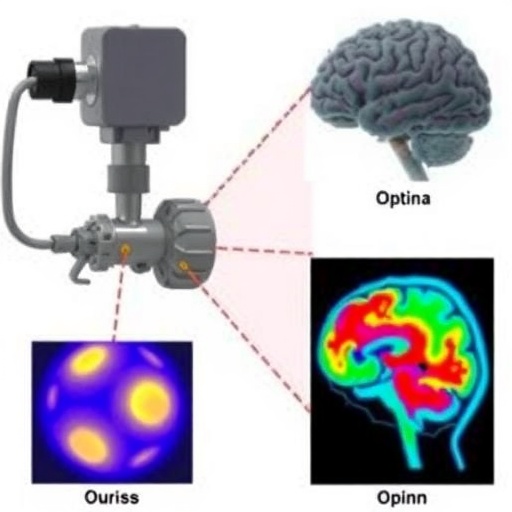
In a groundbreaking advancement poised to redefine the landscape of brain imaging technologies, researchers have unveiled a novel functional near-infrared spectroscopy (fNIRS) system integrating scientific complementary metal-oxide-semiconductor (sCMOS) sensor technology. This innovation promises to elevate the precision and practicality of neural activity monitoring, offering a transformative alternative to traditional neuroimaging modalities. The team, led by Zhou, J., Yan, B., Pu, Y., and colleagues, has embarked on a comprehensive validation of this sCMOS-based fNIRS system, meticulously evaluating its optical performance alongside its capability to capture cortical responses with remarkable fidelity.
The utilization of fNIRS is not new; it leverages near-infrared light to non-invasively probe cerebral hemodynamics, thereby providing insight into neural activity by monitoring oxygenated and deoxygenated hemoglobin concentrations. However, conventional fNIRS systems often grapple with limitations related to signal-to-noise ratio (SNR), temporal resolution, and spatial specificity, hindering their broader adoption in both clinical and research settings. This new sCMOS-based system addresses these challenges by harnessing the advanced imaging characteristics of sCMOS technology, known for its high quantum efficiency, low noise, and rapid frame rates.
Central to the system’s design is the integration of an sCMOS sensor array, replacing traditional photodetector arrangements. This shift enables a substantial leap in optical detection capabilities, enhancing the device’s sensitivity to subtle hemodynamic changes in the cerebral cortex. The sCMOS sensor’s inherent low dark current and minimized readout noise contribute to an enhanced SNR, crucial for capturing the nuanced fluctuations indicative of neural activation. This improvement is pivotal in differentiating true cortical signals from physiological artifacts and environmental noise, a perennial obstacle in neuroimaging.
Equally transformative is the system’s superior temporal resolution, a critical parameter for accurately mapping the dynamic processes of brain function. The rapid frame acquisition facilitated by sCMOS sensors permits real-time monitoring of cerebral blood flow changes with millisecond precision. This temporal acuity empowers researchers and clinicians to observe transient neural events that may elude slower imaging modalities, thus enriching the granularity of brain activity analysis.
Beyond temporal advantages, spatial resolution also experiences a significant boost. The densely packed pixel architecture of sCMOS sensors translates into finer spatial sampling of the cortical surface. This characteristic allows the fNIRS system to delineate hemodynamic responses with improved localization accuracy, bridging the gap between non-invasive imaging and the resolution traditionally reserved for more intrusive methods like functional MRI. As a result, this technology offers a compelling blend of accessibility and detailed brain mapping.
The validation process undertaken by Zhou and team was rigorous, encompassing a range of optical performance metrics including sensitivity curves, dynamic range assessments, and response linearity tests. These evaluations confirmed that the sCMOS-based system maintains high fidelity across various operational conditions, from low-light environments to high-frequency stimulation paradigms. Such robustness ensures its applicability in diverse research contexts, from cognitive neuroscience experiments to psychiatric evaluations.
Crucially, the investigation extended to in vivo assessments involving human subjects, wherein cortical responses to controlled stimuli were recorded utilizing the new system. The data revealed clear, consistent hemodynamic patterns correlating with known neural activations, substantiating the device’s functional relevance. Comparisons with established fNIRS setups underscored the sCMOS-based system’s superior SNR and enhanced temporal-spatial resolution, marking a significant step forward in non-invasive brain monitoring techniques.
The implications of this advancement ripple beyond scientific curiosity, touching upon clinical domains where accurate brain function assessment is vital. Neurological and psychiatric disorders often manifest through altered cortical activity patterns, and the deployment of a sensitive, portable fNIRS system could revolutionize diagnostic procedures, treatment monitoring, and rehabilitation strategies. The sCMOS-based technology’s capacity for real-time, detailed brain activity mapping equips clinicians with a powerful tool to detect subtle neural anomalies early and track therapeutic outcomes objectively.
Moreover, the portability and ease of use inherent to fNIRS systems are amplified in this new iteration, thanks to the compact, efficient design facilitated by sCMOS sensors. This portability opens avenues for bedside monitoring, outpatient assessments, and even ambulatory studies, historically constrained by the bulky and immobile nature of other neuroimaging equipment. The democratization of brain imaging enabled by this technology could foster wider population studies and personalized medicine approaches.
From a technical perspective, this work highlights the intersection of optical engineering and neuroscience, showcasing how innovations in sensor technologies can pivotally enhance medical diagnostics. The adaptation of sCMOS sensors, widely utilized in fields such as astronomy and high-speed photography, brings their remarkable attributes into the realm of brain imaging, exemplifying cross-disciplinary ingenuity. This convergence also sets a precedent for future developments in multimodal neural monitoring systems.
Looking ahead, the research team envisions further refinements to the system, including enhanced algorithms for signal processing and artifact reduction. Machine learning approaches could be integrated to interpret the rich datasets generated, facilitating automated identification of neural patterns associated with specific cognitive or pathological states. Such enhancements would amplify the system’s clinical utility and ease of use, promoting adoption across diverse healthcare settings.
The study, published in Translational Psychiatry in 2026, signals a new era in fNIRS technology, underpinned by meticulous optical characterization and functional validation. It reaffirms the potential of non-invasive, optical brain imaging methods to provide actionable insights into cortical function with unprecedented clarity and speed. The work by Zhou, Yan, Pu, and their colleagues paves the way for integrating high-performance sensing technologies into neuroscience, promising to transform research paradigms and clinical practices alike.
In summary, this sCMOS-based fNIRS system represents a landmark innovation, ushering in superior optical performance and faithful cortical response detection. By overcoming longstanding limitations of existing fNIRS configurations, it extends the frontier of brain imaging, merging sophistication with accessibility. As neuroscience endeavors become increasingly reliant on precise, real-time data, such technological strides will be indispensable in unraveling the complexities of brain function and dysfunction.
The convergence of advanced sensor technology with neural imaging exemplified here not only refines the technical capabilities but also amplifies the potential impact on human health and cognitive science. This development encourages a reevaluation of current neurodiagnostic tools and fosters optimism for future breakthroughs facilitated by optical innovation. The collaboration and interdisciplinary approach embodied in this research underscore the dynamic evolution of brain imaging toward more effective, patient-friendly solutions.
Ultimately, the sCMOS-based fNIRS system stands as a beacon for future research, offering a scalable, sensitive, and temporally precise platform. Its validation marks a critical step not just in imaging technology, but in our fundamental ability to observe and understand the living brain, heralding transformative changes in neuroscience research and medical diagnosis.
Subject of Research: Functional near-infrared spectroscopy (fNIRS) system development and validation using sCMOS sensors to improve brain imaging accuracy.
Article Title: sCMOS-based fNIRS system: validation via optical performance and cortical response.
Article References:
Zhou, J., Yan, B., Pu, Y. et al. sCMOS-based fNIRS system: validation via optical performance and cortical response. Transl Psychiatry (2026). https://doi.org/10.1038/s41398-026-03992-w
Image Credits: AI Generated


