


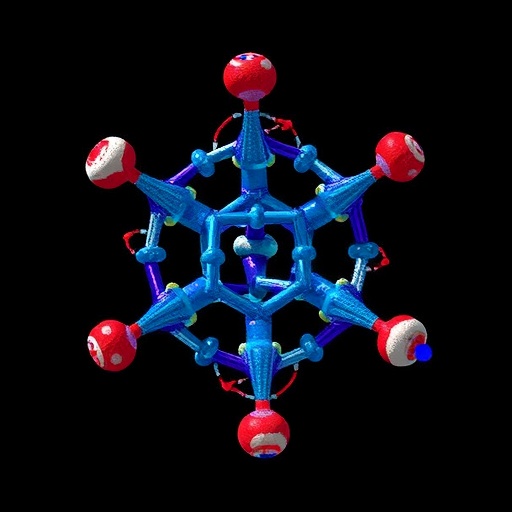
For over fifty years, the precise atomic arrangement of the γ phase of solid nitrogen (γ-N₂) has captivated the curiosity of physicists and materials scientists alike. Despite nitrogen’s molecular simplicity—each molecule consisting of just two nitrogen atoms bonded with an especially strong triple bond—its behavior under extreme pressures and temperatures has persistently defied complete structural characterization. The longstanding ambiguity regarding the exact crystal symmetry and molecular organization within γ-N₂ posed significant challenges, limiting progress in understanding fundamental properties of this crucial diatomic solid under high-pressure conditions.
The latest breakthrough in elucidating γ-N₂’s structure arrives through the concerted efforts of an international research collaboration spearheaded by Prof. LIU Xiaodi at the Hefei Institute of Solid State Physics, affiliated with the Chinese Academy of Sciences. Partnering with scientists from the University of Edinburgh and other global institutions, the team combined rigorous experimental techniques with state-of-the-art computational simulations to finally resolve this decades-old structural enigma. Their findings, published in the journal Matter and Radiation at Extremes, reconcile prior divergent theoretical predictions and experimental interpretations, offering an unprecedentedly detailed picture of γ-N₂ at the atomic level.
Central to their interdisciplinary approach was the employment of high-brilliance synchrotron X-ray diffraction, enabling them to probe the crystal lattice under carefully controlled high-pressure and low-temperature environments with exquisite precision. Complementing the diffraction data, vibrational spectroscopies—specifically Raman and infrared spectroscopy—provided fingerprints of molecular bonding and symmetry changes as pressure varied. These techniques collectively offered insights into subtle distortions and phase transitions inaccessible through direct imaging alone.
Parallel to experimental investigations, first-principles calculations grounded in density functional theory (DFT) played a crucial role in interpreting observed diffraction patterns and vibrational modes. The team conducted comprehensive simulations to explore potential crystal structures compatible with the experimental observations, assessing their stability and electronic structure. This methodological synergy not only validated the empirical data but also refined predictions of molecular arrangements, extinction rules, and lattice parameters for γ-N₂ across a broad pressure-temperature phase space.
Contrary to earlier models that proposed a body-centered cubic (bcc)-like symmetry for γ-N₂, the research conclusively identified a monoclinic structure characterized by the space group P2₁/c. This lower-symmetry arrangement comprises pairs of nitrogen molecules arranged with distinct orientations, representing a cooperative distortion from the high-symmetry phase. The unit cell contains two N₂ molecular entities, whose relative positioning and conformation evolve systematically upon pressure application, giving rise to anisotropic lattice strains and subtle inter-molecular interactions previously unappreciated.
This refined structural model carries profound implications for theoretical predictions of nitrogen’s mechanical, optical, and electronic properties under extreme compression. For instance, the monoclinic distortion modulates vibrational spectra, explaining the complex pressure-dependent shifts and mode splittings observed in Raman and infrared data. It also impacts nitrogen’s bandgap and electronic density of states—critical parameters for envisaging potential high-pressure phases with novel optical or superconducting behaviors.
Beyond fundamental curiosity, these insights into γ-N₂’s behavior deepen our broader comprehension of simple molecular crystals subjected to megabar pressures, relevant not only to condensed matter physics but also to planetary science and high-energy density physics. Nitrogen’s prominence as a major constituent in planetary atmospheres and interiors, coupled with its role as a prototypical molecular solid, positions this research at the intersection of diverse scientific disciplines seeking to unravel matter’s complexities under otherwise inaccessible conditions.
Prof. LIU’s team’s findings affirm long-standing theoretical predictions that had remained experimentally unverified due to challenges of preparing and characterizing samples under simultaneous extreme pressure and temperature. By harnessing cutting-edge synchrotron sources and advances in computational materials science, the study marks a pivotal convergence between prediction and observation, setting a new benchmark for studies of molecular solids.
Moreover, the work exemplifies the power of collaborative science, drawing expertise from crystallography, high-pressure experimentation, computational physics, and spectroscopy to produce a coherent and comprehensive understanding. This cross-pollination of methods establishes a template for addressing similarly obscure or contested structural questions in other elemental and molecular systems subjected to extreme environments.
Importantly, the resolution of γ-N₂’s structure facilitates future targeted investigations into nitrogen’s phase diagram, including potential transitions to polymeric phases or exotic electronic states. These prospects bear direct relevance for the synthesis of novel nitrogen-based materials possessing exceptional hardness or energy density, promising applications in materials science and energy storage.
To conclude, by unveiling the true atomic arrangement of γ-N₂ as a distorted monoclinic P2₁/c phase, this research not only settles a half-century-old scientific puzzle but also advances our fundamental grasp of molecular crystals under pressure. The integration of synchrotron X-ray diffraction, vibrational spectroscopy, and first-principles calculations exemplifies modern experimental-theoretical synergy, pushing the boundaries of knowledge in high-pressure physics.
As gas giants, icy exoplanets, and industrial technologies motivate continued exploration into extreme states of matter, the refined structural understanding of nitrogen reported here will serve as a crucial foundation. This work underscores the enduring value of patience, innovation, and interdisciplinary collaboration in achieving transformative scientific insights.
News Publication Date: 13-May-2026
Web References: DOI: 10.1063/5.0315313
Keywords
Physical sciences, High-pressure physics, Solid nitrogen, Crystal structure, Monoclinic P2₁/c, Synchrotron X-ray diffraction, Raman spectroscopy, Infrared spectroscopy, Density functional theory, Molecular solids, Phase transitions
Cite Scienmag News
Bethany Barker. (June 22, 2026). Scientists Unveil Long-Standing Structural Mystery of γ-N2. Scienmag. https://scienmag.com/scientists-unveil-long-standing-structural-mystery-of-%ce%b3-n2/
Bethany Barker. "Scientists Unveil Long-Standing Structural Mystery of γ-N2." Scienmag, 22 June 2026, https://scienmag.com/scientists-unveil-long-standing-structural-mystery-of-%ce%b3-n2/. Accessed 4 September 2026.
Bethany Barker. "Scientists Unveil Long-Standing Structural Mystery of γ-N2." Scienmag. June 22, 2026. https://scienmag.com/scientists-unveil-long-standing-structural-mystery-of-%ce%b3-n2/


