

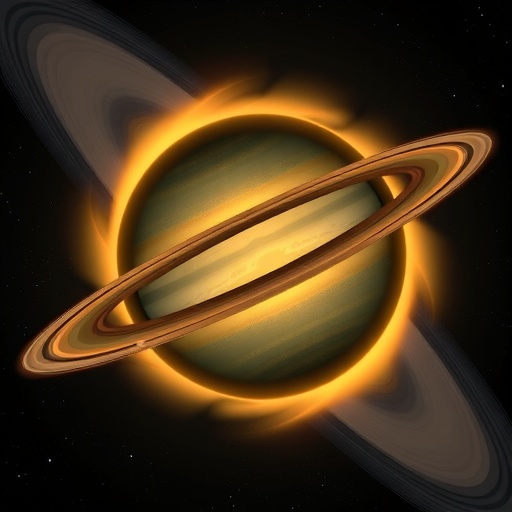
Saturn’s Spinning Secret: How Its Northern Lights Drive a Planet-Wide Heat Engine
Saturn, the majestic ringed giant of our solar system, has long baffled scientists with a perplexing mystery: why does the planet seem to spin at different rates depending on how its rotation is measured? Now, breakthrough observations from the James Webb Space Telescope (JWST) have unveiled the hidden mechanism behind this enigma, revealing a previously unknown feedback cycle driven by Saturn’s own northern lights.
For decades, measurements taken from NASA’s Cassini spacecraft suggested that Saturn’s rotation period wasn’t constant but instead appeared to vary slowly over time. This posed a direct contradiction to fundamental physical principles since a planet cannot simply change its spin rate without an external torque acting upon it. The apparent puzzle implied that something else was manipulating the signals scientists were using to measure the rotation.
In 2021, researchers led by Professor Tom Stallard from Northumbria University brought new insight by showing that the variation was not in Saturn’s rotation itself, but rather in the winds circulating in its upper atmosphere. These powerful zonal winds generate electrical currents that produce auroral emissions, which have been the traditional proxies for estimating the planet’s spin period. However, this revelation only deepened the mystery: what drives these atmospheric winds strong enough to simulate variations in rotation?
The recent study, detailed in the Journal of Geophysical Research: Space Physics, finally closes the loop. Using JWST’s unparalleled infrared imaging capabilities, the international team observed Saturn’s northern auroral region continuously over a full Saturnian day. Infrared light emitted by trihydrogen cations—charged molecules naturally abundant in Saturn’s upper atmosphere—acted as precise thermometers, allowing the team to generate remarkably detailed temperature and particle density maps of the auroral ionosphere.
These measurements achieved tenfold greater accuracy compared to previous data, which had uncertainties of about 50 degrees Celsius—comparable to the very changes the scientists sought to understand. The new data revealed that temperature peaks in the upper atmosphere are offset spatially from the current flows where auroral emissions enter and exit the planet’s atmosphere. This asymmetric heating, detectable only through JWST’s exquisite sensitivity, is not just a side effect of the aurora; it actively sustains the atmospheric winds.
By piecing together these observations with longstanding theoretical models, the team demonstrated that localized auroral heating drives atmospheric winds, which in turn generate the electric currents responsible for powering the aurora itself. This creates a self-sustaining feedback cycle: Saturn’s northern lights heat its upper atmosphere, driving winds that produce currents powering the aurora, which then heats the atmosphere further. The phenomenon is essentially a planetary heat pump perpetuated by the interplay between the atmosphere and auroral currents.
Professor Stallard explains the significance by framing the aurora as more than a dazzling atmospheric spectacle: it is the engine of Saturn’s atmospheric dynamics. “What we are seeing is essentially a planetary heat pump. The aurora heats, the atmosphere reacts with winds, and those winds feed back to power the auroral current system. This loop explains why the planet’s apparent rotation rate—derived from auroral signals—has seemingly fluctuated,” he said.
The implications extend far beyond Saturn itself. The study reveals a close coupling between Saturn’s atmosphere and its magnetosphere, a vast bubble sculpted by the planet’s magnetic field that governs charged particles in space around it. The two-way relationship means atmospheric phenomena directly influence the magnetospheric environment, which in turn affects atmospheric dynamics, making the system remarkably stable over long periods.
This discovery challenges prevailing assumptions about how planetary atmospheres interact with their surrounding space environments. If a giant planet like Saturn can host such a feedback-driven heat engine powered by auroral electrodynamics, it raises new questions about atmospheric-magnetospheric coupling on other planets, both in our solar system and around distant stars.
JWST’s crucial role in solving this puzzle also highlights its transformative potential in planetary science. Its infrared instrumentation, including the NIRSpec and NIRCam instruments, provides unprecedented spatial and spectral resolution, allowing astronomers to peer deeply into the temperature and particle distributions of planetary atmospheres like never before.
The observational campaign combined spectral data captured on November 29, 2024, integrating information on auroral temperatures, particle densities, and emission intensities. These three-dimensional, time-resolved maps show that temperature hotspots are offset from auroral current in- and outflows, confirming the dynamic relationship between electrical currents and atmospheric winds.
“Previous attempts to map these features were hindered by coarse data, with large uncertainties,” noted Melina Thévenot of STScI, who helped process JWST data products. “Now, we can resolve fine-scale asymmetries that unlock the secrets behind Saturn’s auroral heating and its impact on planetary rotation measurements.”
The research team includes collaborators from across the UK and the United States, including Boston University, the University of Leicester, Aberystwyth University, the University of Reading, Imperial College London, Lancaster University, and Johns Hopkins University Applied Physics Laboratory. Their combined efforts underscore the international scope of modern planetary science.
Beyond its intrinsic scientific value, the study illustrates a paradigm shift in understanding planetary atmospheres as active participants within their broader environments. On Earth, auroras are famously spectacular but do not significantly alter global atmospheric dynamics. On Saturn, however, the auroral region acts as a feedback-driven atmospheric engine, influencing winds, currents, and magnetospheric behavior in lockstep.
These insights open exciting avenues for exploration as JWST continues to turn its gaze toward the outer planets and exoplanets alike. The subtle interplay between auroral physics, atmospheric dynamics, and electromagnetic phenomena revealed by this study could be a universal process shaping planetary atmospheres under magnetic influence.
As humanity’s most powerful observatory, JWST is redefining what we know about the solar system’s giants, peeling back layers of complexity to answer long-standing mysteries. The story of Saturn’s shifting spin is a vivid reminder that even the largest planetary features remain dynamic, driven by intricate processes powered by light, wind, and magnetism.
This discovery not only solves a decades-old puzzle but also exemplifies how new technologies illuminate hidden connections in planetary systems. In the case of Saturn, what once appeared as a cosmic mystery is now understood as a self-sustaining auroral heat engine—an elegant cosmic dance of light and wind shaping a giant’s spin.
Subject of Research: Not Applicable
Article Title: JWST/NIRSpec Reveals the Atmospheric Driver of Saturn’s Variable Magnetospheric Rotation Rate
News Publication Date: 12-Mar-2026
References: DOI 10.1029/2025GL118553
Image Credits: NASA/ESA/CSA, Tom Stallard (Northumbria University), Melina Thévenot, Macarena Garcia Marin (STScI/ESA)


