

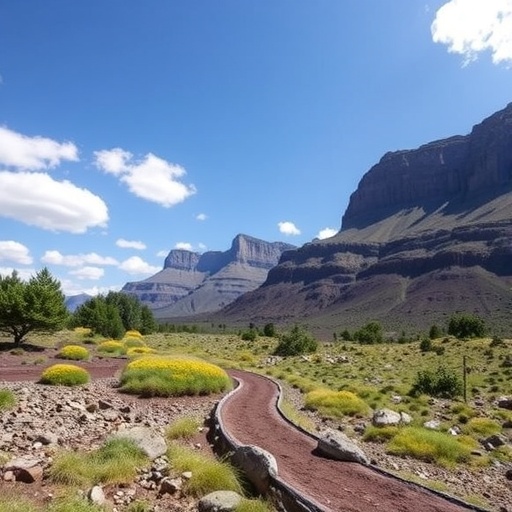
A groundbreaking study led by Professor ZHAO Mingyu from the Institute of Geology and Geophysics at the Chinese Academy of Sciences (CAS) has unveiled compelling evidence that the colonization of land by early plants began reshaping Earth’s surface environments significantly earlier than previously thought. This discovery challenges long-standing views in earth system evolution, recalibrating the timeline for when terrestrial ecosystems began exerting profound influences on global biogeochemical cycles and climate.
This research, recently published in the prestigious journal Nature Ecology & Evolution, focuses on the Late Ordovician period, approximately 455 million years ago, a pivotal era when terrestrial life was in its infancy. The investigation harnessed advanced geochemical proxies to trace the impact of nascent land plants on Earth’s surface environments. Notably, the team analyzed the ratio of organic carbon to total phosphorus (Corg/Ptotal) embedded within marine siliciclastic sediments, recognizing it as a sensitive indicator of terrestrial organic carbon input and net primary productivity.
Unlike marine primary producers, land plants synthesize organic matter characterized by markedly higher organic carbon-to-phosphorus ratios. As land plants spread across ancient continents, terrestrial photosynthesis intensified, augmenting the flux of organic matter from land into the oceans. This increase is imprinted in marine sediment records as elevated Corg/Ptotal ratios, signifying greater terrestrial organic carbon burial, a fundamental component of Earth’s carbon cycle.
The researchers meticulously compiled sediment records from diverse marine depositional environments with varying redox conditions. Their analysis revealed a substantial and abrupt rise in Corg/Ptotal ratios commencing around 455 million years ago. Their interpretations suggest this shift most plausibly reflects a pronounced increase in terrestrial net primary productivity, driven by the early expansion of land plants.
To reconcile alternative explanations, the team evaluated various controlling factors influencing organic carbon and phosphorus deposition but identified the surge in terrestrial plant biomass as the dominant cause. Mixing models reinforced this conclusion, indicating that since the Late Ordovician, terrestrial organic matter contributed approximately 42 ± 15% of the total organic carbon in marine sediments—a figure strikingly comparable to present-day contributions, which range from 30 to 57%.
Spatial analyses of ancient continental configurations further suggest that plant colonization and expansion occurred heterogeneously, with the Laurentian continent possibly exhibiting earlier and more pronounced vegetation growth. These findings illuminate the uneven geographic spread of terrestrial flora during the Ordovician, linking paleoenvironmental conditions to biological diversification and ecosystem engineering.
Intriguingly, the temporal fluctuations of Corg/Ptotal ratios correspond closely with two major Late Ordovician carbon isotopic excursions. This synchronicity implies that increased delivery of phosphorus-poor but carbon-rich terrestrial organic matter to marine sediments intensified global carbon burial. Enhanced organic carbon sequestration would have facilitated the accumulation of atmospheric oxygen while concurrently driving down atmospheric carbon dioxide levels, exerting critical controls on Earth’s climate system in this epoch.
The researchers also posit that the accelerated weathering of silicate and phosphorus minerals—a process stimulated by widespread land plant colonization—amplified these biogeochemical feedbacks. Enhanced weathering would have drawn down atmospheric CO2 and supplied nutrients facilitating further biological productivity, creating a cascade of interconnected effects that reshaped Earth’s atmosphere and climate profoundly.
Collectively, these processes underscore the pivotal role of early land plants in Earth’s surface oxygenation, climatic cooling, and the instigation of the Late Ordovician glaciation. Moreover, the timing aligns with significant mass extinction events, suggesting that terrestrial vegetation not only transformed geochemical cycles but also indirectly influenced biosphere-wide evolutionary trajectories by modulating environmental conditions.
The research represents a significant interdisciplinary collaboration, drawing expertise from institutions including Yale University, the University of Exeter, the University of Leeds, the University of Science and Technology of China, and the Institute of Vertebrate Palaeontology and Palaeoanthropology under CAS. This collective effort integrates geochemistry, paleontology, and Earth system modeling to reconstruct ancient Earth surface processes with unprecedented resolution.
Financial support for this study was provided by prominent Chinese funding bodies, including the CAS Strategic Priority Research Program (Category A), the National Key Research and Development Program of China, and the National Natural Science Foundation of China. Such backing underscores the strategic importance of understanding Earth’s early terrestrial ecosystems and their lasting impact on planetary evolution.
This transformative insight into the timing and magnitude of early land plant influence on Earth’s systems invites reevaluation of models concerning atmospheric composition, climate change mechanisms, and biotic responses during the Ordovician. It heralds a new paradigm, enriching our comprehension of how terrestrial ecosystems have long shaped the trajectory of life and the environment on our planet.
Subject of Research: Early land plants and their influence on Earth’s surface environments during the Late Ordovician period.
Article Title: Early land plants reshaping Earth’s surface environments in the Late Ordovician.
News Publication Date: February 24, 2026.
Web References: https://doi.org/10.1038/s41559-026-02995-6
Image Credits: Image by CAI Jiachen.
Keywords: Biogeochemistry, Physical geology, Earth sciences.


