

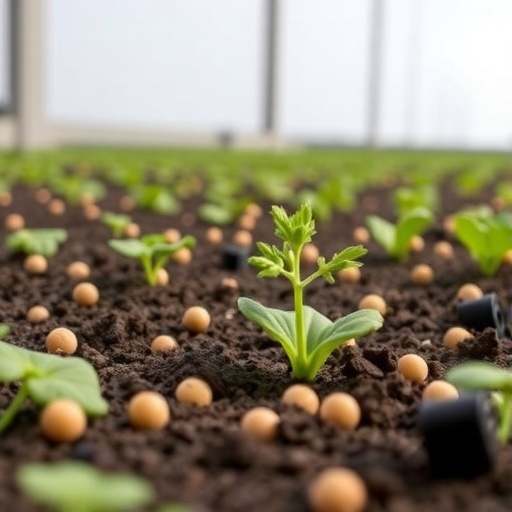
As humanity sets its sights on returning to the lunar surface with NASA’s Artemis II mission, the question of sustaining life beyond Earth grows ever more pressing. One pivotal aspect of this challenge is the cultivation of food in extraterrestrial environments where traditional soil, water, and atmospheric conditions are absent or severely limited. Groundbreaking research from The University of Texas at Austin proposes an intriguing solution: growing chickpeas in simulated lunar regolith. This study not only advances our understanding of space agriculture but signals a significant leap toward establishing self-sufficient habitats on the Moon.
Lunar regolith, often colloquially referred to as “moon dirt,” embodies a complex mixture of fine rock fragments and dust created over billions of years by meteoroid impacts. Unlike terrestrial soils, this regolith lacks the organic matter and diverse microbial life that plants need to thrive. These missing components create significant obstacles for cultivating plants, as essential nutrients that support root growth and nutrient uptake in Earth-bound agriculture are absent. Moreover, the regolith contains heavy metals which could pose toxicity risks to plants and, subsequently, to humans consuming those plants.
The team, led by Sara Santos, a distinguished postdoctoral fellow at the University of Texas Institute for Geophysics, approached these formidable challenges with a comprehensive understanding of soil science and plant biology. Their research hinged on the hypothesis that modifying lunar soil simulant with biologically active amendments could transform this barren medium into a viable growth substrate. Collaborating with experts at Texas A&M University, they focused on establishing symbiotic relationships that enhance nutrient availability and reduce toxicity risks.
Central to their methodology was the incorporation of vermicompost into lunar soil simulant. Vermicompost, a biologically rich product generated by red wiggler earthworms digesting organic waste, is known for its high content of essential plant nutrients and beneficial microorganisms. This amendment theoretically enriches the regolith with a microbiome capable of facilitating nutrient cycles and improving soil structure – attributes indispensable for productive agriculture. Importantly, the idea of recycling organic waste—such as food scraps and cotton-based hygiene products from lunar missions—into vermicompost aligns well with sustainable life support systems for space exploration.
To further bolster plant health, the team coated chickpea seeds with arbuscular mycorrhizal fungi (AMF), which form mutualistic associations with plant roots. AMF extend the root system’s effective reach, improving nutrient uptake, especially phosphorus, while concurrently sequestering heavy metals to mitigate their transport within plants. The fungi’s role in this lunar soil simulation was pivotal, as it aided in reducing plant stress caused by toxic elements present in the regolith, effectively allowing the plants to flourish in a hostile environment.
The choice of chickpeas, specifically the ‘Myles’ variety, was deliberate. Compact and resilient, this legume is well-suited for growth in spatially constrained environments such as those expected in lunar habitats. Chickpeas also contribute to the sustainability of crops through nitrogen fixation, which can enhance soil fertility—a crucial advantage when cultivating successive generations of plants on the Moon where replenishing nutrients is logistically challenging.
Experimental results demonstrated that mixtures containing up to 75% lunar regolith simulant paired with vermicompost successfully yielded harvestable chickpeas. Above this threshold, the elevated proportion of regolith led to signs of plant stress, premature decline, and limited survival. However, notably, the chickpeas inoculated with mycorrhizal fungi exhibited extended viability compared to non-inoculated controls, underscoring the protective and nutrient-facilitating role of these fungi in extreme growing media.
Further investigations revealed that the mycorrhizal fungi were capable of colonizing the lunar soil simulant environment and sustaining themselves without repeated inoculations, suggesting that in a practical lunar agriculture system, a single introduction of beneficial fungi might suffice long-term. This finding could reduce the complexity of maintaining soil microbiomes on the Moon, a critical factor for designing regenerative life support systems where resupply is constrained.
While the achievement of successfully growing chickpeas outside terrestrial soil is monumental, the road ahead includes critical evaluative steps. The research team is now focused on analyzing the chickpeas’ nutritional profile to ensure they meet the dietary needs of astronauts. Toxic metal uptake remains a paramount concern: verifying that these elements do not accumulate in edible plant tissues beyond safe levels is essential for human consumption safety.
Jessica Atkin, a doctoral candidate at Texas A&M University and first author of the study, emphasized the importance of ensuring these plants are both nutritious and safe for consumption in space missions. Determining how many plant generations are required to reach an optimal state of growth and safety when cultivated in lunar regolith amendments will be a vital parameter for mission planners and bioregenerative system designers.
This innovative research has garnered support from NASA through a FINESST grant, highlighting its potential impact on future space exploration strategies. The ability to produce food locally on lunar surfaces could dramatically reduce cargo mass and mission costs while enhancing crew autonomy and mission duration.
Such advancements not only pave the way for lunar agriculture but also provide insights transferable to other celestial bodies where soil and environmental conditions are inhospitable. Understanding plant-fungi-soil interactions in extraterrestrial contexts widens the frontiers of astrobiology and biogeochemistry with direct applications to human spaceflight.
In summary, the successful cultivation of chickpeas in lunar regolith simulant enriched with vermicompost and mycorrhizal fungi represents a landmark achievement in space agriculture research. It masterfully integrates soil science, mycology, microbiology, and plant physiology to address the formidable challenge of growing food in alien environments. As humanity prepares to establish a sustainable presence beyond Earth, these findings bring the dream of lunar farming closer to reality, promising new paradigms for surviving and thriving among the stars.
Subject of Research: Bioremediation of lunar regolith simulant through symbiotic plant-fungi interactions to enable crop cultivation.
Article Title: Bioremediation of lunar regolith simulant through mycorrhizal fungi and plant symbioses enables chickpea to see
News Publication Date: March 5, 2026
Web References:
Scientific Reports Article
DOI Link
Image Credits: University of Texas Institute for Geophysics
Keywords
Lunar Agriculture, Chickpea Cultivation, Lunar Regolith, Mycorrhizal Fungi, Space Farming, Vermicompost, Bioremediation, Artemis II, Extraterrestrial Soil, Plant Symbiosis, Space Life Support, Lunar Missions


