


Crave that cup of coffee in the morning? Globally, consumers drink more than 2.2 billion cups daily. Someone grows all that joe: More than 100 million farmers worldwide produce coffee.

Credit: Courtesy, Felipe Ferrao, UF/IFAS
Crave that cup of coffee in the morning? Globally, consumers drink more than 2.2 billion cups daily. Someone grows all that joe: More than 100 million farmers worldwide produce coffee.
Coffee beans consumed across the globe come from two species: Coffea arabica and Coffea canephora, also known as Robusta (or Conilon) coffee. Historically, coffee drinkers prefer Arabica beans for their specific flavor and aroma, said Felipe Ferrao, a University of Florida research assistant scientist in horticultural sciences.
But by 2050, about 80% of Arabica production is predicted to decrease because of climate change. So, Ferrao and colleagues from France (RD2 Vision) and Brazil (Incaper Institution) are investigating to see if they can find alternative coffee cultivars.
Scientists see two alternatives to supplement Arabica: one, adapt coffee farming practices to new environments and two, focus on species that are more resilient. New UF/IFAS-led research shows that Robusta coffee might be a good candidate to augment Arabica.
“If you consider that nowadays, about 60% of coffee beans commercialized around the globe are from Coffea arabica, the coffee industry is looking for alternatives,” said Ferrao, lead author of the new study. “This is how and where Robusta coffee emerges as a good candidate.”
In the past few decades, production of Robusta coffee increased about 30%, representing a significant improvement in the coffee chain, he said.
“Overall, the species produces more coffee than Arabica, using fewer inputs, such as fertilizer and water. As its name suggests, the plant is more robust,” Ferrao said. “While the demand for Robusta coffee likely won’t decrease, our biggest challenge is to meet the demand for quality and productivity required by the coffee chain. In this sense, genetics and breeding studies can provide basic elements for a better understanding of diversity and factors that affect quality.”
For the study, Ferrao and his colleagues evaluated Robusta/Conilon and Arabica for multiple traits, in three locations in high altitudes in Brazil, for five years. They ultimately wanted to find out whether the Robusta cultivars could have a good yield when produced in alternative climates and whether they tasted good.
The study showed Robusta is highly adaptable and grows in high altitude regions, which means it combines good production and flavor scores.
“Robusta is flexible because it has a large diversity and therefore different plants can be selected, depending on the weather conditions,” Ferrao said. “With that said, we can shed some light on the fundamental question about the coffee of the future – climate-smart coffee.”
Researchers suggest Robusta can combine the following three elements for coffee cultivars:
- Sustainability – produce more with fewer inputs.
- Quality – good flavor to meet consumer demand.
- Plasticity – capacity to adapt to new production systems.
Now that they’ve found good results with Robusta in Brazil, scientists are trying to see if it can grow in Florida.
“Here in Florida, we have some trials to test both Robusta and Arabica coffees in different locations. When compared to Brazil, the differences in the soil properties, rainfall distribution, temperature and weather events will certainly impact the coffee production and its quality,” Ferrao said.
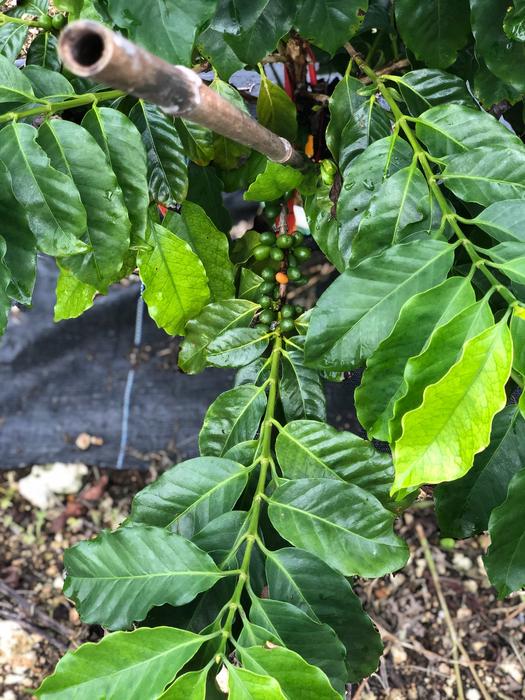
UF/IFAS scientists are trying to grow coffee cultivars in South Florida. Courtesy, Felipe Ferrao, UF/IFAS.
To test coffee as an alternative crop for Florida growers, he and his UF/IFAS team are trying to grow coffee at the Tropical Research and Education Center (TREC) in Homestead. At TREC, Ferrao is working with Jonathan Crane, professor and associate center director and Ali Sarkhosh, associate professor, who’s based in Gainesville. Both are colleagues in the horticultural sciences department.
Ferrao is also trying to grow coffee in Pierson (in Volusia County) and with indoor production using high-tunnel structures in North Florida, marking the first time they’ve tested such a diverse set of coffee materials in Florida conditions.
Journal
Crop Science
Article Title
Robust and smart: Inference on phenotypic plasticity of Coffea canephora reveals adaptation to alternative environments
Article Publication Date
9-Jul-2024
Cite Scienmag News
Sloane Callahan. (July 25, 2024). Scientists study how to bring you ‘climate-smart coffee’. Scienmag. https://scienmag.com/scientists-study-how-to-bring-you-climate-smart-coffee/
Sloane Callahan. "Scientists study how to bring you ‘climate-smart coffee’." Scienmag, 25 July 2024, https://scienmag.com/scientists-study-how-to-bring-you-climate-smart-coffee/. Accessed 3 September 2026.
Sloane Callahan. "Scientists study how to bring you ‘climate-smart coffee’." Scienmag. July 25, 2024. https://scienmag.com/scientists-study-how-to-bring-you-climate-smart-coffee/

