


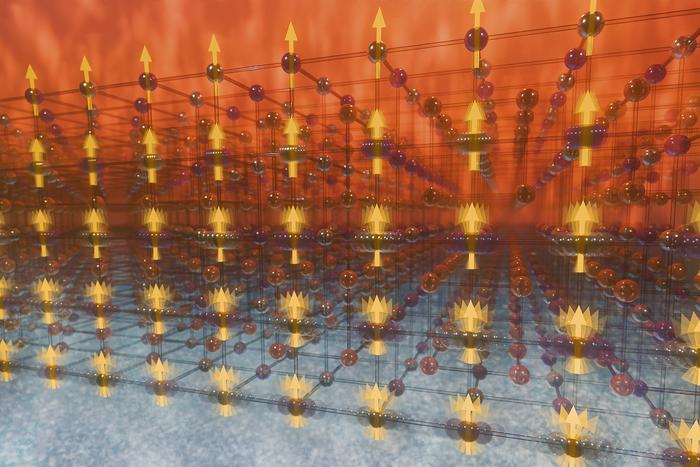
A research team led by the Department of Energy’s Oak Ridge National Laboratory has bridged a knowledge gap in atomic-scale heat motion. This new understanding holds promise for enhancing materials to advance an emerging technology called solid-state cooling.

Credit: Phoenix Pleasant/ORNL, U.S. Dept. of Energy
A research team led by the Department of Energy’s Oak Ridge National Laboratory has bridged a knowledge gap in atomic-scale heat motion. This new understanding holds promise for enhancing materials to advance an emerging technology called solid-state cooling.
An environmentally friendly innovation, solid-state cooling could efficiently chill many things in daily life from food to vehicles to electronics — without traditional refrigerant liquids and gases or moving parts. The system would operate via a quiet, compact and lightweight system that allows precise temperature control.
Although the discovery of improved materials and the invention of higher-quality devices are already helping to promote the growth of the new cooling method, a deeper understanding of material enhancements is essential. The research team used a suite of neutron-scattering instruments to examine at the atomic scale a material that scientists consider to be an optimal candidate for use in solid-state cooling.
The material, a nickel-cobalt-manganese-indium magnetic shape-memory alloy, can be deformed and then returned to its original shape by driving it through a phase transition either by increasing temperature or by applying a magnetic field. When subjected to a magnetic field, the material undergoes a magnetic and structural phase transition, during which it absorbs and releases heat, a behavior known as the magnetocaloric effect. In solid-state cooling applications, the effect is harnessed to provide refrigeration. A key characteristic of the material is its nearness to disordered conditions known as ferroic glassy states, because they present a way to enhance the material’s ability to store and release heat.
Magnons, also known as spin waves, and phonons, or vibrations, couple in a synchronized dance in small regions distributed across the disordered arrangement of atoms that comprise the material. The researchers found that patterns of behavior in these small regions, referred to as localized hybrid magnon-phonon modes in the team’s paper detailing the research, have important implications for the thermal properties of the material.
The scientists revealed that the modes cause the phonons to be significantly altered or shifted by the presence of a magnetic field. The modes also modify the material’s phase stability. These changes can result in fundamental alterations in the material’s properties and behavior that can be tuned and tailored.
“Neutron scattering shows that the cooling capacity of the magnetic shape-memory alloy is tripled by the heat contained within these local magnon-phonon hybrid modes that form because of the disorder in the system,” said ORNL’s Michael Manley, the leader of the study. “This finding reveals a path to make better materials for solid-state cooling applications for societal needs.”
The magnetic shape-memory alloy that the team studied is in a phase that has nearly formed disordered conditions known as spin glass and strain glass — not the familiar glass used in windows and elsewhere but rather unconventional phases of matter that lack order. The magnetic moments, or tiny magnets, associated with the atoms in the spin glass phase are randomly oriented rather than pointing in the same direction. Comparatively, in the strain glass phase, the lattice of atoms is strained at the nanometer scale in a messy and irregular pattern. Spin glass and strain glass are referred to as frustrated conditions in a material because they arise from competing interactions or constraints that prevent the material from achieving a stable ordered state.
“As the material approaches this frustrated state, the amount of heat being stored increases,” Manley said. “Long- and short-range interactions manifest as localized vibrations and spin waves, which means they’re getting trapped in small regions. This is important because these extra localized vibrational states store heat. Changing the magnetic field triggers another phase transition in which this heat is released.”
Controlling the functions of the magnetic shape-memory alloy so that it can be used as a heat sponge could be one way to allow for efficient solid-state cooling without the need for traditional refrigerants or mechanical components.
This study was supported by DOE’s Office of Science Materials Sciences and Engineering Division. A portion of the neutron scattering work for this research was performed at the High Flux Isotope Reactor and the Spallation Neutron Source, DOE Office of Science user facilities at ORNL. The National Institute of Standards and Technology of the Department of Commerce also provided neutron research facilities.
UT-Battelle manages ORNL for DOE’s Office of Science. The single largest supporter of basic research in the physical sciences in the United States, the Office of Science is working to address some of the most pressing challenges of our time. For more information, please visit energy.gov/science.
Journal
Science Advances
Method of Research
Experimental study
Subject of Research
Not applicable
Article Title
Hybrid magnon-phonon localization enhances function near ferroic glassy states
Article Publication Date
14-Jun-2024
Cite Scienmag News
Bethany Barker. (July 1, 2024). Scientists probe chilling behavior of promising solid-state cooling material. Scienmag. https://scienmag.com/scientists-probe-chilling-behavior-of-promising-solid-state-cooling-material/
Bethany Barker. "Scientists probe chilling behavior of promising solid-state cooling material." Scienmag, 1 July 2024, https://scienmag.com/scientists-probe-chilling-behavior-of-promising-solid-state-cooling-material/. Accessed 4 September 2026.
Bethany Barker. "Scientists probe chilling behavior of promising solid-state cooling material." Scienmag. July 1, 2024. https://scienmag.com/scientists-probe-chilling-behavior-of-promising-solid-state-cooling-material/

