


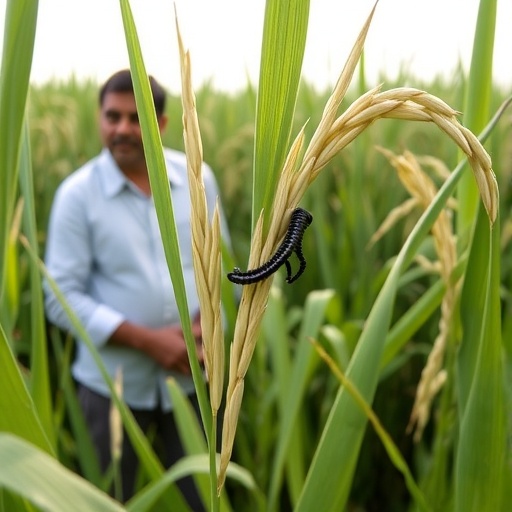
In a groundbreaking study emerging from the University of Arkansas, scientists have uncovered a startling natural defense mechanism in rice plants: they trap and kill caterpillars using tiny, spike-like hairs called trichomes located on rice spikelets. This discovery not only sheds new light on plant-insect interactions but also opens the door to innovative biological pest control strategies that could greatly benefit global agriculture. The findings, published in the journal Ecological Processes, reveal that rice spikelets use a combination of floral scent and physical entrapment to neutralize one of agriculture’s most notorious pests, the fall armyworm.
The fall armyworm, a voracious caterpillar known for devastating crops worldwide, has posed major challenges to farmers due to its growing resistance to conventional insecticides. What makes the research so exciting is its demonstration that rice spikelets—structures at the tips of rice panicles bearing florets—emit specific floral volatiles that effectively lure these dangerous larvae. Once enticed, the young caterpillars are ensnared by the dense trichomes covering the spikelets, which act like natural barbs. The spikelet then gradually closes, trapping the caterpillar inside until it perishes.
Dr. Devi Balakrishnan, a graduate researcher involved in the study, stumbled upon this phenomenon while conducting experiments unrelated to pest control. Rather than feeding as expected, the fall armyworm larvae were discovered dead within the spikelets—a serendipitous observation that launched the detailed investigations. These examinations included four replicated trials focusing on how many caterpillars were trapped and killed, confirming that approximately 50% of one-week-old fall armyworm caterpillars succumbed to this natural defense within 48 hours.
Through these carefully controlled studies, the researchers also examined the role of floral volatiles—chemical scents emitted by the open florets during flowering. These scents appeared to play a crucial part in attracting fall armyworms, which showed a preference for spikelets that were in the flowering stage versus later developmental stages. This indicates an evolved strategy where the rice plant simultaneously entices caterpillars to approach while preparing a physical trap to negate the threat.
The trichomes themselves are microscopic, hairlike projections that serve dual purposes: initially, they impede the caterpillars’ movement and feeding attempts, and subsequently, they map the trapped pest deeper into the spikelet as it closes shut. This gradual closing mechanism essentially cages the caterpillar alive, resulting in an effective biological quarantine and death chamber. This phenomenon represents an elegantly evolved adaptation previously undocumented in major cereal crops like rice.
Associate Professor Rupesh Kariyat, who co-advised the study, emphasized the novelty and importance of this discovery. The research team is particularly intrigued by the possibility of leveraging this natural system through agricultural practices. By isolating and synthesizing the floral scent compounds responsible for luring caterpillars, they speculate that it might be possible to develop new pest control formulations. These could be sprayed during the flowering phase of rice cultivation to amplify the plant’s natural defense, reducing reliance on chemical insecticides.
The study also invites broader questions regarding the diversity of herbivorous insects affected by this phenomenon. While the current research focused on the fall armyworm, other caterpillar species and developmental stages may be susceptible to similar trapping. Larger, more mature caterpillars with stronger mandibles might escape, but younger larvae appear highly vulnerable, suggesting targeted timing could optimize control effectiveness.
This botanical self-defense marks a remarkable intersection of chemical ecology and physical plant traits. It adds to a growing understanding that many “passive” plants possess highly specialized active defensive strategies. The rice plant, traditionally not regarded as a toxic or highly defensive species, reveals a hidden arsenal that contributes to its resilience. This redefines how scientists and agronomists conceptualize plant resistance beyond conventional pest deterrents and insecticide application.
Dr. Balakrishnan’s discovery was a silver lining amid a series of otherwise inconclusive experiments. Her initial work examined the role of certain protein kinases in rice stress tolerance using fall armyworms as bioassay agents. However, the unexpected finding of caterpillar deaths inside spikelets turned into a major breakthrough—dubbed humorously in the lab as the “Devi Effect.” This breakthrough highlights how unpredictable discoveries often arise when scientists remain observant and curious during routine experimental work.
The implications are significant, especially considering rice feeds nearly half the world’s population. Reducing fall armyworm populations using natural plant defenses could mitigate crop losses, support sustainable farming, and decrease environmental impacts caused by chemical pesticides. Moreover, this research underscores the vital importance of fundamental botanical and entomological research in solving pressing global agricultural challenges.
In conclusion, the University of Arkansas team’s work opens promising avenues for biocontrol innovations by translating nature’s own strategies into scalable agriculture solutions. As the researchers continue to probe the chemical composition of the floral volatiles and the mechanical properties of the trichomes, the potential to design eco-friendly pest management tools grows increasingly within reach. Such integrative approaches herald the future of pest control—combining evolutionary biology, chemistry, and crop science to safeguard global food security.
News Publication Date: 21-Mar-2026
Web References:
https://doi.org/10.1186/s13717-026-00683-8
Cite Scienmag News
Alan Morgan. (May 13, 2026). Scientists Observe Rice Plants Capturing and Eliminating Fall Armyworm Caterpillars. Scienmag. https://scienmag.com/scientists-observe-rice-plants-capturing-and-eliminating-fall-armyworm-caterpillars/
Alan Morgan. "Scientists Observe Rice Plants Capturing and Eliminating Fall Armyworm Caterpillars." Scienmag, 13 May 2026, https://scienmag.com/scientists-observe-rice-plants-capturing-and-eliminating-fall-armyworm-caterpillars/. Accessed 3 September 2026.
Alan Morgan. "Scientists Observe Rice Plants Capturing and Eliminating Fall Armyworm Caterpillars." Scienmag. May 13, 2026. https://scienmag.com/scientists-observe-rice-plants-capturing-and-eliminating-fall-armyworm-caterpillars/


