

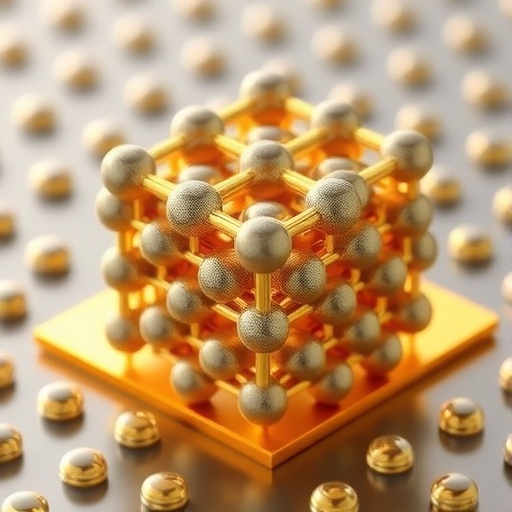
In a groundbreaking advancement that could redefine the future of spintronic technologies and nanoelectronics, researchers have demonstrated robust room-temperature multiferroicity in a two-dimensional (2D) metal, bilayer chromium ditelluride (CrTe₂). This achievement arrives on the heels of long-standing challenges faced by bulk multiferroic materials, which traditionally suffer from inadequate spontaneous polarization, feeble magnetoelectric coupling, and instability under ambient conditions—all obstacles that have stifled their widespread technological adoption. The research team, spearheaded by scientists at the Institute of Physics of the Chinese Academy of Sciences, in collaboration with Zhejiang University, has successfully harnessed an intrinsic magnetoelectric (ME) coupling mechanism within a novel layered 2D architecture, overcoming these barriers and carving a promising path toward CMOS-compatible, energy-efficient spintronic memory devices.
Multiferroic materials are widely coveted for their unique ability to simultaneously exhibit ferroelectricity—an electric polarization reversible by an external electric field—and magnetic order, including ferromagnetism or antiferromagnetism. This coexistence enables the coveted magnetoelectric effect, whereby electric fields can tune magnetic properties and vice versa, offering unprecedented control in multifunctional devices. However, conventional bulk multiferroics rarely achieve strong coupling at room temperature. Oxygen vacancies and other crystal imperfections further exacerbate leakage currents, curtail device longevity and operational stability under ambient conditions. These limitations have confined their applications largely to niche, low-temperature environments.
Capitalizing on the transformative potentials of two-dimensional van der Waals materials, the research team turned their attention to bilayer CrTe₂, which they skillfully engineered through molecular beam epitaxy to obtain high-quality, atomically thin films. The essence of their breakthrough lies in deliberately stacking antiferromagnetic and ferromagnetic layers in an alternating bilayer configuration. This structural motif intrinsically disrupts inversion symmetry—a fundamental spatial symmetry where the crystal structure remains unchanged under spatial inversion—by inducing a built-in electrostatic potential difference across the layers. This spontaneous inversion symmetry breaking, absent in many traditional systems, is the origin of a sizable out-of-plane ferroelectric polarization that is both reversible and stable at room temperature.
The researchers employed a comprehensive suite of investigative techniques to validate their findings. First-principles calculations, rooted in density functional theory, predicted the emergence of this asymmetric electrostatic potential and its consequent ferroelectric behavior. These predictions were substantiated via state-of-the-art scanning tunneling microscopy, piezoresponse force microscopy, and magnetic force microscopy experiments, each confirming the coexistence of magnetism and electric polarization within the bilayer CrTe₂ films. Intriguingly, this mechanism diverges from the spin-orbit-coupling-driven processes predominant in type-II multiferroics, as the bilayer’s ME coupling is primarily driven by interlayer charge asymmetry, which remains robust even at room temperature.
By achieving voltage-controlled magnetic order in a 2D metallic system, this study pioneers a new paradigm whereby electric fields can directly manipulate magnetic states without the need for large magnetic fields or cumbersome cryogenic apparatuses. The implication of this feat cannot be overstated: it opens avenues for low-power, high-speed spintronic memory elements that can be integrated seamlessly into existent complementary metal-oxide-semiconductor (CMOS) technology. The compatibility with ambient conditions and electrical writing/magnetic reading schemes positions bilayer CrTe₂ as a prototypical material for next-generation nanoelectronic devices, potentially accelerating the end of Moore’s law scaling limitations via new functional device architectures.
Fundamentally, the FM/AFM superlattice design embodies a universal principle for engineering intrinsic 2D multiferroics, transcending the idiosyncrasies of individual materials. This layered approach harnesses controlled symmetry breaking and electrostatic engineering to induce novel physical phenomena unattainable in bulk analogs. Such insights further enrich the fundamental physics landscape of multiferroics while simultaneously propelling their technological viability. The demonstrated strong magnetoelectric coupling persisting at room temperature and stability in air marks a significant leap forward in multiferroic research.
Furthermore, the research underscores the potency of molecular beam epitaxy as a precise thin-film fabrication method capable of synthesizing high-purity 2D materials with tailored electronic and magnetic properties. This technique ensures atomically sharp interfaces and uniform layering essential for observing these subtle interlayer effects, which are typically masked in conventional polycrystalline or bulk samples. The interplay of theory and experiment showcased here exemplifies the synergistic approach necessary to unlock the full potential of 2D multiferroics.
From a technological perspective, these findings herald a new class of devices capable of electrical writing and magnetic reading with minimal energy dissipation. Such devices promise significant advantages for memory technology, including nonvolatile memory cells and logic elements designed for ultra-low energy consumption without compromising speed or data retention. Incorporating this material into existing semiconductor fabrication workflows could catalyze the development of spin-based transistors and memory units, pivotal for the next era of computing paradigms such as neuromorphic systems and quantum information processing.
As the demand for multifunctional, energetically efficient nanoelectronics grows exponentially, innovations like the bilayer CrTe₂ multiferroic metal are poised to fill critical gaps left by traditional materials. While previous efforts were hamstrung by operational restrictions and weak coupling, this research illuminates a way forward by capitalizing on the unique physics of 2D van der Waals heterostructures. The demonstration of ambient-stable, electrically tunable magnetism in a metallic multiferroic at room temperature is a milestone that could soon transition from laboratory curiosity to industry cornerstone.
Looking ahead, the universal design principles elucidated through this work invite further exploration of other 2D material systems capable of analogous stacking-induced symmetry breaking and charge asymmetry effects. Such exploration may yield a richer library of materials with customizable multiferroic properties, adapted for various device functionalities and environments. The exploitation of these mechanisms may well redefine the interface between fundamental quantum materials research and scalable technological solutions.
In conclusion, this pioneering study not only challenges existing perceptions about the limitations of multiferroics but also unlocks practical pathways for their integration into future spintronic and nanoelectronic technologies. By harnessing the unique advantages of 2D bilayer CrTe₂, including stable room-temperature multiferroicity and strong magnetoelectric coupling via an innovative electrostatic potential asymmetry mechanism, the researchers have charted a course toward energy-efficient, electrically controllable magnetic devices, poised to accelerate a new era of functional quantum materials in everyday technologies.
Subject of Research: Two-dimensional multiferroic metals; magnetoelectric coupling in bilayer CrTe₂; voltage-controlled magnetic order
Article Title: Room-temperature two-dimensional multiferroic metal with voltage-controllable magnetic order
News Publication Date: 9-Mar-2026
Web References: https://doi.org/10.1038/s41563-026-02537-2
References: Research article published in Nature Materials
Keywords
2D multiferroics, chromium ditelluride, bilayer CrTe₂, magnetoelectric coupling, ferroelectric polarization, antiferromagnetic/ferromagnetic superlattice, molecular beam epitaxy, spintronics, room-temperature multiferroicity, voltage-controlled magnetism, nanoelectronics, CMOS-compatible materials


