

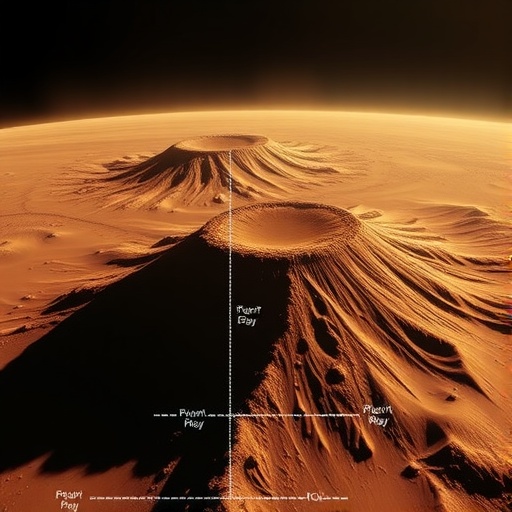
Deep beneath the surface of Mars lies a hidden complexity that challenges previous assumptions about volcanic activity on the Red Planet. Recent research has unveiled that what may appear as straightforward volcanic eruptions are, in fact, the visible endpoints of intricate geological processes occurring within evolving magmatic systems over extended durations. This revelation not only transforms our understanding of Martian volcanism but also offers a window into the dynamic interior mechanisms of terrestrial planets beyond Earth.
Mars’ volcanic history has often been interpreted through the lens of rapid, singular eruptive events. However, new high-resolution mineralogical and morphological data obtained from orbital surveys have illuminated a far more nuanced narrative. Scientists have discovered that the youngest volcanic systems on Mars operated through complex, multi-phase eruptive sequences driven by magmatic plumbing systems undergoing continuous differentiation and evolution. These findings emphasize that Martian volcanism is a product of prolonged geological mechanisms rather than simple, short-term outbursts.
An international collaboration of geoscientists, including researchers from Adam Mickiewicz University, the University of Iowa’s School of Earth, Environment, and Sustainability, and Lancaster Environment Centre, embarked on an ambitious investigation to decode the volcanic architecture south of Pavonis Mons, one of Mars’ most colossal volcanoes. Their approach combined meticulous surface geomorphological mapping with advanced orbital spectral analysis, enabling an unprecedented reconstruction of the magmatic and volcanic evolution within this key Martian volcanic system.
The study illustrates that the Pavonis fissure system was not a static or singular event. Instead, it evolved through distinct eruptive phases characterized by transitions from widespread fissure-fed lava flows to localized, point-source volcanic activity that formed cone-shaped vents. Remarkably, despite the varying surface expressions of these flows, they emanated from the same underlying dynamic magma reservoir. Each eruptive phase was marked by unique mineralogical signatures, discernible through spectral data, which serve as critical indicators of changing magmatic conditions over time.
Mineralogical differentiation within this system highlights the evolutionary nature of Martian magmas. Variations in mineral composition and crystallization temperatures suggest that the magma’s source depth and residence times beneath the surface were not fixed but fluctuated considerably. These shifts indicate that magmatic differentiation processes, such as fractional crystallization or magma mixing, operated during the lifespan of the volcanic system, altering the chemistry and physical properties of the eruptive materials.
Bartosz Pieterek, a leading geologist involved in the research, emphasized that their findings demonstrate the presence of persistently active and evolving magma chambers beneath Martian volcanoes, even during the planet’s most recent volcanic epochs. This complexity parallels terrestrial volcanic systems, where subsurface magma dynamics govern eruption style, frequency, and composition over millennia, thereby reshaping planetary landscapes.
The implications for planetary geology are profound. Since direct sampling missions to Martian volcanoes remain technologically challenging and economically prohibitive, remote sensing methodologies provide the best avenue to probe subsurface processes. The spectral data acquired from orbiting spacecraft offer crucial insights into the mineralogical composition of lava flows, allowing reconstruction of subsurface magmatic histories and assessment of volcanic system longevity on Mars.
Furthermore, this research underscores the invaluable role of orbital observations in transcending the limitations of surface examination. By detecting subtle mineralogical variations linked to different eruptive stages, scientists can infer transitions in magma supply, storage, and eruption mechanisms. This integrative approach enhances our ability to model volcanic plumbing systems not only on Mars but also on other rocky bodies in the solar system where direct access is impractical.
The discoveries documented in this study resonate beyond Martian geology, providing analogues for volcanic evolution on early Earth and other terrestrial planets. Insights into magmatic differentiation processes on Mars contribute to our broader understanding of planetary interior dynamics, crustal development, and the evolution of planetary atmospheres influenced by volcanic degassing over geological time scales.
As research methodologies advance and future missions equip orbiters with higher resolution mineralogical sensors, the intricate workings of Martian volcanism will be further unraveled. This ongoing exploration promises to refine models of how planetary interiors operate and evolve, thereby informing comparative planetology and the search for habitable environments beyond Earth.
In conclusion, the comprehensive analysis of the Pavonis fissure volcanic system reveals that Mars continues to harbor dynamic, evolving magmatic processes similar in complexity to Earth’s volcanic systems. This challenges simplified models of Martian volcanic activity and highlights the sophistication of planetary magmatism as a critical driver of surface and atmospheric evolution throughout the solar system.
Subject of Research: Magmatic differentiation and volcanic evolution within Martian volcanic systems
Article Title: Spectral evidence for magmatic differentiation within a martian plumbing system
News Publication Date: 29-Jan-2026
Web References: https://pubs.geoscienceworld.org/gsa/geology/article/doi/10.1130/G53969.1/725337/Spectral-evidence-for-magmatic-differentiation
References: Pieterek, B., et al., 2026, Spectral evidence for magmatic differentiation within a martian plumbing system
Image Credits: Image courtesy Bartosz Pieterek
Keywords: Geology, Astrogeology


