


The hypothalamus, located at the base of the brain, is a crucial component of the nervous system, performing essential functions that regulate homeostasis, which are vital for survival. It controls a wide array of autonomous processes, including body temperature regulation, hunger and thirst signals, hormonal control over the pituitary gland, circadian rhythms, and various instinctive behaviors encompassing fear and aggression. The significance of the hypothalamus belies its small size; it boasts a complex architecture and a diverse range of neuronal types that manage these critical processes. While substantial knowledge has been amassed regarding other brain regions, such as the cerebral cortex and cerebellum, much less attention has been directed toward understanding the developmental mechanisms underpinning this intricate structure and its evolutionary adaptations.
In a groundbreaking study led by Professor Wu Qingfeng and his team from the Institute of Genetics and Developmental Biology at the Chinese Academy of Sciences, important insights have been gleaned into the conserved cellular development and evolutionary changes that have shaped the human hypothalamus. This research, published in Developmental Cell on April 8, highlights the necessity of examining the developmental trajectory of the hypothalamus to fully grasp its complexity. Understanding this evolution can shed light on both human biology and the broader context of mammalian development.
The study presents a significant advancement in our understanding of the mammalian brain’s development, particularly focusing on the hypothalamus. It emphasizes the intricate, genetically regulated sequence of events that governs brain development. Neural progenitor cells, which are critical early brain cells, play a major role in shaping the hypothalamus. The study explores the heterogeneity of these progenitor domains, the generation of neurons, the formation of inter-neuronal connections, and the fine-tuning of their communications during the developmental stages. The hypothalamus, while following a similar developmental blueprint to other brain areas, diverges in its approach to meet its varied functional demands.
Previously, WU’s team proposed a "cascade diversifying model" that elucidates the means by which the hypothalamus achieves such remarkable neuronal diversity. This model highlights how different progenitor cell types contribute in a stepwise manner to the fate diversification of hypothalamic neurons. This study builds upon that model, offering a more nuanced understanding of the organization and lineage of brain cells within the developing hypothalamus, while differentiating genetic features conserved across various mammals and those uniquely altered in humans.
The new research employs a sophisticated approach, leveraging advanced techniques such as single-cell analysis, single-nucleus sequencing, and spatial transcriptomics. These methodologies allow for an unprecedented level of detail regarding gene activity throughout the development of the brain. The resulting spatial map, detailing the distribution of different neural progenitor cells within the developing hypothalamus, is a substantial resource that can facilitate further investigations into this vital brain region.
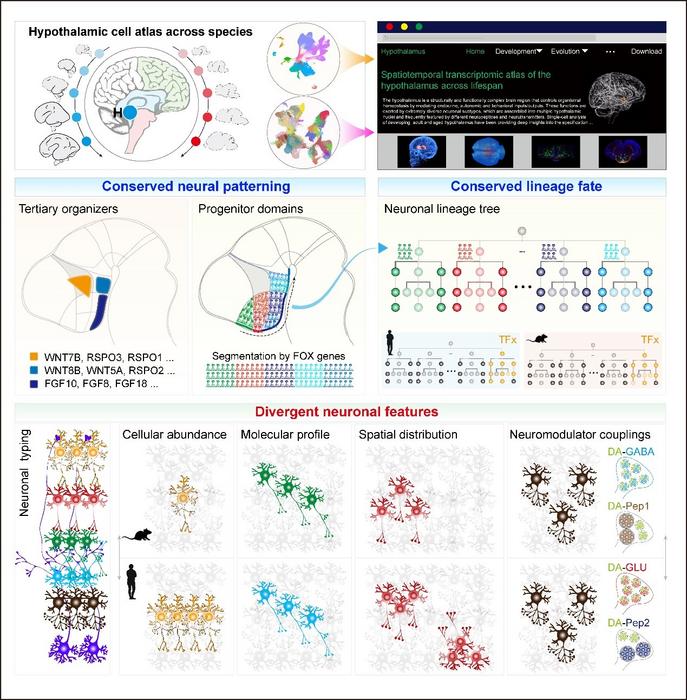
A notable conceptual contribution from the study is the identification of three conserved morphogenetic centers, termed "tertiary organizers," which orchestrate early hypothalamic regionalization by emitting signals that shape the hypothalamic primordium along the anteroposterior axis. These insights illuminate the underlying mechanisms that govern neural patterning processes, enhancing our comprehension of hypothalamic development in both humans and mice. This represents a significant leap in our understanding of how form and function are intertwined during critical stages of brain development.
Moreover, WU’s team employed computational methods to accurately reconstruct a neurogenic lineage tree, tracing the developmental path of various types of hypothalamic neurons from distinct progenitor regions. Through their analysis, they identified a set of conserved lineage factors that guide this process, revealing a tapestry of genetic interactions that dictate cell fate decisions. Furthermore, the study revealed an intriguing discovery: the existence of a unique neuronal subtype exclusive to humans, whose specific function is yet to be determined. This finding raises important questions about what such specialization might indicate concerning human neurobiology and evolution.
The research also uncovered significant increases in the expression of neuromodulatory genes within human neurons compared to those of other species. This increased expression includes genes encoding ion channels, receptors, and neuropeptides, highlighting the complexity and potential adaptability of the human hypothalamus in response to various external stimuli and internal demands. This increased complexity could reflect the unique pressures and requirements of human social interaction and cognition, thus bridging the gap between evolutionary biology and neurodevelopment.
Spatial mapping conducted within the study has yielded vital information regarding the distribution of neuroendocrine neurons—specifically, the Gonadotropin-Releasing Hormone (GnRH) and Growth Hormone-Releasing Hormone (GHRH) types—across species. The findings indicate significant differences in how these neurons are organized in humans in comparison to mice, suggesting that the neuroendocrine systems have undergone evolutionarily distinct adaptations in response to different survival and reproductive needs. This elaboration of neuroendocrine neuron distribution illuminates how hormonal signaling may differ across species, further emphasizing the need to understand these systems in a comparative framework.
An innovative aspect of this study involves the cross-species comparison of hypothalamic dopamine neurons, which offered compelling evidence for shifts in the co-transmission of dual neurotransmitters and peptide-neurotransmitter combinations across species. Such shifts—observed in the dopamine-GABA and dopamine-glutamate couples—suggest noteworthy evolutionary divergences. These potential changes in neurotransmitter coupling may underpin phenotypic disparities among species, impacting areas like reward-based learning, motivation, growth, and stress responses. To bolster their findings, the research team developed machine learning frameworks that support lineage reconstruction and the inference of regulatory networks, using extensive multi-species transcriptomic datasets.
In summary, this study underscores a wealth of conserved neural patterning mechanisms and significant evolutionary shifts that encompass the development of the mammalian hypothalamus. The identification of a distinct human-enriched neuronal subtype, enhanced neuromodulation, variations in neuroendocrine neuron locations, and alterations in the neurochemistry of hypothalamic dopamine neurons presents a comprehensive and rigorous analysis of how these factors impact physiology and behavioral outcomes. Such findings hold profound implications for understanding the complexities of human brain functions and their evolution over time, particularly as they relate to social cognition and behavioral flexibility.
As an integrative exploration into the cellular development and evolutionary divergence of the mammalian hypothalamus, this research not only augments our understanding of hypothalamic specialization but also highlights the delicate balance of conservation and innovation in brain development. The nuances revealed from analyzing cellular ontogeny versus evolutionary divergence can help pave the way for ongoing research into human-specific physiological functions and associated disease vulnerabilities, further enriching our grasp of the intricate mechanisms shaping human health and behavior.
Cite Scienmag News
Gavin Prescott. (April 8, 2025). Scientists Discover Evolutionary Insights and Innovations in Mammalian Hypothalamus Development. Scienmag. https://scienmag.com/scientists-discover-evolutionary-insights-and-innovations-in-mammalian-hypothalamus-development/
Gavin Prescott. "Scientists Discover Evolutionary Insights and Innovations in Mammalian Hypothalamus Development." Scienmag, 8 April 2025, https://scienmag.com/scientists-discover-evolutionary-insights-and-innovations-in-mammalian-hypothalamus-development/. Accessed 4 September 2026.
Gavin Prescott. "Scientists Discover Evolutionary Insights and Innovations in Mammalian Hypothalamus Development." Scienmag. April 8, 2025. https://scienmag.com/scientists-discover-evolutionary-insights-and-innovations-in-mammalian-hypothalamus-development/


