

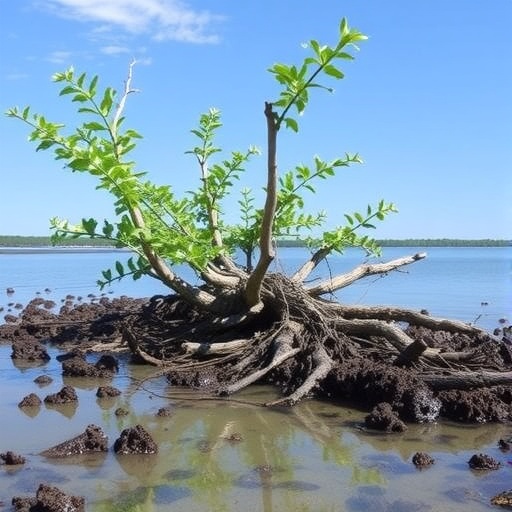
A revolutionary new tool developed by Brazilian researchers is reshaping the way scientists and environmental managers assess the health of mangrove soils across different stages of ecosystem development. This innovative Soil Health Index (SHI) quantifies soil vitality, providing an intuitive scale from 0 to 1, where 0 indicates the poorest soil health and 1 represents optimal functioning. When applied to various mangrove sites, including degraded, restored, and pristine forests, the index unveils the stark contrast in ecosystem service potential, revealing that healthy, including restored, mangroves perform near their maximum capacity, while deforested areas sustain only minimal functional benefits.
Mangrove forests are among the planet’s most valuable ecosystems, often referred to as “blue carbon” sinks due to their unparalleled capacity to sequester and store atmospheric carbon dioxide in soil organically. Despite their ecological importance, mangroves have suffered massive losses globally—between 30% and 50% over the past five decades—driven by anthropogenic pressures such as deforestation, urban encroachment, and the amplifying effects of climate change like rising sea levels and intensifying storm activity. Brazil stands out with the world’s second-largest mangrove coverage, hosting approximately 1.4 million hectares along its coastline, making it a vital case study for restoration efforts and soil health monitoring.
The SHI represents a breakthrough by translating complex biogeochemical and ecological processes into a single, straightforward metric that can guide conservation and restoration priorities. Unlike previous methods, this index integrates a suite of interrelated physical, chemical, and biological indicators fundamental to soil function. It encompasses parameters such as soil texture variability, organic carbon content, and concentrations of pseudototal iron—each critical for understanding carbon dynamics and contaminant immobilization in the sediment matrix. Additionally, it evaluates enzymatic activities of soil microbes, essential drivers of nutrient cycling that ensure ecosystem sustainability.
Applying the SHI to the estuarine mangrove of the Cocó River in Ceará, Brazil, researchers observed pronounced spatial variability in soil health corresponding to restoration age and degradation levels. Mature, undisturbed mangroves yielded SHI values near the upper limit (0.99 ± 0.03), denoting near-optimal soil function. In contrast, severely degraded sites plummeted to scores as low as 0.25 ± 0.01. Intriguingly, regions replanted nine and thirteen years ago demonstrated intermediate values (0.37 ± 0.01 and 0.52 ± 0.02 respectively), underscoring a slow but measurable recovery trajectory. These results confirm that mangrove soil recovery is gradual yet tangible when restoration is carefully managed.
The significance of this index transcends academic curiosity; it equips ecosystem managers with a tangible tool to monitor restoration success and prioritize interventions. The ability to objectively evaluate whether a rehabilitated mangrove site achieves functional equivalency with mature forests is crucial for sustainable coastal environmental management. As evidenced by Laís Coutinho Zayas Jimenez, who spearheaded this research during her doctoral studies at the University of São Paulo, the SHI’s practical application will empower policymakers to align restoration efforts with ecosystem service delivery, including carbon sequestration, nutrient cycling, and contaminant immobilization.
Mangroves’ capacity to provide ecosystem services extends beyond carbon storage. They act as nurseries for marine biodiversity, support subsistence and commercial fisheries, and serve as natural buffers against coastal erosion. However, human activities and climate-driven forces complicate their conservation. With continuous loss posing a substantial threat, tools like the SHI are essential for quantifying ecosystem degradation and reinforcing the urgency for restoration.
The team behind this advancement hails from multidisciplinary backgrounds, including geography, soil science, and environmental management, highlighting the collaborative nature of tackling ecological challenges. The study received support from the FAPESP foundation and involved prominent researchers such as Tiago Osório Ferreira and Hermano Melo Queiroz, whose expertise in soil biogeochemistry and geography ensured rigorous scientific grounding. Their coordinated effort lays critical groundwork for large-scale monitoring of mangrove restoration and soil health across Brazil’s vast and diverse coastal regions.
One remarkable aspect of the SHI is its adaptability. The index can incorporate region-specific data reflecting different environmental conditions and local ecosystem service priorities. For instance, it factors in geochemical complexities such as phosphorus content, which can variably enhance or impair ecosystem balance depending on context. Excess phosphorus may lead to eutrophication, a process characterized by algal blooms that deplete oxygen, degrade water quality, and threaten aquatic biodiversity.
Looking forward, researchers aim to refine the index further by dissecting the types and stability of carbon pools returning to restored soils. Such insights will deepen the understanding of how restoration efforts influence long-term carbon sequestration potentials. Moreover, this investigation catalyzed a new multi-institutional project dedicated to mapping mangrove soil health on a national scale using combined methodologies of soil analysis, remote sensing, and spatial modeling. This pioneering venture promises to offer the first comprehensive insight into Brazilian mangroves’ soil ecosystem across distinct biogeographical regions.
The broader implications of this work align with global climate mitigation goals. Mangrove restoration and conservation initiatives, such as the international Mangrove Breakthrough, aim to rehabilitate millions of hectares by 2030, leveraging these ecosystems’ carbon storage power to offset anthropogenic emissions. Maintaining and restoring soil health within these forests is fundamental to sustaining their role as climate buffers, fisheries habitats, and coastal protectors.
This index’s development demonstrates that while mangroves are resilient, the degradation they have endured is severe and rapid. Nevertheless, the promise of effective, informed restoration offers hope for reversing declines in ecosystem functions. The key lies in leveraging robust scientific tools to guide stewardship actions, ensuring that restored mangroves not only survive but thrive to deliver maximum ecosystem benefits.
Brazilian mangroves, owing to their ecological richness and vast spatial extent, are indispensable assets in global blue carbon strategies. By operationalizing the SHI, Brazil is poised to lead in scientifically monitoring mangrove soil health, a critical yet previously underappreciated component of coastal ecosystem resilience. As these soil health measurements gain adoption, they will become benchmarks for restoration success worldwide and models for integrating soil biogeochemistry in ecosystem service management.
In summary, the Soil Health Index marks a pioneering step in marine ecosystem conservation science. It bridges complex soil processes with practical management, offering a scalable and sensitive method to assess mangrove soil quality and ecosystem service provisioning. Through this innovation, mangrove restoration can be quantitatively verified and optimized, enhancing biodiversity conservation, climate resilience, and socio-economic benefits for communities relying on these coastal forests.
Subject of Research:
Soil Health Index for Mangrove Restoration and Ecosystem Service Assessment
Article Title:
Tracking mangrove restoration using a biogeochemical soil health index and ecosystem service indicators
News Publication Date:
10-Dec-2025
Web References:
https://www.nature.com/articles/s41598-025-30909-2
https://ccarbon.usp.br/
https://www.mangrovebreakthrough.com/about
http://dx.doi.org/10.1038/s41598-025-30909-2
Image Credits:
Gabriel Nóbrega/UFC
Keywords:
Mangroves, Carbon fixation, Environmental monitoring, Soil health, Ecosystem services, Blue carbon, Restoration ecology, Biogeochemistry, Nutrient cycling


