


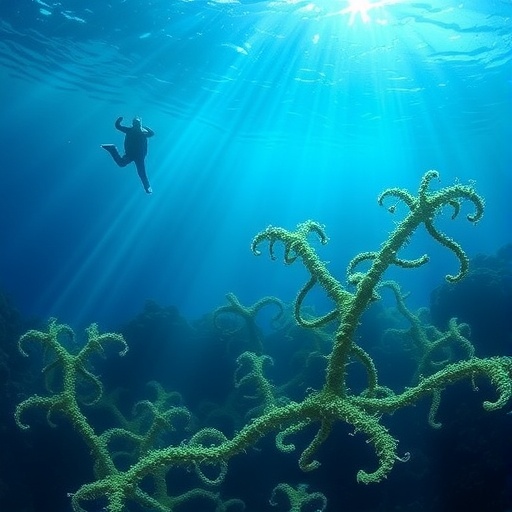
In the ever-changing expanse of the ocean, invisible to the naked eye, microbial life thrives in a delicate balance influenced by dynamic environmental factors. Recent research by Peoples, L.M., Eppley, J.M., Barone, B., and colleagues, published in Nature Communications, uncovers the intricate and fundamental processes underlying diel (daily) and eddy-driven changes in microbial gene expression and biogeochemical activity within the oceanic chlorophyll maximum. This chlorophyll maximum is a critical layer in the ocean where phytoplankton productivity peaks, exerting profound influence on global carbon cycling and marine ecosystems.
The study’s revelations stem from an ambitious integration of molecular biology with oceanographic observations, offering unprecedented insights into how microbial communities in these regions adjust their genetic activity in response to both the daily light cycle and mesoscale eddies. These swirling ocean features, often spanning tens to hundreds of kilometers, create nutrient-rich environments that sculpt the distribution and function of microbes, ultimately dictating elemental fluxes and biochemical transformations in the water column.
At the heart of the investigation lies the observation that microbial gene expression is not static but varies predictably over the course of a day. This diel variation aligns tightly with light availability, influencing photosynthetic activity and subsequent metabolic pathways. Phytoplankton, the primary photosynthetic organisms in the chlorophyll maximum, modulate gene transcription to optimize photosystem functioning during daylight, and engage different metabolic strategies during nighttime. Coupled with this are the impacts of localized eddy dynamics that drive nutrient mixing and organic matter distribution, further shaping micro-scale biogeochemical gradients and microbial community responses.
One of the study’s key methodologies involved high-resolution metatranscriptomic analyses, which enabled the researchers to capture snapshots of gene expression from diverse microbial populations at various times across day-night cycles and different eddy states. This approach uncovered rhythmic patterns in gene transcription tightly linked to environmental cues, offering clues about the regulatory networks marine microbes employ to cope with fluctuating light and nutrient regimes.
Marine eddies emerged as more than physical oceanographic phenomena; they serve as biological hotspots where gene expression patterns shift distinctly compared to non-eddy waters. Enhanced vertical nutrient fluxes within these eddies stimulate primary production, prompting a cascade of genetic responses that include upregulation of genes involved in carbon fixation, nutrient uptake, and stress responses. These intricate changes suggest that eddies act as natural perturbations, periodically reprogramming microbial communities to maintain ecosystem resilience.
The biogeochemical significance of these microbial dynamics cannot be overstated. Photosynthetic microbes capture atmospheric CO2, sequestering it through organic matter synthesis. Fluctuations in their gene expression, influenced by diel light cycles and eddy-induced nutrient supply, regulate how efficiently this carbon fixation occurs. Additionally, the release of organic compounds by microbes during different phases can alter nutrient cycling and energy flow within the food web, impacting higher trophic levels and broader ocean health.
Another striking discovery relates to the diversity of microbial taxa responding differentially to these environmental drivers. While phytoplankton displayed pronounced diel transcriptional rhythms, heterotrophic bacteria and archaea also exhibited gene expression adjustments, particularly in functions related to organic matter degradation and nutrient remineralization. This broad community response underscores a tightly coupled microbial network that dynamically adapts to physical oceanographic forces.
The implications of this research stretch beyond ocean science and into the arenas of climate change and global biogeochemical modeling. Understanding how microbial communities regulate their activity under natural variability informs predictions about how changing ocean conditions—such as shifting wind patterns that influence eddy formation—might alter carbon sequestration and nutrient cycling. These processes, in turn, feedback into climate regulation mechanisms, making the study crucial for holistic environmental forecasting.
Advanced sensor technologies and sampling platforms played pivotal roles in this research, enabling the simultaneous capture of physical, chemical, and biological data. Autonomous underwater vehicles equipped with fluorometers mapped chlorophyll concentrations, while in situ RNA preservation techniques safeguarded delicate genetic material for downstream molecular analyses. This multidisciplinary approach exemplifies the next frontier in marine science, where genomics meets oceanography to decode the living ocean’s response to dynamic processes.
The research also highlights the importance of temporal resolution in studying microbial ecology. Previous oceanographic studies often relied on single time-point samplings that obscured the rhythms governing microbial life. By meticulously sampling across diel cycles and contrasting eddy versus non-eddy conditions, this study unmasked the layered complexity of microbial function and its coupling with physical drivers, redefining our understanding of marine ecosystem dynamics.
The fine-scale interplay revealed by this work adds nuanced perspectives to the classical paradigm of nutrient limitation in the upper ocean. Instead of a uniform limitation framework, microbial communities respond to transient and localized enhancements in nutrient supplies within eddies, modulating gene expression profiles that reflect rapid metabolic shifts. Such plasticity is indicative of microbial resilience and adaptability, traits paramount for ecosystem stability amid environmental fluctuations.
Furthermore, this research invites new hypotheses regarding the evolution of microbial regulatory networks in the ocean. The synchronization of gene expression with diel light cycles and responses to eddy-driven nutrient regimes suggest that marine microbes have developed sophisticated sensing and signaling pathways. These mechanisms likely confer selective advantages in the heterogeneous and dynamic aquatic environment, enhancing survival and ecosystem functionality.
The study’s outcomes resonate beyond academic circles, holding potential implications for biotechnological applications. Understanding natural genetic rhythms and metabolic restructuring in marine microbes could inspire innovations in synthetic biology, such as engineering microbes for optimized biofuel production or bioremediation strategies that mimic natural environmental responsiveness.
As scientists continue to unravel the molecular choreography of microbial communities in the oceanic chlorophyll maximum, the findings from Peoples and colleagues serve as a benchmark that underscores the ocean’s complexity and vitality. The research exemplifies how cutting-edge molecular tools, combined with detailed oceanographic observations, can illuminate the fundamental processes shaping life and biogeochemical cycles in the planetary oceans.
By bridging disciplines and scales—from genes to ecosystems to global cycles—the study sets a new standard for marine microbial ecology and underscores the ocean’s central role in Earth’s biosphere. Future research building on these insights promises to deepen our grasp of the ocean’s microbial engine that drives climate regulation and sustains marine life.
In essence, this transformative research reveals the ocean not just as a vast, static body of water but as a dynamic, biologically vibrant realm where microbial life dances to the cadence of light and currents, orchestrating vital planetary processes that sustain life on Earth.
Cite Scienmag News
Violet Maxwell. (March 10, 2026). Microbial Gene Shifts Drive Ocean Chlorophyll Changes. Scienmag. https://scienmag.com/microbial-gene-shifts-drive-ocean-chlorophyll-changes/
Violet Maxwell. "Microbial Gene Shifts Drive Ocean Chlorophyll Changes." Scienmag, 10 March 2026, https://scienmag.com/microbial-gene-shifts-drive-ocean-chlorophyll-changes/. Accessed 6 September 2026.
Violet Maxwell. "Microbial Gene Shifts Drive Ocean Chlorophyll Changes." Scienmag. March 10, 2026. https://scienmag.com/microbial-gene-shifts-drive-ocean-chlorophyll-changes/


