

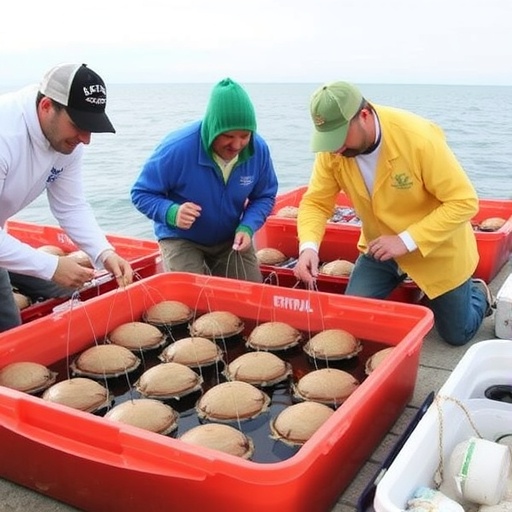
Rutgers University’s marine science team has unveiled groundbreaking research that could revolutionize seafood farming along the U.S. Atlantic coast. Led by marine scientist Daphne Munroe, the study demonstrates the first successful offshore aquaculture of Atlantic surfclams (Spisula solidissima) in the open ocean. This pioneering work not only proves the feasibility of scaling clam farming beyond traditional coastal and bay environments but also suggests a future where sustainable seafood production can meet rising consumer demand without compromising wild populations.
Aquaculture, the practice of farming aquatic organisms, is typically confined to inshore environments such as protected bays, estuaries, and man-made ponds. These locations allow easier management and shelter from storm damage but come with significant drawbacks, including competition from other coastal users and water quality issues that can negatively impact productivity. Munroe’s team sought to challenge these limitations by extending clam farming into the harsher, open ocean environment, where cleaner water and expansive space may offer enhanced growth potential and fewer conflicts with human activities.
Surfclams, large bivalves known for their robust shells and prominent role in commercial seafood markets, have traditionally been harvested from wild stocks. They burrow into sandy marine substrates and provide a key ingredient in various culinary dishes, including chowders and fried clam strips. This study hypothesized that juvenile surfclams could thrive in offshore cages designed to protect them from predators while providing optimal conditions for growth and survival in the dynamic oceanic environment.
The experimental design involved deploying more than 300,000 juvenile surfclams into custom-engineered cages located miles offshore along the New Jersey coast. These cages featured innovative construction aimed at mitigating predation and sediment intrusion—two significant challenges in clam farming. By elevating clams off the ocean floor, the cages allowed a continuous flow of cleaner water, reducing sand buildup inside the clams’ shells and improving meat quality for consumption.
Throughout the year-long study, the team monitored clam growth and survival rates across spring and fall seasons, with detailed assessments of environmental factors such as wave action, sedimentation, and temperature. Notably, clams introduced in spring exhibited more rapid growth rates and higher survivorship than those placed in the fall. This seasonal variation was attributed to calmer sea conditions and fewer storms during spring, which facilitated easier maintenance and monitoring of the farming equipment.
The findings have important implications for both the aquaculture industry and environmental stewardship. Avoiding crowded coastal zones reduces conflicts with other marine users and may minimize the ecological footprint often associated with nearshore aquaculture. Additionally, the research demonstrated that clams grown offshore had minimal grit in their meat—a common complaint affecting clam palatability. This suggests that offshore aquaculture could produce superior quality seafood that appeals to high-end markets.
Equally significant is the durability of the cages themselves. The harsh offshore environment with its strong waves and frequent storms demands resilient aquaculture infrastructure. Munroe’s team engineered cages capable of withstanding these conditions without damage, underscoring the viability of sustained offshore clam farming over longer timeframes. This technological advancement addresses one of the critical operational hurdles that have limited expansion of aquaculture into open ocean waters.
This study was conducted in close collaboration with commercial fishing enterprises and supported by funding from the National Oceanic and Atmospheric Administration (NOAA). Working directly with industry partners ensured that the research addressed practical challenges and real-world conditions, accelerating the translation of scientific discoveries into scalable business models. The collaboration highlights the importance of integrating academic research with commercial expertise to innovate within the seafood sector.
Looking ahead, while the results are encouraging, Munroe emphasizes the necessity of overcoming remaining regulatory and logistical barriers. Navigating the complex permitting processes for offshore aquaculture and ensuring long-term equipment durability remain essential priorities. Nevertheless, the research presents a compelling case for expanding ocean farming as a sustainable strategy to bolster local economies, increase seafood supply, and reduce pressure on wild clam populations.
The Rutgers-led project adds a vital piece to the evolving puzzle of sustainable ocean resource utilization. By demonstrating the feasibility and benefits of offshore clam farming, the study opens new avenues for aquaculture innovation that align with environmental conservation goals. It fosters optimism that seafood production can evolve beyond traditional practices and scale in a responsible manner that supports coastal communities and ecosystems alike.
In their efforts, the researchers have set a precedent for integrating ecological understanding with engineering solutions to address key aquaculture challenges. Future work will likely focus on optimizing cage designs, refining seasonal deployment strategies, and expanding to other species with similar ecological niches. The long-term vision is an offshore aquaculture industry that is productive, resilient, and harmonious with marine environments.
According to Munroe, the success of offshore surfclam farming exemplifies a new frontier where science meets industry to produce tangible benefits. “We’re excited to show that this is not only possible but can be done in a way that protects the environment and creates jobs,” she said. This innovation could represent a paradigm shift in how seafood is farmed, with implications extending well beyond New Jersey’s waters.
The research team contributing to this milestone includes Laura Steeves, formerly a postdoctoral researcher at the Rutgers Haskin Shellfish Research Laboratory and now affiliated with the Flødevigen Research Station in Norway, fisheries researcher Sarah Borsetti, and doctoral student Rachel Davitt, all of whom played integral roles in the experimental setup, monitoring, and data analysis.
As global seafood demands intensify amid environmental concerns over wild fisheries, the potential for offshore aquaculture to deliver sustainable, high-quality shellfish is garnering increasing attention. Rutgers University’s breakthrough in Atlantic surfclam culture may well inspire similar initiatives along other coastlines eager to balance economic development with marine conservation.
Subject of Research: Animals
Article Title: Offshore aquaculture of Atlantic surfclams Spisula solidissima: Growth, survival and feasibility
News Publication Date: 12-Feb-2026
Web References: 10.1093/naaqua/vraf038
Image Credits: Sarah Borsetti/Rutgers University
Keywords: Fisheries, Marine biology


