

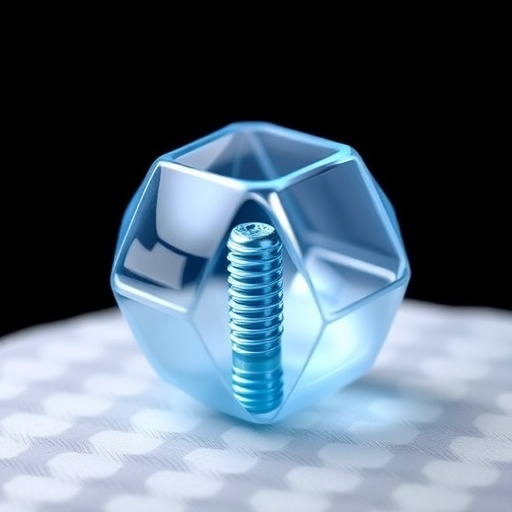
In a groundbreaking advancement for orthopedic medicine, researchers have unveiled a novel hybrid metallic implant designed to overcome critical limitations of conventional bone repair materials. This innovation leverages cutting-edge additive manufacturing combined with powder metallurgy to produce a partially biodegradable composite that not only mimics the structural integrity of natural bone but also promotes biological compatibility and controlled degradation. As implanted metals have long served as the backbone of orthopedic repair, this development promises to redefine the future of implant technology and patient outcomes.
Traditional orthopedic implants have predominantly relied on metals such as titanium alloys, stainless steel, and cobalt-chromium alloys due to their strength and durability. However, these materials are permanent fixtures within the body and often exhibit mechanical properties that starkly contrast with those of the surrounding bone. One notable drawback is their excessive stiffness relative to natural bone, which can induce adverse effects such as stress shielding. Stress shielding refers to the phenomenon where the implant absorbs the majority of mechanical load, leading to the weakening and resorption of adjacent bone tissue. Over time, this contributes to implant loosening, failure, and necessitates complex revision surgeries.
Addressing this challenge, Prof. Dr.-Ing. K.G. Prashanth and his international research collaborators have developed an innovative orthopedic implant that cleverly integrates two metals with complementary properties. The core of the implant is a 3D-printed lattice crafted from a titanium alloy, Ti-6Al-4V, its structure ingeniously inspired by the hexagonal geometry of natural honeycombs. This biomimetic design offers a trifecta of benefits: exceptional mechanical strength, efficient material usage, and a porous architecture conducive to body fluid perfusion and bone cell migration. Such tissue interconnectivity is instrumental in fostering osseointegration, the process by which new bone forms and firmly anchors the implant.
The titanium lattice is subsequently infiltrated with zinc, implemented via pressure-assisted sintering, emblematic of the researchers’ hybrid manufacturing approach. Zinc is carefully selected for its biodegradable nature, possessing the capacity to gradually dissolve under physiological conditions. The gradual dissolution rate is critical; it ensures that the implant provides mechanical stability during the initial phases of bone healing but eventually degrades to permit the natural regeneration of bone without lingering foreign material. This strategy aims to circumvent the chronic complications engendered by permanent metallic implants.
Central to the composite’s success is the novel combination of additive manufacturing and powder metallurgy techniques. Additive manufacturing, particularly selective laser melting used here, enables the precise fabrication of the titanium alloy lattice with controlled porosity and geometry tailored to mimic bone’s mechanical profile. Pressure-assisted sintering then facilitates the densification of zinc within the lattice, producing a tightly integrated composite with enhanced mechanical cohesion. This dual-process manufacturing ensures the implant achieves a balance between strength, biodegradability, and biocompatibility.
Mechanical testing of the composite revealed its compressive strength reaches approximately 292 megapascals (MPa), surpassing the strength of natural cortical bone, typically around 230 MPa. This is a significant leap, as achieving a stiffness and strength comparable to native bone is essential to prevent stress shielding and implant failure. Moreover, the degradation rate of zinc within the composite closely aligns with the ideal benchmark of 0.157 millimeters per year under simulated physiological conditions, signifying a controlled resorption process finely tuned to support gradual load transfer to the healing bone.
Biocompatibility assessments conducted in vitro demonstrated that the composite fosters the proliferation and differentiation of bone-related cells, corroborating its suitability for implantation. The porous nature of the titanium lattice not only supports mechanical requirements but also facilitates nutrient diffusion, waste removal, and vascularization within the regenerating bone tissue. These biological advantages are crucial for successful long-term integration and functional recovery.
The implications of this research extend beyond the immediate clinical benefits. By providing a scaffold that dissolves over time while simultaneously supporting mechanical loads and biological integration, these implants could radically diminish the frequency of revision surgeries—which are often risky and costly. This advancement holds particular promise for aging populations and trauma patients, where bone healing is compromised, and the need for durable yet adaptable implants is paramount.
Moreover, the adoption of such hybrid manufacturing approaches signals a paradigm shift in medical device production. The ability to tailor implants with hierarchical architectures, biomimetic designs, and controlled degradation profiles allows for unprecedented customization to patient-specific anatomical and physiological demands. This personalized approach could lead to more efficient healing trajectories, reduced recovery times, and improved overall patient quality of life.
The research, published in the prestigious journal Advanced Light Materials, underscores the intersection of materials science, biomedical engineering, and additive manufacturing innovation. It exemplifies how interdisciplinary collaboration can yield tangible improvements in healthcare technologies. The work furthers the quest to develop “smart” implants—devices that adapt and evolve in concert with the biological environment, embodying the ideal combination of strength, bioactivity, and biodegradability.
Looking forward, the research team is poised to transition from laboratory scale testing to preclinical and clinical trials, validating long-term safety and efficacy. They are also exploring the incorporation of additional bioactive elements and coatings that could further enhance osteoinductive properties and antibacterial capabilities, fortifying the implant’s functionality in challenging physiological milieus.
In summation, the Ti-6Al-4V/zinc composite developed through this hybrid additive and powder metallurgy manufacturing represents a compelling next-generation orthopedic implant. Its design elegantly solves the conundrum of balancing mechanical support with biological compatibility and controlled degradation, thereby holding the potential to revolutionize bone repair strategies worldwide. As this technology progresses toward clinical use, it brings hope for patients suffering from bone injuries and diseases, promising faster recovery, fewer complications, and implants that seamlessly integrate and eventually harmonize with the human body.
Subject of Research: Development of a partially biodegradable titanium-zinc composite implant for orthopedic applications using hybrid additive manufacturing and powder metallurgy.
Article Title: Novel partially biodegradable Ti-6Al-4V/Zn composites fabricated through hybrid additive manufacturing and powder metallurgy
Web References:
10.1016/j.almate.2026.03.001
Keywords
Orthopedic implants, additive manufacturing, powder metallurgy, titanium alloy, zinc, biodegradable implants, bone regeneration, biomimetic lattice, mechanical strength, controlled degradation, osseointegration, hybrid composites


