


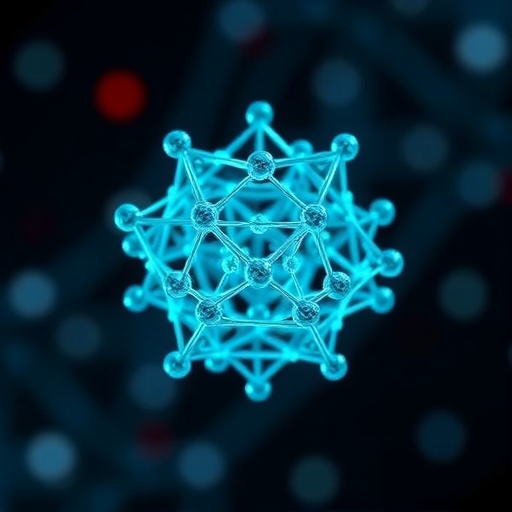
In a groundbreaking development that may reshape the landscape of nanotechnology, researchers at Brown University have unveiled compelling experimental evidence for a novel nanomaterial composed entirely of boron atoms. This discovery centers on an 80-atom boron cluster exhibiting the distinctive spherical geometry traditionally associated with the iconic carbon buckyball, or Buckminsterfullerene, which is composed of 60 carbon atoms. The resemblance between these two molecular giants extends far beyond their shared name; the boron buckyball could potentially unlock a new class of materials with unprecedented electronic and chemical properties.
The carbon buckyball, first discovered over four decades ago, revolutionized nanoscience by demonstrating that carbon atoms could be arranged into a perfectly spherical cage—a geodesic structure reminiscent of the architectural designs popularized by Buckminster Fuller. This form not only captivated scientists with its symmetry and elegance but also introduced versatile applications ranging from energy storage to targeted drug delivery. Driven by the search for similar or superior structures, Professor Lai-Sheng Wang and his team have long pursued the question of whether boron, adjacent to carbon on the periodic table, could assemble into comparable nano-architectures.
In pursuit of this goal, Wang’s laboratory employed a sophisticated approach that involved unprecedented precision in fabricating boron clusters. By bombarding a boron target with a high-powered laser, streams of boron atoms were liberated and rapidly cooled to facilitate the spontaneous formation of clusters with varying numbers of atoms. These clusters were subsequently analyzed in a mass spectrometer to identify their exact atomic compositions before being subjected to photoelectron spectroscopy—an advanced technique capable of unraveling the intricate electronic structure of molecular formations.
Photoelectron spectroscopy played a pivotal role in characterizing the newly synthesized clusters. By irradiating the boron assemblies with laser light, electrons were ejected and their velocities measured along what Wang terms an “electron racetrack.” These measurements yield the electron binding energy spectrum, an electronic fingerprint reflecting how electrons are distributed and held within the molecular framework. Remarkably, the boron-80 cluster’s spectrum exhibited sharp and well-defined peaks, signaling a highly symmetric and stable molecular architecture—an unexpected outcome that diverged starkly from theoretical predictions.
Prior computational models, largely relying on density functional theory (DFT), had cast doubts on the stability of an 80-atom boron buckyball, anticipating that such a configuration would relax into less symmetrical and less stable forms. The discrepancy between theory and experiment compelled the team to reconsider the limitations of DFT in predicting the behavior of boron clusters. Wang suggests that inaccuracies in bond length estimation by DFT may have led to erroneous conclusions about the feasibility of the boron buckyball’s stability, underscoring the need for refined computational techniques tailored to boron’s unique bonding characteristics.
The identification of the boron buckyball was confirmed through collaborative efforts involving computational chemists and experimentalists across multiple institutions. By comparing theoretical predictions with the experimentally obtained electron binding energy spectrum, the researchers were able to conclusively match the data only with the spherical boron-80 cage. This discovery not only validates the existence of the structure but also opens avenues for exploring boron’s ability to form new allotropes beyond those previously known.
This breakthrough builds on previous findings from Wang’s team, including the realization of planar boron clusters consisting of 36 atoms. Such planar clusters suggested the potential to construct borophene—a one-atom-thick, two-dimensional boron sheet analogous to graphene—which was later synthesized independently in other laboratories. The progression from planar clusters to hollow cages exemplifies a stepwise ascent in understanding boron’s versatility and its capacity to form diverse nanostructures.
The boron buckyball’s high symmetry and stability may also have profound implications for its chemical reactivity and potential applications. However, synthesizing these clusters in bulk quantities remains an unresolved challenge, as the current production methods generate clusters isolated in vacuum conditions that may not translate directly to ambient environments. Wang and colleagues emphasize the necessity of investigating the cluster’s chemical stability under typical conditions to determine whether it can withstand exposure without fragmenting or reacting undesirably.
Moreover, probing the chemical reactivity of the boron buckyball stands as a crucial next step for elucidating its potential usefulness. Understanding how the cage interacts with other molecules will illuminate pathways for functionalization, enabling tailored applications in catalysis, drug delivery, or energy materials. Given the similarities with carbon buckyballs yet distinct electronic properties, boron buckyballs might exhibit unique behaviors that could be harnessed for novel technologies.
The discovery challenges existing paradigms in nanochemistry, demonstrating that boron can form highly symmetric, spherical molecules previously thought exclusive to carbon. This finding propels boron into the spotlight as a versatile element capable of creating complex nano-architectures with potentially enhanced functionalities. The research community will keenly watch the subsequent efforts aimed at synthesis, characterization, and application development related to boron buckyballs.
In the broader context of material science, this discovery underscores the importance of integrating experimental techniques with computational methods to uncover new phenomena. It also highlights the limitations of conventional theoretical frameworks when applied to unconventional elements and nanostructures, suggesting a resurgence in methodological innovation is warranted.
Ultimately, Wang’s team remains cautiously optimistic about replicating the rapid progress seen in borophene research, where bulk synthesis transpired within two years of initial discovery. Should similar strategies succeed for boron buckyballs, the resulting materials could ignite revolutionary advances across multiple scientific and technological disciplines, introducing a new class of functional nanomaterials with properties elegantly crafted at the atomic level.
News Publication Date:
22-May-2026
Web References:
https://pubs.rsc.org/en/content/articlelanding/2026/sc/d6sc02674e
http://dx.doi.org/10.1039/D6SC02674E
Keywords
Nanotechnology, Boron nanoclusters, Buckminsterfullerene, Boron buckyball, Photoelectron spectroscopy, Density functional theory, Borophene, Nanomaterials, Molecular symmetry, Electron binding energy spectrum
Cite Scienmag News
Bethany Barker. (June 10, 2026). Scientists at Brown Discover 80-Atom Boron ‘Buckyball’ in Potential Nanoscale Breakthrough. Scienmag. https://scienmag.com/scientists-at-brown-discover-80-atom-boron-buckyball-in-potential-nanoscale-breakthrough/
Bethany Barker. "Scientists at Brown Discover 80-Atom Boron ‘Buckyball’ in Potential Nanoscale Breakthrough." Scienmag, 10 June 2026, https://scienmag.com/scientists-at-brown-discover-80-atom-boron-buckyball-in-potential-nanoscale-breakthrough/. Accessed 4 September 2026.
Bethany Barker. "Scientists at Brown Discover 80-Atom Boron ‘Buckyball’ in Potential Nanoscale Breakthrough." Scienmag. June 10, 2026. https://scienmag.com/scientists-at-brown-discover-80-atom-boron-buckyball-in-potential-nanoscale-breakthrough/


