


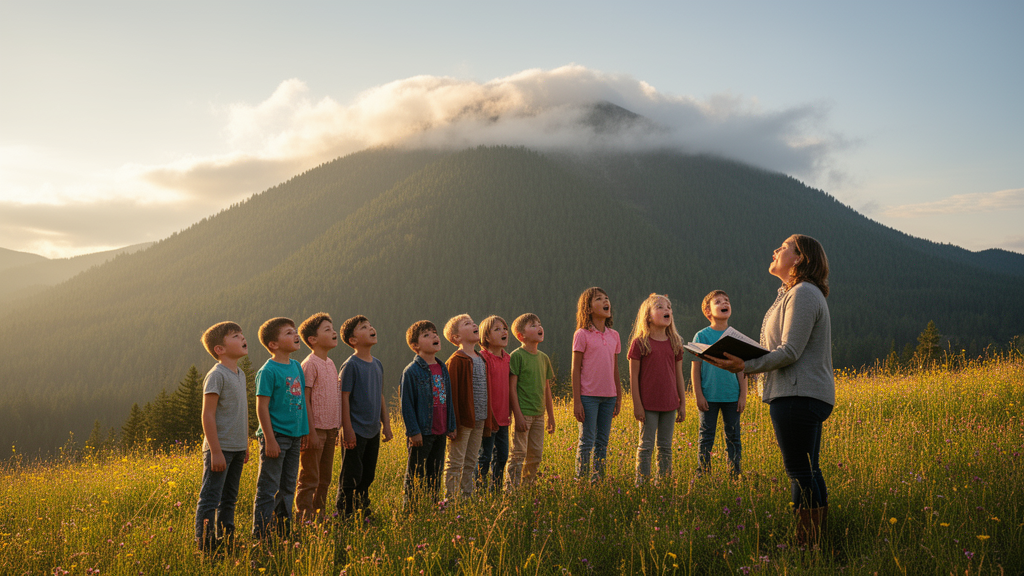
In the western suburbs of Tokyo, where the forested slopes of Mt. Takao rise above the city of Hachioji, a curious question has been quietly tested: can the words of a school song change what a school actually does with its students? A new study suggests they can. Researchers found that public elementary and junior high schools whose official songs mention mountains are significantly more likely to use nearby green spaces in their educational activities than schools whose songs leave the landscape out. The finding, published in the journal Nature Conservation, offers one of the first statistical links between a cultural ecosystem service embedded in an institutional tradition and a concrete, observable behavior.
Cultural ecosystem services, or CES, are the non-material benefits people draw from nature: recreation, aesthetic pleasure, spiritual meaning, and the formation of cultural identity. For years, researchers have treated these services as somewhat soft outcomes, valuable but difficult to trace into action. That picture is changing. Place attachment and place identity, the emotional bonds people form with specific landscapes, have been shown in meta-analyses to be positively associated with conservation behavior. The Hachioji study extends this logic into an unexpected arena: the school song, an institutionally embedded text performed repeatedly by every generation of students within a defined community.
The logic of the hypothesis is elegant. Unlike popular songs, whose references to ecosystems tend to be generic and untied to any particular place, school songs are bound to a specific institution and its surrounding landscape. Their lyrics frequently incorporate natural symbols from the local environment. If singing about a nearby mountain year after year reinforces local ecological identity, then schools with such songs might be expected to translate that symbolic attachment into tangible practices: outdoor learning, excursions into nearby green spaces, and community engagement with local ecosystems.
To test this, the researchers turned to Hachioji City, a core city of roughly 560,000 residents in western Tokyo. The city’s identity is inseparable from Mt. Takao, a landmark that dominates local culture, history, and tourism, so much so that the official tourism portal is named “Let’s go to HACHIOJI, TAKAOSAN.” The study focused on public schools rather than private ones for a deliberate reason: public elementary and junior high schools have designated school districts, so students live in the neighborhoods surrounding their schools. The local environment, the researchers reasoned, is therefore more likely to be reflected in the lyrics of their school songs.
The methods combined lyric analysis with a questionnaire survey. The team collected school songs from the official websites of all 104 public schools in the city, comprising 67 elementary schools, 35 junior high schools, and two integrated elementary-junior high schools whose divisions were counted separately when their songs differed. From the Japanese lyrics, they extracted mountain-related keywords: the term “Takao” itself, plus general words for mountain, peak, base of the mountain, elevated area, and hill range. Educational practices were measured through a questionnaire administered between August 4 and September 7, 2021, with schools asked to report their situation as it stood before fiscal year 2018, since the COVID-19 pandemic had canceled many outdoor events. Valid responses came from 63 schools, a response rate of 60.6 percent.
The lyric analysis revealed how deeply the mountain is woven into Hachioji’s institutional culture. Seven school songs explicitly contained the term “Takao,” while the general words for mountain and peak appeared in the songs of 14 and 15 schools respectively. In total, 30 of the 63 songs, roughly half, contained at least one mountain-related term. On the activity side, 29 schools reported running nature-based outdoor school programs, and 42 schools reported using nearby green spaces in their educational activities. Only three schools participated in the activities of local nature conservation organizations, too few for statistical analysis.
The statistical core of the study used generalized linear models with a binomial error distribution and a logit link, assessing significance with Wald tests. The dependent variables were yes/no indicators of each educational activity, and the explanatory variables captured whether a school’s song contained the term “Takao,” whether it contained any mountain-related word, and how many such words it contained. The results were selective in an informative way. Neither the presence of the term “Takao” nor the mountain-related words showed any significant relationship with nature-based outdoor school programs. But for the use of nearby green spaces, both the presence and the number of mountain-related words in school songs were significantly and positively associated with the activity.
Why the split? The researchers offer a compelling interpretation centered on distance. Nature-based outdoor school programs typically involve overnight stays in more distant natural settings, so their implementation may not depend on local place attachment. Using nearby green spaces, by contrast, is an everyday, place-based practice, exactly the kind of behavior that symbolic attachment to the local landscape might motivate. The recurrent singing of songs that reference local mountains may reinforce the symbolic importance of those landscapes, thereby nudging schools to incorporate the surrounding ecosystems into curricular and extracurricular activities. Interestingly, the explicit name “Takao” itself was not associated with any activity, suggesting that generic mountain imagery, rather than a single named landmark, carried the statistical signal.
The study situates its result within a broader body of evidence. Previous research has shown that folk music reflects the natural conditions of its regions, including mountain ranges, terrain, and rivers, acting as a carrier of local ecological identity. Music has also been identified as one of the most effective tools for environmental education, capable of enhancing environmental consciousness. Childhood experiences in nature are well established as a strong influence on adult environmental awareness, and schools located in ecologically rich settings or with nature-emphasizing curricula tend to produce students with stronger nature connection and outdoor engagement. The Hachioji findings extend this line by demonstrating that cultural symbols institutionalized in school songs are associated with tangible behavioral outcomes in educational settings.
The authors are careful about causality. It is possible that both the creation of the lyrics and the design of outdoor programs reflect broader community values related to nature, so the observed association does not prove that songs drive behavior. The keyword approach also captures only mountain references, leaving rivers, forests, and locally significant species unexplored. Longitudinal and qualitative approaches could help disentangle these dynamics. Still, the implications are striking. If cultural representations embedded in school traditions can mediate concrete human-nature interactions, then the cultural dimensions of environmental education and conservation planning deserve far more attention than they typically receive. A song sung at every assembly, it turns out, may be doing quiet ecological work.
Subject of Research: Are cultural ecosystem services expressed in school songs associated with nature-related educational activities?
Article Title: Are cultural ecosystem services expressed in school songs associated with nature-related educational activities?
Article References: Miyauchi, K., & Osawa, T. (2026). Are cultural ecosystem services expressed in school songs associated with nature-related educational activities?. Nature Conservation, 63, 237-245. https://doi.org/10.3897/natureconservation.63.180492
Image Credits: AI Generated
DOI: 10.3897/natureconservation.63.180492
Keywords: cultural, ecosystem, services, expressed, school, songs, associated, nature-related, educational, activities, scientific research
Cite Scienmag News
Gavin Prescott. (October 17, 2026). School Songs That Name the Mountain May Shape How Kids Meet Nature. Scienmag. https://scienmag.com/school-songs-that-name-the-mountain-may-shape-how-kids-meet-nature/
Gavin Prescott. "School Songs That Name the Mountain May Shape How Kids Meet Nature." Scienmag, 17 October 2026, https://scienmag.com/school-songs-that-name-the-mountain-may-shape-how-kids-meet-nature/. Accessed 17 October 2026.
Gavin Prescott. "School Songs That Name the Mountain May Shape How Kids Meet Nature." Scienmag. October 17, 2026. https://scienmag.com/school-songs-that-name-the-mountain-may-shape-how-kids-meet-nature/


