

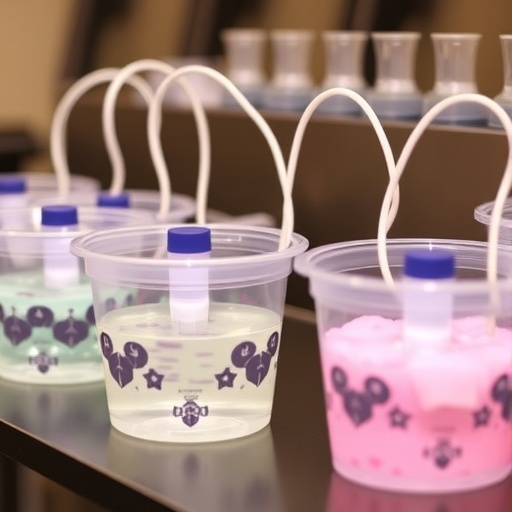
In a groundbreaking advancement poised to revolutionize immune cell research and regenerative medicine, scientists have unveiled an innovative protocol for producing macrophages derived from induced pluripotent stem cells (iPSCs) using an intermediate-scale bioreactor system. This pioneering method stands to dramatically enhance the standardization, yield, and scalability of macrophage manufacturing, a critical step forward for translational applications ranging from cancer therapy to inflammatory disease treatment.
Macrophages are pivotal players in the immune system, orchestrating responses to pathogens, facilitating tissue repair, and maintaining homeostasis. Their versatility and central role in immune mechanism make them key targets for therapeutic development. However, the reliable and scalable production of human macrophages that retain physiological relevance has historically been an obstacle for researchers, particularly in academic settings where sophisticated bioprocessing tools might be limited.
This new protocol addresses these limitations directly by providing a feeder-free, semi-defined culture system adaptable to benchtop bioreactors with volumes between 10 and 50 milliliters. Unlike conventional large-scale bioreactor systems that demand advanced expertise and infrastructure, this user-friendly setup is accessible to scientists with basic iPSC culture experience. Importantly, it balances sophistication with practicality, enabling researchers to produce consistent batches of macrophages without excessive resource investment.
The method is structured around the generation of mesoderm-primed aggregates known as hemanoids, which possess potent hematopoietic potential. These cellular clusters represent an intermediate developmental stage, bridging pluripotent cells and definitive macrophages. By optimizing conditions that favor this transition, the system ensures robust hematopoietic differentiation within the controlled environment of the bioreactor, thereby significantly improving downstream macrophage yields.
A key feature distinguishing this protocol is its capacity for continuous macrophage production over extended culture periods. Researchers can harvest mature macrophages at multiple intervals—at least five consecutive collections per vessel—yielding approximately 20 to 30 million cells per harvest. This sustained output from a single bioreactor vessel marks a substantial improvement over traditional batch cultures, which are often limited by finite differentiation windows.
The bioreactors themselves operate independently, each accommodating a maximum volume of 50 milliliters, and are equipped with real-time monitoring for critical parameters such as carbon dioxide concentration, temperature, and pH. This semi-automated system allows for tighter process control and reduces variability, fostering enhanced reproducibility and cell quality. Through in-process monitoring, potential deviations can be swiftly detected and corrected, mitigating batch failure risks.
Crucially, the entire differentiation and maturation pipeline unfolds over approximately 24 days, commencing from single-cell suspensions of iPSCs and culminating in ready-to-use macrophages. This timeline strikes an optimal balance, enabling rapid experimentation cycles without sacrificing cell functionality or phenotype. Moreover, the scalability of this intermediate system offers a valuable bridge between small laboratory cultures and large industrial production platforms.
The implications for biomedical research are profound. Reliable access to standardized populations of human macrophages unlocks new potential in drug discovery, disease modeling, and cell-based therapies. For example, in cancer research, macrophages can be engineered or modulated to enhance tumor clearance, while in regenerative medicine, their role in tissue remodeling becomes pivotal. This protocol democratizes access to such macrophages, empowering a broad spectrum of investigators.
Compared to prior methodologies, the semi-defined and feeder-free nature of this protocol reduces batch-to-batch variation associated with complex culture additives or undefined feeder systems. This consistency enhances experimental rigor and fosters comparability across studies and laboratories. The cost-effectiveness and accessibility of the bioreactor further lower the barriers for adoption in diverse research contexts.
In addition to production benefits, the resulting macrophages exhibit phenotypic and functional properties closely resembling their in vivo counterparts. This fidelity is crucial for translational applications where cell authenticity impacts therapeutic efficacy and safety. The platform also allows for customization, permitting adjustments in culture conditions to tailor macrophage phenotypes for specific research questions or therapeutic goals.
This work represents a vital step towards the scalable manufacturing of immune cells, a field that has historically lagged behind other areas such as stem cell-derived cardiomyocytes or neurons. By providing a standardized, reliable pathway for macrophage production, this study lays the groundwork for future clinical-grade manufacturing and potential commercialization.
Moreover, the modular design of the bioreactor system enables parallel operation of multiple vessels, facilitating higher throughput experimentation. This capacity is particularly advantageous for drug screening platforms where large numbers of cells are necessary for robust statistical analyses. The real-time monitoring further supports integration with automated workflows, propelling the field toward fully automated immune cell biomanufacturing.
Future directions stemming from this advancement could include refining molecular cues to generate macrophage subtypes associated with specific tissue milieus or disease states. The platform’s adaptability may also enable integration with gene editing technologies, producing genetically modified macrophages with enhanced therapeutic functionalities.
The presented protocol exemplifies the power of engineering and biology converging to overcome long-standing barriers in cell manufacturing. By enabling accessible, reproducible, and efficient production of iPSC-derived macrophages, this approach enhances both the pace and precision of immunological research and its translation into clinical applications.
Ultimately, this innovation not only meets the immediate need for scalable macrophage production but also paves the way for broader efforts to harness pluripotent stem cells for immune cell therapies. Its impact will resonate across disciplines, from fundamental immunology to cutting-edge regenerative medicine, accelerating the realization of next-generation cellular therapeutics.
Subject of Research: The research focuses on the production and application of induced pluripotent stem cell-derived macrophages using an intermediate-scale bioreactor system.
Article Title: Harnessing intermediate-scale bioreactors for next-generation macrophage production and application.
Article References:
Saleh, F., Valdivia Malqui, E.E., Gensch, I. et al. Harnessing intermediate-scale bioreactors for next-generation macrophage production and application. Nat Protoc (2026). https://doi.org/10.1038/s41596-025-01313-x
Image Credits: AI Generated
DOI: https://doi.org/10.1038/s41596-025-01313-x


