

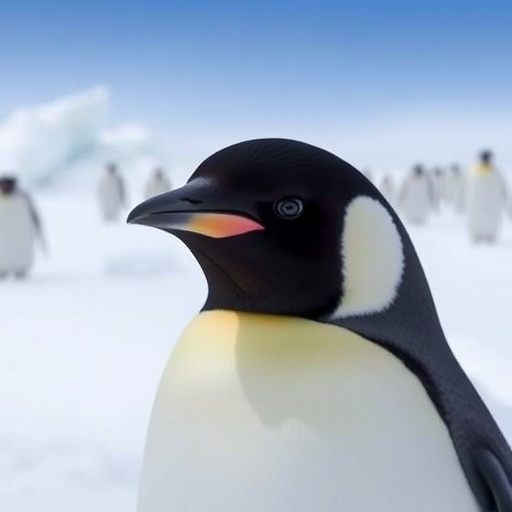
In a groundbreaking study published recently in Communications Earth & Environment, researchers have employed advanced satellite imagery to identify previously unknown moulting sites of emperor penguins in Antarctica. This discovery unveils a critical aspect of the emperor penguins’ life cycle and highlights new environmental threats facing these iconic seabirds, underscoring how climate change and human activities may imperil their delicate habitats.
The emperor penguin, renowned for its adaptation to one of Earth’s harshest environments, undergoes an annual moulting period during which it sheds old feathers to grow new ones. Traditionally, these birds have been observed to return to established and well-characterized moulting colonies on the Antarctic sea ice. However, utilizing high-resolution satellite technology, researchers have now detected new moulting grounds scattered across Antarctica that were previously unknown. This finding radically expands our understanding of the spatial extent of emperor penguin moulting behavior and challenges past assumptions driven by limited on-the-ground observation.
Employing state-of-the-art remote sensing instruments, the research team analyzed multispectral satellite images to detect specific bio-signatures associated with circumpolar penguin colonies. The distinctive guano stains and the presence of dense penguin aggregations at moulting sites produce unique spectral reflectance signatures identifiable from orbit. These spectral signals were processed and validated using drone imagery and field verification, confirming the presence of moulting emperor penguin populations at multiple unrecorded locations.
The discovery’s timing is pivotal. Emperor penguins rely on stable sea ice and coastal shelf habitats to moult successfully. Since moulting prevents them from swimming and feeding, suitable, safe land or ice platforms free from predators and environmental disturbances are essential. Satellite data now reveal that many of these new moulting sites are precariously positioned in areas increasingly affected by irregular freeze-thaw cycles and seasonal sea ice retreat, consequences of anthropogenic climate warming trends.
Beyond mapping these sites, the study underscores potential conservation challenges. The spread of moulting locations suggests that habitat fragmentation might be occurring. Such dispersal could indicate that emperor penguin populations are responding dynamically to environmental stressors by seeking alternative moulting grounds, which might not offer optimal conditions. If these new sites are less stable or more vulnerable to predators and human interference, the species’ reproductive success and survival rates could decline sharply.
This paradigm shift in understanding moulting ecology calls for reassessment of conservation strategies. Traditionally, protection efforts focused on known breeding and moulting colonies, but the newly identified moulting grounds fall outside existing protected areas. Consequently, these vulnerable sites could be exposed to emerging threats such as increased tourism, scientific activity, and expanding fisheries—each carrying potential risks through habitat degradation or disturbance.
Technologically, the study’s use of satellite imagery speaks to the growing role of Earth observation tools in ecological research. The satellites employed operate in the visible and near-infrared spectra, enabling fine discrimination of penguin colonies even amidst the highly reflective Antarctic ice surfaces. Algorithms developed specifically for this study filter out confounding elements such as snow cover and shadows, enhancing detection accuracy. The capacity to monitor remote, inhospitable regions where traditional fieldwork is challenging has transformed comprehensive wildlife monitoring, setting a precedent for future studies on species impacted by climate change.
Importantly, the study also integrates temporal analysis, observing progressive changes in site suitability over recent decades by evaluating longitudinal satellite records. These trends point to a contraction and relocation of moulting habitats correlating strongly with sea ice phenology shifts and rising regional temperatures. Linking ecological phenomena with geophysical data allows for forecasting future habitat scenarios under different climate models, essential for preemptive conservation measures.
Furthermore, the identification of novel moulting colonies could impact population estimates for emperor penguins. Prior censuses became progressively uncertain due to the difficulty of accessing all breeding sites. Including the newfound moulting sites in demographic assessments might yield revised population figures, potentially altering current understanding of species status and vulnerability according to International Union for Conservation of Nature (IUCN) criteria.
Another notable aspect involves the researchers’ application of machine learning techniques to classify and distinguish penguin sites. Training datasets composed of known colonies were used to refine classification models, which then extrapolated predictions to unexamined areas. This innovative approach not only enhances detection precision but also enables periodic updating of penguin distribution maps as environmental conditions fluctuate.
The ecological importance of moulting extends beyond the individual bird level. Successful moulting underpins social behaviors such as group cohesion and mating readiness. Disruption of moulting sites can cascade into broader ecological ramifications by compromising individual fitness and population dynamics. Recognizing this interdependency underscores why the newly detected moulting grounds are ecologically significant and demand urgent protection consideration.
Intriguingly, the study opens avenues to investigate how emperor penguins adapt behaviorally and physiologically to changing landscapes. The presence of multiple discrete moulting locations might reflect a bet-hedging strategy against environmental unpredictability. Such plasticity could improve species resilience but also complicates conservation efforts by dispersing populations across a broader geographical and environmental spectrum.
Research of this caliber also highlights the intersection of climate science, remote sensing technology, and conservation biology. By synthesizing these disciplines, researchers are equipped to provide actionable insights that inform policies aimed at mitigating anthropogenic impacts on vulnerable species. This integrative approach represents a model for addressing global biodiversity challenges in the Anthropocene era.
The implications resonate beyond emperor penguins, representing a microcosm of polar ecosystem vulnerability. As climate change drives habitat alterations at unprecedented rates, many species may be forced into analogous shifts in life-history patterns and habitats. Understanding these processes via technological advancements is crucial to adapting management frameworks and international conservation treaties to emerging realities.
Ultimately, this study’s revelations extend an urgent call to global stakeholders to recognize and address the nuanced, multifaceted threats impacting Antarctic fauna. Protecting emperor penguins demands proactive habitat safeguarding, enhanced monitoring, and international cooperation to secure these majestic creatures’ future in a rapidly changing world.
As satellite capabilities continue to evolve, expanding spectral resolution and revisit frequency, the prospect of near-real-time biodiversity tracking in remote regions becomes increasingly attainable. Such developments promise to revolutionize conservation science, enabling more immediate responses to environmental crises and contributing to the preservation of Earth’s natural heritage for generations to come.
Subject of Research: Emperor penguins’ moulting sites and their ecological and conservation significance revealed through satellite imagery.
Article Title: Discovery of Antarctic moulting sites in satellite imagery reveals new threat to emperor penguins.
Article References:
Fretwell, P.T. Discovery of Antarctic moulting sites in satellite imagery reveals new threat to emperor penguins. Commun Earth Environ 7, 192 (2026). https://doi.org/10.1038/s43247-026-03231-6
Image Credits: AI Generated


