


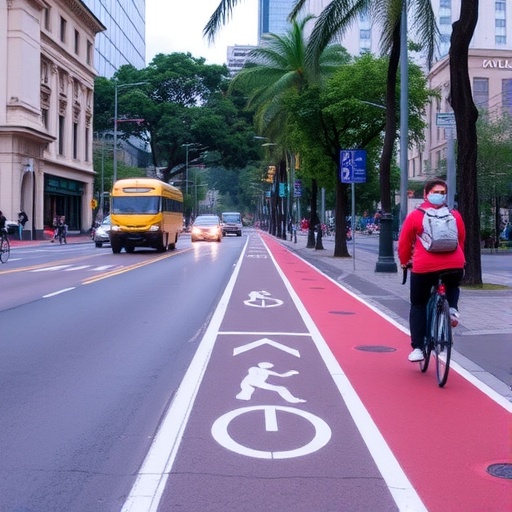
In a groundbreaking decade-long study analyzing São Paulo’s urban landscape, researchers have revealed how the expansion of bike lanes and public parks profoundly influences physical activity and public health. Between 2014 and 2024, the city’s bike lane network surged from 242 to 743 kilometers, complemented by the addition of 15 municipal parks. This urban transformation was linked to increased transport-related cycling, emphasizing the critical role of accessible infrastructure within a 500-meter radius of residents’ homes.
The study’s multidisciplinary approach combined longitudinal surveys of 1,500 residents with geospatial datasets from the Geosampa platform, enabling precise correlation between environmental changes and behavior. Findings indicate that proximity to bike lanes significantly counteracts declining bicycle use trends, suggesting these facilities serve as protective factors promoting sustained physical activity. Such activity reduction directly translates to lower risks of cardiovascular disease, cancer, and improved mental health outcomes like reduced anxiety and depression.
Importantly, the research underscores active transportation infrastructure not only as a logistical planning tool but as a vital public health strategy. By reducing reliance on automobiles, these interventions diminish air pollution and traffic-related accidents, thereby contributing to climate change mitigation efforts. However, the study highlights uneven developments: wealthier neighborhoods received disproportionate infrastructure investments, calling for policy shifts to equip underserved zones with similar amenities.
Beyond infrastructural improvements, the researchers emphasize that sociocultural elements and affordability constraints also limit cycling uptake. Despite increased bike lanes, economic barriers such as the high cost of bicycles and gender disparities in cycling participation suggest that integrated approaches—encompassing recreational street design, bike-sharing expansions, and commuter support facilities—are necessary for meaningful behavioral shifts.
An illustrative testimony comes from a local photographer who transitioned from motorbike to bicycle commuting due to new bike bridges providing direct, safer routes. While embracing cycling’s growth, he voices concerns about road space allocation favoring cars and the emerging challenges of cyclists’ vulnerability amid the rise of faster electric bikes. Additionally, issues of public safety and bike theft remain barriers to broader adoption.
Overall, the findings reveal that São Paulo’s urban planning efforts over the past decade represent a promising model of how thoughtfully designed public open spaces can foster healthier, more sustainable cities. Still, ensuring equitable access and addressing multifaceted cultural and socioeconomic factors remain essential for realizing the full potential of active transport systems.
Keywords
Urban planning, Transportation, Public health, Cycling, Active transportation, São Paulo, Infrastructure, Mental health
Cite Scienmag News
Denise Maddox. (July 9, 2026). São Paulo’s Bike Lane Expansion Boosts Cycling Among Residents. Scienmag. https://scienmag.com/sao-paulos-bike-lane-expansion-boosts-cycling-among-residents/
Denise Maddox. "São Paulo’s Bike Lane Expansion Boosts Cycling Among Residents." Scienmag, 9 July 2026, https://scienmag.com/sao-paulos-bike-lane-expansion-boosts-cycling-among-residents/. Accessed 4 September 2026.
Denise Maddox. "São Paulo’s Bike Lane Expansion Boosts Cycling Among Residents." Scienmag. July 9, 2026. https://scienmag.com/sao-paulos-bike-lane-expansion-boosts-cycling-among-residents/


