Most of the published systematic reviews on salmon farming are methodologically weak, according to an overview of reviews published in Environmental Evidence. Researchers screened 327 unique records and included 37 reviews of salmon aquaculture, then graded each one with the CEESAT critical appraisal tool. Not a single review met the threshold for high methodological rigour. Only four reviews, about 11 percent, were rated moderate quality. Nine reviews, 24 percent, were judged exceptionally low, and the remaining 23 reviews, 62 percent, were judged low rigour. The authors conclude that decision-makers should interpret existing evidence syntheses on salmon aquaculture with caution, because apparent consensus in the literature may reflect methodological artefacts rather than robust underlying evidence.
The overview was carried out by Neal Haddaway, María D. López Rodríguez, Hazel Cooley, Matthew Grainger and colleagues, and followed guidelines from the Collaboration for Environmental Evidence and the ROSES reporting standards. The team deliberately used a broad definition of a systematic review, including any review that called itself systematic or reported at least one explicit methodological component such as structured searching, screening, data extraction, critical appraisal or quantitative synthesis. The authors argue this inclusiveness is a feature rather than a flaw: it let them evaluate how the term systematic review is actually used in the salmon farming literature, and how far that usage corresponds to recognised principles of rigorous evidence synthesis. Any mismatch between claims of systematicity and observed practice is itself a key finding of the work.
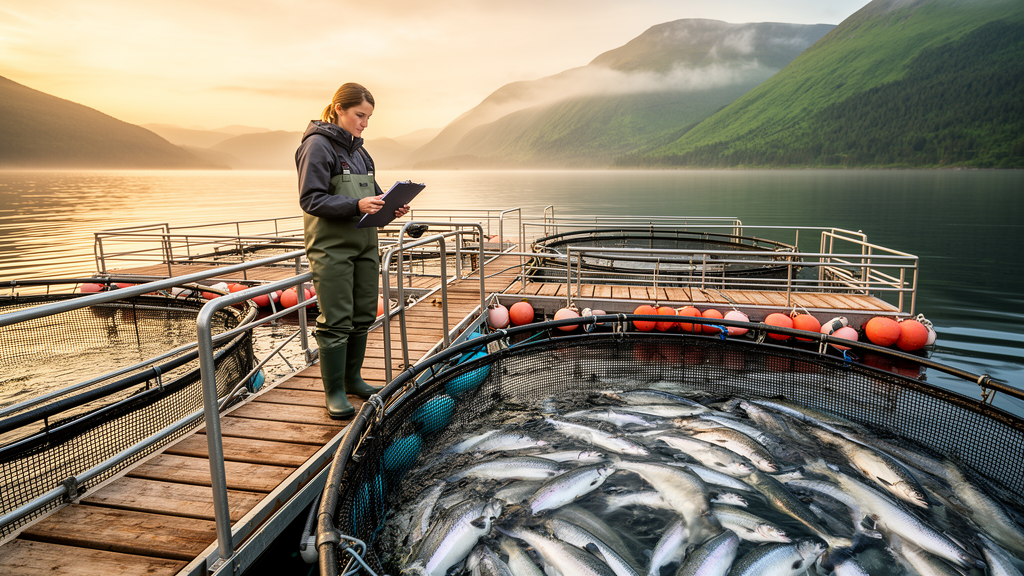
Salmon aquaculture has expanded rapidly since the 1980s, driven by technological advances, shifting market dynamics and rising global demand for fish protein. Atlantic salmon dominate global production, with Norway, Chile, Canada and Scotland leading output, and salmon farming now occurs on every continent except Africa. Norway’s salmon exports were valued at 17.7 billion USD in 2022, and Chile, despite lacking native salmon populations, exceeded one million tonnes of production in 2020. The industry’s growth has brought economic benefits but also amplified concerns, including disease transmission to wild populations, genetic introgression from escaped farmed fish, nutrient pollution, antibiotic overuse and conflicts with Indigenous and artisanal fishing communities. Feed supply chains carry global consequences too, from the depletion of West African fisheries for fishmeal and fish oil to deforestation linked with soy production for feed.
Against that backdrop, the reviewers searched Scopus, Web of Science and Lens.org in February 2025, using a structured search string validated against a benchmark list of six reviews of known relevance, all of which the search returned. Database searches yielded 653 results and 327 unique records. After title and abstract screening, 180 records remained, and full text screening left 34 records. Citation chasing on 37 reviews with DOIs added 3,948 unique records, from which one further relevant review was retained, bringing the final database to 35 articles and 37 reviews. Inclusion required that salmon be a core focus, covering Atlantic salmon, which forms 90 percent of farmed salmon worldwide, plus Pacific species including steelhead and rainbow trout, coho, chinook, pink, sockeye, masu and chum salmon.
The thematic picture was heavily skewed. Most reviews focused on production-related topics such as fish health, sea lice and feed supply, with pathology and sea lice attracting the greatest research attention. Very few addressed environmental or social impacts. The most common production stage was sea-cage grow-out, the focus of 15 reviews or 41 percent, followed by feed supply chains with seven reviews, largely life-cycle analyses. Salmon supply chains and consumption each drew four reviews, while 15 reviews did not mention a production stage or were relevant across stages. Atlantic salmon appeared in 23 reviews and rainbow trout in nine, with other salmon species each mentioned fewer than four times. Fifteen reviews included 50 or fewer primary studies, one scoping review included 1,760 studies, and nine reviews failed to report how many studies they included.
Funding patterns added a further caution. Government funding bodies were the most common funder, supporting 13 reviews, followed by industry research bodies with eight, while funding was not reported for six reviews. Industry co-authorship was present in seven reviews, with nine industry partners listed as co-authors across these articles, including companies such as AquaGen AS, Bakkafrost Scotland, BioMar Group, Cermaq Finnmark AS, Mowi Scotland and Scottish Sea Farms Ltd. In background analysis, 7.4 percent of funding statements in a Lens.org search explicitly referenced industry funding, though 90 percent lacked indexed funding disclosures. The authors note that industry funding poses a risk of bias, shaping research agendas and outcomes in ways that may favour commercial interests.
The CEESAT appraisal exposed weaknesses at nearly every step of the review process. Only one review referred to a protocol, and 86 percent failed to use a protocol document or provide enough methodological detail for replicability. Just nine reviews described searches in a replicable way, seven gave no search details at all, and only six searched an appropriate number of resources, meaning more than two bibliographic databases plus grey literature. Consistency checking or dual screening was rare, with 81 percent of reviews giving no details of cross-reviewer verification, and 73 percent gave no details of the number of screened or included studies. Among narrative and quantitative reviews, 82 percent failed to assess any aspect of risk of bias or study validity. Some 43 percent failed to describe data extraction methods, 49 percent reported no extracted data, and 12 reviews relied on vote counting or other inappropriate quantitative synthesis practices. Fewer than 10 percent explicitly referenced any limitations of the review or the evidence base.
Because most reviews were judged unreliable, the authors synthesised findings only from the four moderately rigorous reviews. Cantillo and Deshpande reviewed 91 primary studies from 2015 to 2024 on alternative protein sources for Atlantic salmon feed, finding that carbon footprints for insect and single-cell proteins ranged from 0.1 to 132 kg CO2 per kg of protein, largely because of inconsistent assumptions, system boundaries and life-cycle assessment methodologies, though energy and substrate production were consistently cited as hotspots. Philis and colleagues compared methodological choices across 24 salmonid life-cycle assessment studies and found the inconsistencies prevented definitive comparisons of production systems; open-net pens showed lower energy demands but higher eutrophication potential, while recirculating aquaculture systems had higher carbon footprints. Morris and colleagues documented escaped farmed salmon in 87 percent of rivers in eastern North America surveyed near aquaculture sites between 1984 and 2006, but found no standardised monitoring and insufficient genetic or population-level impact assessments. Cerbule reviewed the three most widely used salmon lice treatments, chemical treatments, cleaner fish and warm water treatment, and found most data focused on increasingly ineffective chemical treatments, while cleaner fish lack long-term, regionally generalisable studies and warm water treatments are underrepresented, with little known about their welfare implications or environmental trade-offs.
The authors are careful about the limits of their own work. They searched only English-language databases and academic publications, restricted grey literature to theses and dissertations, and did not include reviews on topics relevant to but not explicitly referencing salmon aquaculture, such as reviews of sea lice treatment effectiveness. They believe the risk of missing relevant reviews is very low, but acknowledge that evidence syntheses may exist in non-English resources and that further work should identify and appraise these. They also draw on selected grey literature and journalistic sources to contextualise gaps, treating them as contextual rather than synthesised evidence.
The implications are pointed. The current evidence base is heavily skewed towards production outcomes, with limited synthesis of environmental and socio-economic impacts, and the authors stress that absence of synthesised evidence should not be interpreted as evidence of absence. Reliance on individual reviews lacking transparent methods or critical appraisal may lead to misleading conclusions, and precautionary, transparent approaches to decision-making are warranted under such uncertainty. For researchers, the prescription is concrete: future reviews should use a priori protocols, comprehensive and reproducible search strategies, transparent screening and data extraction, and formal critical appraisal of included studies, alongside greater independence and transparency in research funding and authorship, so that future syntheses provide a reliable foundation for decisions about one of the world’s fastest-growing food industries.
Subject of Research: Methodological quality of systematic reviews on Atlantic and Pacific salmon aquaculture
Article Title: What evidence exists on salmon farming? An overview of reviews
Article References: Haddaway, N., López Rodríguez, M. D., Cooley, H., & Grainger, M. (2026). What evidence exists on salmon farming? An overview of reviews. Environmental Evidence, 15(1), Article 12. https://doi.org/10.1186/s13750-026-00391-y
Image Credits: AI Generated
DOI: 10.1186/s13750-026-00391-y
Keywords: salmon farming, aquaculture, systematic reviews, evidence synthesis, methodological quality, sea lice, environmental impacts, industry funding, CEESAT, Atlantic salmon, research bias, sustainability
Cite Scienmag News
Violet Maxwell. (October 28, 2026). Salmon farming reviews mostly flawed, overview finds. Scienmag. https://scienmag.com/salmon-farming-reviews-mostly-flawed-overview-finds/
Violet Maxwell. "Salmon farming reviews mostly flawed, overview finds." Scienmag, 28 October 2026, https://scienmag.com/salmon-farming-reviews-mostly-flawed-overview-finds/. Accessed 28 October 2026.
Violet Maxwell. "Salmon farming reviews mostly flawed, overview finds." Scienmag. October 28, 2026. https://scienmag.com/salmon-farming-reviews-mostly-flawed-overview-finds/