

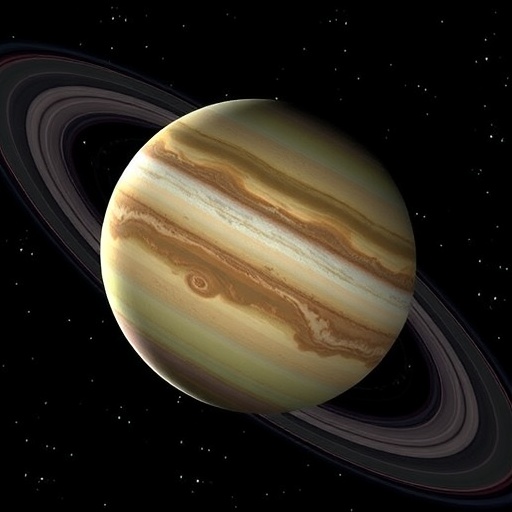
For decades, the astronomical community has faced a persistent challenge in distinguishing between giant planets and brown dwarfs. These two celestial objects, both larger than Earth yet distinct in their nature, occupy a notoriously ambiguous space in cosmic classification. Brown dwarfs, often dubbed “failed stars,” possess masses insufficient to sustain nuclear fusion in their cores, setting them apart from true stars. Giant planets, meanwhile, are massive planets orbiting distant stars. Observationally, they overlap in brightness, temperature ranges, and atmospheric signatures, making traditional methods of differentiation cumbersome and often inconclusive.
Recent advancements have brought new clarity to this cosmic conundrum. A pioneering Northwestern University-led study has revealed a fundamental property that decisively separates giant planets from brown dwarfs: their rotational velocities. This groundbreaking research presents compelling evidence that giant exoplanets spin at substantially faster rates than their brown dwarf counterparts. The implications of this discovery extend beyond mere classification—it sheds light on the divergent formation pathways and evolutionary histories that sculpt these intriguing astronomical objects.
The research, soon to be published in The Astronomical Journal, represents the most extensive spectroscopic survey of rotational speeds in directly imaged extrasolar planets and brown dwarfs to date. The team meticulously analyzed the rotational dynamics of six giant exoplanets alongside 25 brown dwarfs, exploiting the unparalleled capabilities of the W.M. Keck Observatory in Hawaiʻi. This institutional partnership enabled high-resolution spectroscopy using the Keck Planet Imager and Characterizer (KPIC), an instrument finely tuned to detect the faint spectral features indicative of spin.
Skin-deep similarities in brightness and atmospheric composition had long made it nearly impossible to definitively categorize objects as either giant planets or brown dwarfs. Yet, the rotational rate—intimately connected to an object’s angular momentum and formation environment—emerged as a robust distinguishing characteristic. By assessing how fast these stellar companions rotate, the team unlocked a diagnostic parameter that holds promise for revolutionizing planetary classification frameworks. The faster spin of giant planets suggests retention of angular momentum during their formation in circumstellar disks, whereas brown dwarfs exhibit spin rates curtailed by magnetic interactions and other braking mechanisms.
Observationally, the rotation speeds were derived by measuring the Doppler broadening of spectral lines emanating from the atmospheres of these distant bodies. As an object spins, its spectrum exhibits subtle line broadening; features on the side rotating toward Earth are blueshifted while those on the opposite side are redshifted. By capturing these minute shifts with KPIC’s precision, the researchers could infer rotation velocities, offering a window into the formation conditions and internal processes of these objects.
Combining new data with antecedent measurements allowed the researchers to construct a curated dataset encompassing a broad population of giant planets, brown dwarfs, and related substellar objects. Analysis of this diverse sample revealed a striking pattern: giant exoplanets tend to rotate at a much higher fraction of their breakup velocity—the rotational speed at which centrifugal forces would destabilize the object—than brown dwarfs. The discrepancy points to fundamental differences in how these objects acquire and retain angular momentum over their lifetimes.
This divergence is hypothesized to arise from contrasting formation mechanisms. Giant planets predominantly form within protoplanetary disks composed of gas and dust surrounding newborn stars. These disks influence the accretion process and angular momentum transfer, allowing planets to maintain rapid rotational velocities. Brown dwarfs, conversely, form through more star-like processes, including the gravitational collapse of gas clouds unbound to protoplanetary disks. Their strong magnetic fields interact with the circumstellar environment to remove angular momentum, akin to a cosmic braking mechanism, resulting in notably slower spins.
A compelling case study within the research compared a giant planet in the HR 8799 system, spinning impressively fast at about seven times Jupiter’s mass, with a neighboring brown dwarf roughly three times more massive yet rotating six times slower. This stark contrast underscores how mass alone does not dictate rotational speed; magnetic braking and formation context play equally pivotal roles. Additionally, the study found that brown dwarfs gravitationally bound to stars spin more slowly than isolated brown dwarfs adrift in interstellar space, suggesting environmental factors further modulate their rotational evolution.
The implications extend beyond classification. Spin rates encode a fossil record of formation conditions and angular momentum history, offering clues into the physical processes operating in early stellar and planetary systems. By integrating rotational data with atmospheric characterization and mass measurements, scientists can better infer formation timelines, migration histories, and composite structures of these objects.
Looking forward, the research team plans to enhance their survey by including free-floating planetary-mass objects—“rogue planets” drifting independently of host stars—and expanding chemical composition analyses of planetary atmospheres. Advancements in telescope technology and instrumentation promise even finer rotational measurements, enabling a holistic understanding that unites rotation, chemistry, and formation within a comprehensive planetary system framework.
This pioneering study not only provides a new approach to resolving the long-standing identity crisis between giant planets and brown dwarfs but also opens a window into the physical mechanisms governing their birth and evolution. As spin measurements mature into a standard astrophysical tool, our grasp of the diverse menagerie populating the cosmos will deepen, reshaping theories of planetary system formation and stellar evolution alike.
Subject of Research: Observational and spectroscopic analysis of rotational velocities distinguishing giant exoplanets from brown dwarfs.
Article Title: Distinct Rotational Evolution of Giant Planets and Brown Dwarf Companions
News Publication Date: March 18, 2026
Web References: http://dx.doi.org/10.3847/1538-3881/ae434b
References: Hsu, C.-C. D., Wang, J., et al. (2026). “Distinct Rotational Evolution of Giant Planets and Brown Dwarf Companions.” The Astronomical Journal. DOI: 10.3847/1538-3881/ae434b
Image Credits: Not provided.
Keywords
Exoplanets, Brown Dwarfs, Rotational Velocity, Angular Momentum, Spectroscopy, Keck Observatory, KPIC, Protoplanetary Disks, Planet Formation, Substellar Objects, Doppler Broadening, Astrophysics


