


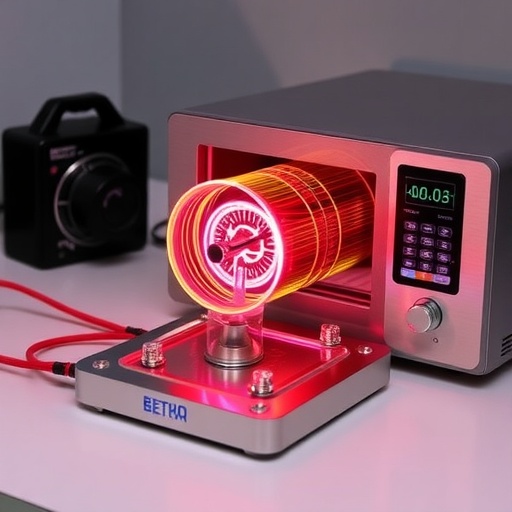
Microwave technology is entering a new phase in which quantum behavior may no longer be confined to dilution refrigerators and laboratory-scale cryogenic systems. In a study published in Nature Electronics, researchers report a hybrid device that generates strongly correlated microwave signals at room temperature. The platform combines a printed-circuit-board microstrip resonator with a thin film of yttrium iron garnet, or YIG, a magnetic material widely used in microwave and spin-wave research. By coupling electromagnetic cavity modes to collective magnetic excitations, the team created pairs of hybrid quasiparticles known as magnon polaritons. The result is a compact cavity–magnonic source designed to produce correlated microwave signals without the millikelvin temperatures normally associated with quantum microwave hardware.
Correlated microwave photons are important because they can carry linked information across separate channels. In quantum-limited sensing, correlations can improve the detection of extremely weak signals. In communication systems, they may help distinguish meaningful information from noise, while in signal amplification they can support performance approaching fundamental quantum limits. Yet many existing sources of correlated microwave radiation depend on superconducting circuits that must be cooled to temperatures only a fraction of a degree above absolute zero. Such refrigeration is expensive, physically demanding and difficult to deploy outside specialized facilities. A room-temperature source would therefore address one of the central obstacles preventing broader use of quantum-inspired microwave technologies.
The new system uses a microwave cavity fabricated in the form of a printed-circuit-board microstrip resonator. Unlike bulky three-dimensional cavities, a microstrip structure can be produced using manufacturing methods familiar from conventional electronics. The resonator confines microwave electromagnetic fields and provides the environment in which they interact with the YIG film. Within the magnetic material, the relevant excitations are magnons: collective disturbances in the alignment of many spins. When the frequency of a magnon mode approaches that of a cavity photon mode, the two can exchange energy efficiently. Their interaction produces magnon polaritons, hybrid states that inherit properties from both magnetic excitations and microwave photons.
A key feature of the reported device is that it couples the magnon system to two cavity photon modes at the same time. This enables non-degenerate excitation, meaning that the two resulting partners occupy distinct frequencies rather than sharing an identical one. Frequency separation is valuable for practical systems because it allows the two correlated outputs to be routed, filtered and detected through different microwave channels. Instead of generating a single type of excitation, the platform creates a pair of magnon polaritons whose frequencies are different but whose fluctuations remain strongly connected. Those correlations provide the physical resource needed for applications in sensing, communications and advanced microwave signal processing.
The researchers describe the process as the splitting of one input microwave photon into a pair of magnon polaritons. In the linear interaction regime, the cavity and magnetic modes exchange energy in a controlled way, allowing the input field to be transformed into hybrid excitations. In the nonlinear regime, the response becomes more complex: the magnetic system can mediate interactions between modes, changing how energy and fluctuations are distributed across the output frequencies. The resulting pair is not simply two independent microwave signals. Measurements show that the output modes maintain strong intermode correlations, indicating that their behavior is linked even though they are separated spectrally.
That distinction could be decisive for real-world microwave systems. Classical signals can also display correlations, but the behavior of a hybrid magnon–photon platform is governed by the interaction between a resonant electromagnetic field and collective spin dynamics. The device therefore offers a route to studying and exploiting correlated excitations in a format that is closer to standard microwave engineering than many cryogenic quantum platforms. Its printed-circuit-board architecture also suggests potential compatibility with integrated components, although further work would be required to determine how readily the system can be scaled, packaged and combined with commercial electronics.
The study also examines the nonlinear dynamics of the magnon polaritons. According to the researchers, these dynamics exhibit true randomness, a property that can be useful when unpredictable behavior is required. Randomness is essential in areas ranging from secure communications to probabilistic computing and the generation of physical random numbers. Because the device produces multiple correlated channels, the same platform can also support multichannel correlations rather than a single pair of linked outputs. The researchers report that these correlations remain robust across the system’s operating conditions, suggesting that the nonlinear response is not merely a transient laboratory effect but a potentially useful operating regime.
To demonstrate an application, the team used the platform for microwave communication through two noisy channels. In this setup, information was transmitted while the signals were exposed to channel noise, a central challenge for any practical communication system. The correlated outputs allowed the researchers to work with linked microwave channels and achieve reliable signal transmission. The demonstration does not represent a complete replacement for existing communication infrastructure, but it shows how a room-temperature correlated source might be used to coordinate signals or recover information when each individual channel is affected by disturbances.
The significance of the work lies in bringing cavity–magnonic functionality into a more accessible thermal environment. Room-temperature operation removes the immediate need for millikelvin refrigeration, while the printed-circuit-board resonator points toward a less specialized hardware platform. The device still relies on carefully engineered resonances, magnetic materials and precise control of mode interactions, so substantial challenges remain before such sources become standard components. Even so, the reported combination of non-degenerate magnon polaritons, nonlinear dynamics, strong intermode correlations and noisy-channel communication marks an important step toward practical correlated microwave technologies. It suggests that quantum-inspired sensing, amplification and communication may eventually move beyond the cryogenic laboratory and into compact systems operating on ordinary electronic platforms.
Cite Scienmag News
Denise Maddox. (August 19, 2026). Room-Temperature Cavity-Magnonic Source Generates Correlated Microwave Magnon-Polariton Pairs. Scienmag. https://scienmag.com/room-temperature-cavity-magnonic-source-generates-correlated-microwave-magnon-polariton-pairs/
Denise Maddox. "Room-Temperature Cavity-Magnonic Source Generates Correlated Microwave Magnon-Polariton Pairs." Scienmag, 19 August 2026, https://scienmag.com/room-temperature-cavity-magnonic-source-generates-correlated-microwave-magnon-polariton-pairs/. Accessed 4 September 2026.
Denise Maddox. "Room-Temperature Cavity-Magnonic Source Generates Correlated Microwave Magnon-Polariton Pairs." Scienmag. August 19, 2026. https://scienmag.com/room-temperature-cavity-magnonic-source-generates-correlated-microwave-magnon-polariton-pairs/


