


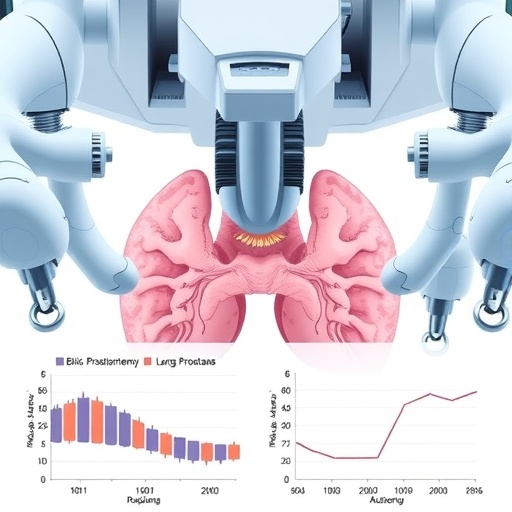
In a significant development within urological oncology, a recent retrospective study has illuminated the practicality and efficacy of robotic radical prostatectomy for patients suffering from prostate cancer with large-volume prostates exceeding 100 milliliters. This investigation delves deeply into the surgical outcomes and clinical feasibility of employing robotic assistance in cases traditionally considered challenging due to gland size and tumor burden.
Prostate cancer remains one of the most prevalent malignancies affecting men worldwide, with tumor size and prostate volume often complicating surgical intervention. Larger prostates have historically posed increased technical challenges during prostatectomy, potentially leading to higher complication rates and suboptimal oncological control. The study in question systematically reviews 50 cases performed over a three-year period, providing pivotal data on surgical performance and postoperative outcomes in this high-risk subgroup.
The patient cohort analyzed ranged widely in age, from 55 to 77 years, with an average of 66.5 years, indicating the inclusion of typical prostate cancer demographics. Preoperative prostate-specific antigen (PSA) readings spanned from modest to markedly elevated levels, underscoring the variable tumor biology encountered in clinical practice. Additionally, Gleason scores, a critical prognostic indicator, were predominantly high-grade, reflecting the aggressive nature of the cancers managed in this series.
The research team meticulously collated preoperative assessments including laboratory evaluations, multiparametric pelvic magnetic resonance imaging (MRI), and comprehensive whole-body bone scans. These diagnostic modalities ensured accurate staging and suitability for the robotic approach, minimizing patient risk and targeting those without surgical contraindications.
A hallmark of this study is the consistent completion of all surgeries via the robotic route without necessitating conversion to open procedures or encountering major vascular injuries. The mean operative time of approximately 105 minutes emphasizes the procedure’s efficiency, while estimated blood loss averaging 110 milliliters and the absence of transfusions highlight its safety profile within the context of substantial prostate size.
Postoperative recovery parameters were equally encouraging. Patients experienced catheter removal around four days post-surgery, and hospital stays averaged less than five days, indicating a relatively swift convalescence. The return of bowel function, marked by the time to first flatus, occurred within 1 to 3 days, suggesting minimal gastrointestinal disruption associated with the procedure.
Complications, although rare, were documented to provide a comprehensive safety overview. Two cases presented with postoperative lymphatic leakage, a recognized but manageable risk in pelvic surgeries. Importantly, positive surgical margins, which could signify residual tumor and portend recurrence, were minimal, observed in only three cases within the cohort.
Oncological staging post-surgery demonstrated a varied distribution, predominantly within the T2a to T3b categories, reflecting the nuanced spectrum of disease progression encountered in large-volume prostatic cancers. Furthermore, the identification of positive lymph nodes in two patients underscores the merit of thorough preoperative staging and the adaptability of robotic surgery in addressing nodal involvement.
A median follow-up duration exceeding a year enabled the researchers to ascertain early biochemical recurrence rates, with only 7.9 percent of patients exhibiting prostate-specific antigen resurgence at one year. Such findings align with the growing consensus that robotic-assisted prostatectomy offers durable cancer control even in technically demanding clinical contexts.
Patient quality of life postoperatively, particularly regarding urinary continence, revealed remarkable outcomes. Over 90 percent reported satisfaction with their continence status at one year, a critical measure of surgical success given the potential for significant morbidity in prostate surgeries.
The study’s conclusions advocate for the integration of robotic radical prostatectomy as a primary surgical strategy in managing large prostate glands affected by cancer. The procedure’s feasibility, coupled with its safety and oncological efficacy, offers hope for broadened patient eligibility and improved long-term outcomes.
Technical mastery and sufficient institutional case volume were highlighted as essential components to optimize results. The intricate nature of large gland dissections necessitates surgeon expertise, reinforcing the value of specialized training and experience when embarking upon robotic prostate surgeries in this patient demographic.
This comprehensive retrospective analysis adds to a growing body of evidence positioning robotic-assisted techniques at the forefront of minimally invasive urologic oncology. As technology and surgical proficiency advance, the boundaries of prostate cancer operability continue to expand, offering patients less invasive yet highly effective treatment options.
Future prospective studies with longer follow-up intervals are warranted to corroborate these findings and explore functional outcomes further, including sexual function and broader quality-of-life metrics. Nevertheless, current data solidly support robotic prostatectomy as a transformative approach for tackling challenging large-volume prostatic cancers.
The combination of minimal intraoperative blood loss, reduced hospital stays, rapid recovery milestones, and high rates of oncological control underscore an evolving paradigm shift in prostate cancer surgery. Robotic platforms provide enhanced dexterity, superior visualization, and precision, crucial in navigating the complexities posed by bulky prostate anatomy.
Ultimately, this investigation paves the way for more widespread adoption of robotic surgery in high-volume, advanced prostate cancer cases. Continued innovation in surgical robotics, refined patient selection criteria, and rigorous outcome tracking will further illuminate the potential of this modality to improve survival and quality of life among affected men globally.
Cite Scienmag News
Nathaniel Bowman. (April 15, 2025). Robotic Prostatectomy for Large Prostates Analyzed. Scienmag. https://scienmag.com/robotic-prostatectomy-for-large-prostates-analyzed/
Nathaniel Bowman. "Robotic Prostatectomy for Large Prostates Analyzed." Scienmag, 15 April 2025, https://scienmag.com/robotic-prostatectomy-for-large-prostates-analyzed/. Accessed 5 September 2026.
Nathaniel Bowman. "Robotic Prostatectomy for Large Prostates Analyzed." Scienmag. April 15, 2025. https://scienmag.com/robotic-prostatectomy-for-large-prostates-analyzed/


