


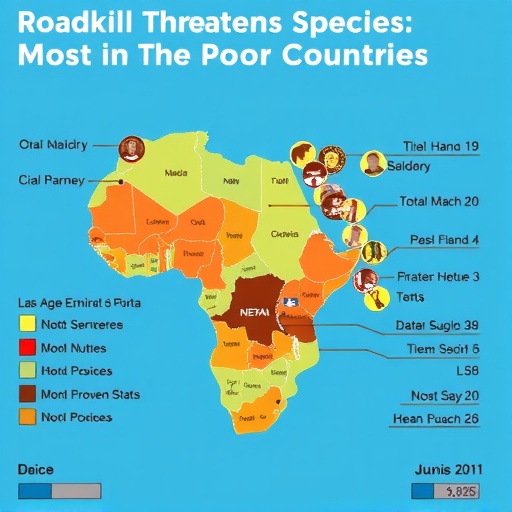
In an increasingly interconnected world, expanding road networks have become a critical component of development and economic growth. However, a recent study published in Nature Communications reveals a compelling and concerning pattern: the global burden of roadkill disproportionately impacts threatened species, with a pronounced concentration of collision risks in low- and middle-income countries. This groundbreaking research highlights how infrastructural progress, while beneficial to human mobility, poses dire threats to biodiversity across economically varied landscapes. The study meticulously quantifies and maps global roadkill data to expose deep inequalities underlying wildlife-vehicle collision hotspots.
Roadkill – wildlife struck and killed by vehicles on roads – represents a significant and often overlooked driver of animal mortality. It not only directly removes individuals from vulnerable populations but also acts as a persistent hazard that can exacerbate species decline, especially for those already threatened with extinction. Traditionally, roadkill research has focused on local or national scales, typically within high-income countries, leaving major gaps in global understanding. This new investigation addresses that void by employing an unparalleled aggregation of global roadkill records combined with socioeconomic data to delineate the spatial footprints of collision risk worldwide.
The study elucidates that roadkill incidents are not distributed uniformly across the planet. Instead, it identifies a stark inequality in the burden borne by wildlife species in different economic contexts. Low- and middle-income countries, especially those rich in endemic and threatened biodiversity, experience disproportionately high roadkill rates. This intersection between socioeconomic status and ecological vulnerability suggests critical environmental justice issues at a planetary scale. Species inhabiting these regions often confront compounding survival challenges: habitat loss, hunting, climate change, alongside the pervasive threat of road mortality.
Researchers utilized advanced geographic information system (GIS) techniques to overlay road density, species conservation status, and traffic data across continents. By integrating data on species threat levels from the International Union for Conservation of Nature (IUCN) Red List with road network expansion mapping, they could identify collision risk zones with finer resolution. The study’s methodology leveraged novel machine learning algorithms to predict roadkill hotspots based on environmental factors, traffic volume, and species activity patterns, making this the most comprehensive global synthesis to date.
One of the pivotal findings of the study is the heightened vulnerability of threatened species in resource-limited settings. These countries tend to lack robust road planning frameworks incorporating wildlife conservation considerations, which are more prevalent in wealthier nations. Consequently, rapid urbanization and infrastructure growth in these regions often proceed without adequate mitigation measures such as wildlife crossings, fencing, or driver awareness programs, which have proven effective elsewhere. The absence of such interventions contributes to disproportionately high mortality rates in species already teetering on the brink of extinction.
The implications of these findings extend beyond biodiversity loss; they highlight a broader socio-ecological mismatch. While roads fuel economic activity and accessibility, their ecological costs are frequently externalized and concentrated on vulnerable populations and ecosystems. This global inequality underscores the necessity for international collaboration and policy frameworks that prioritize biodiversity-friendly infrastructure. Integrating ecological expertise into transportation planning represents not only environmental stewardship but a commitment to sustainable development goals emphasizing equity and conservation.
Furthermore, the researchers underscore the urgency for systematically collected, standardized roadkill data to inform mitigation strategies. Many low- and middle-income countries currently lack comprehensive monitoring programs, impeding effective policy responses. The study advocates leveraging citizen science, mobile technology, and automated monitoring solutions, including camera traps and sensors, to bolster data acquisition. Enhanced data streams will enable adaptive management, better prioritization of mitigation measures, and evaluation of their effectiveness over time.
The study also sparks reflection on the intricate interplay between infrastructure and ecological connectivity. Roads fragment habitats, disrupting animal movement and gene flow, which compound roadkill impacts by isolating populations. The research calls for landscape-level conservation approaches that integrate road design with ecological corridors, preserving species’ natural behaviors while minimizing collision risk. Such integrative planning is essential to reduce extinction pressure and maintain ecosystem resilience, especially amid accelerating environmental changes.
Importantly, the study challenges conventional paradigms that view roadkill primarily as a local traffic safety or nuisance issue. Instead, it frames roadkill as a critical conservation concern with far-reaching implications for global biodiversity. By revealing socio-economic disparities in collision risk, the research prompts reconsideration of responsibilities and resource allocation for wildlife conservation, emphasizing equity in environmental protection across nations.
The study’s timeline suggests that without concerted global efforts, roadkill mortality could escalate dramatically, paralleling increased road infrastructure expansion forecasted in developing regions. This trajectory threatens to accelerate biodiversity losses at a time when global species extinction rates are alarmingly high. Therefore, the study stresses preemptive implementation of mitigation strategies like wildlife overpasses, strategically placed underpasses, and effective fencing, aligned with local ecological and socioeconomic contexts.
In addressing how to bridge these inequities, the study encourages international funding mechanisms and knowledge transfer to empower affected countries. Capacity building in wildlife monitoring, integration of conservation priorities in road development policies, and community engagement models are highlighted as vital components. Achieving these goals demands synergistic partnerships spanning governments, NGOs, academia, and the private sector focused on harmonizing economic development with biodiversity conservation.
The broader significance of this research lies in its holistic approach to understanding and responding to anthropogenic impacts on wildlife. By mapping collision risk through a socioecological lens, the study pioneers a framework for tackling one of the most insidious forms of human-wildlife conflict. Its findings resonate deeply in a world pursuing the United Nations’ Sustainable Development Goals, particularly those pertaining to life on land, sustainable cities, and responsible consumption and production.
Ultimately, this landmark study serves as a clarion call to rethink infrastructure planning in a way that embraces biodiversity as a non-negotiable element of inclusive and sustainable progress. Protecting threatened species from road mortality requires a paradigm shift where environmental concerns are integrated early and systematically in national and regional development agendas. The global community stands at a critical juncture—prioritizing ecological equity in road infrastructure could mark a decisive step toward a more sustainable future.
The synthesis of ecological data and socioeconomic factors presented by Li, Zhao, Chen, and colleagues opens promising pathways for future research and policy innovation. It challenges scientists, planners, and policymakers alike to consider the full scope of road impacts on biodiversity, especially in the world’s most vulnerable regions. Through targeted collaboration and technology-enabled monitoring, the deadly toll of roadkill on threatened species may yet be reversed, ensuring that the march of human progress does not trample the diversity of life upon which it ultimately depends.
As this study makes clear, addressing global inequalities in roadkill burden is not merely an environmental imperative but a profound ethical challenge. The preservation of threatened species in low- and middle-income countries demands both recognition and action on an international scale. Only through concerted effort can the collision risks be alleviated and a more just and biodiverse planet safeguarded for generations to come.
Cite Scienmag News
Margaret Porter. (July 1, 2026). Roadkill Threatens Species Most in Poor Countries. Scienmag. https://scienmag.com/roadkill-threatens-species-most-in-poor-countries/
Margaret Porter. "Roadkill Threatens Species Most in Poor Countries." Scienmag, 1 July 2026, https://scienmag.com/roadkill-threatens-species-most-in-poor-countries/. Accessed 4 September 2026.
Margaret Porter. "Roadkill Threatens Species Most in Poor Countries." Scienmag. July 1, 2026. https://scienmag.com/roadkill-threatens-species-most-in-poor-countries/


