

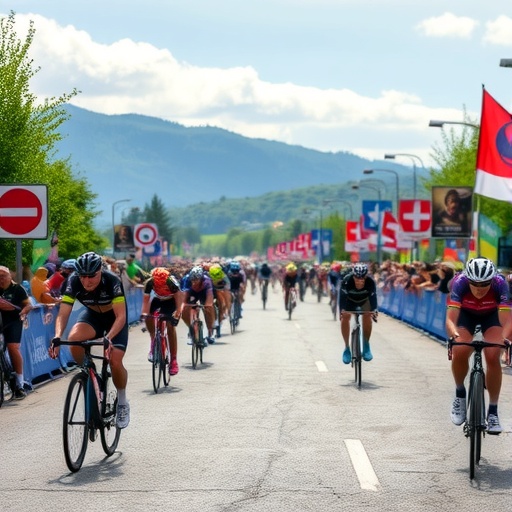
The relentless ascent of global temperatures is casting an increasingly long shadow over Europe’s summer sporting events, with the iconic Tour de France standing as a striking testament to this emerging challenge. A recent study published in Scientific Reports undertakes a comprehensive analysis of climate data spanning more than 50 editions of this historic race, highlighting the profound implications of rising heat stress risks on athlete safety and event planning. Spearheaded by the French National Research Institute for Sustainable Development (IRD), this investigation draws upon the collaborative expertise of institutions such as the London School of Hygiene & Tropical Medicine (LSHTM) and the Barcelona Institute for Global Health (ISGlobal), underscoring the urgency of addressing environmental hazards in elite sport.
This investigative endeavor meticulously examined the conditions under which the Tour de France has operated, scrutinizing the interplay of heat stress risk levels with specific race dates and locations from 1974 to 2023. Employing the Wet Bulb Globe Temperature (WBGT) — a sophisticated heat index combining air temperature, relative humidity, solar radiation, and wind speed — the study reveals an unmistakable upward trajectory in heat stress risk at the times and places chosen for the race. Particularly alarming is the fact that the last decade has witnessed a surge in extreme heat episodes, signaling a shifting baseline that threatens to transform the competitive landscape and athlete welfare frameworks.
What emerges from the data is a narrative of proximity to peril. While thus far the Tour de France has evaded conditions classified as maximum health risk, its avoidance has often been marginal, hinging on mere days or fractions of a degree Celsius. This razor-thin margin accentuates the advocation by researchers that the race’s current scheduling and operational protocols may soon be tested by unforeseen, extreme heat scenarios. Ivana Cvijanovic, the study’s first author and IRD researcher, characterizes the Tour as “an extremely fortunate race,” noting that key urban centers such as Paris have crossed high heat-risk thresholds during the summer months frequently — five times in July for Paris alone, with four instances occurring since 2014. Yet, crucially, these extremes have not coincided with race stages themselves.
The identification of geographic heat stress “hotspots” is a key dimension of this research, revealing Southwest France—especially around Toulouse, Pau, and Bordeaux—and Southeast France, near Nîmes and Perpignan, as regions experiencing the most frequent episodes of dangerous heat. Urban hubs like Paris and Lyon are rapidly emerging as new risk frontiers where high heat stress thresholds are increasingly being eclipsed. ISGlobal’s Desislava Petrova emphasizes the necessity of heightened vigilance and adaptation in planning future race stages within these vulnerable areas. In contrast, the study highlights that traditional mountainous stage locations such as Col du Tourmalet and Alpe d’Huez have consistently remained within safer, lower to moderate heat stress categories, with no recorded extreme heat conditions. These findings suggest that altitude and terrain variability retain some moderating influence on heat effects, providing potentially strategic refuge zones in the evolving climate context.
Temporal patterns further nuance the risk profile. Morning hours persist as the comparatively safest window for competition, with heat stress intensifying and persisting well into the late afternoon. This diurnal gradient underscores a critical operational insight: scheduling modifications favoring earlier start times could materially reduce heat exposures for cyclists, support staff, and spectators alike. Effective risk mitigation will necessitate this and other dynamic adaptations, including route adjustments and the enhancement of heat management protocols.
The implications of escalating heat risk extend beyond cycling. This research serves as an instructive case study illuminating a broader crisis confronting all summer sports. Rising ambient temperatures and intensified heat waves jeopardize not only performance metrics but also the fundamental health and safety of athletes at the elite level. International governing bodies have responded by instituting heat risk assessment systems and corresponding safety measures — such as mandatory hydration breaks or cooling interventions — yet a fragmented patchwork of thresholds and protocols remains, lacking standardization or integration across sporting disciplines.
Physiological understanding of heat stress, particularly within the cohort of elite athletes, remains remarkably underdeveloped. The extreme exertion, conditioning, and acclimatization levels characteristic of professional cyclists and other high-performance competitors complicate heat vulnerability assessments. James Begg of Galson Sciences highlights the critical need for access to anonymized physiological data, which would empower researchers to transcend reliance on environmental indices alone and elucidate sport-specific heat resilience mechanisms. Such granular biological insights are imperative for evolving nuanced, evidence-based guidelines that safeguard athlete health in the era of climate upheaval.
Methodologically, the study leverages historical meteorological observations from twelve locations with a legacy of hosting Tour de France stages during July race dates. The application of WBGT values provides a multi-variable integrative measure reflecting realistic heat stress conditions. Analysis centers on instances where WBGT exceeds the Union Cycliste Internationale (UCI) high-risk threshold of 28 °C, marking potential triggers for activation of preventative safety measures during competition. This rigorous climatological approach anchors the research in objective, quantitatively robust parameters relevant for policy and operational decision-making.
The data illuminate a striking contrast between race day exposures and all July days historically observed. For example, Paris reached a highest WBGT of 26.8 °C on race dates compared to 28.8 °C on other July days, signaling the narrow margin that has protected riders thus far from the most hazardous conditions. Such proximity to dangerous heat underscores the fragility of current event scheduling and the imperative for proactive, climate-adaptive strategies that anticipate intensifying exposures in forthcoming decades.
Looking ahead, this body of work functions as an urgent call to action for the organizers of the Tour de France and similar events. The increasing frequency and intensity of heatwaves, driven by anthropogenic climate change, predict a future where extreme heat stress days will inevitably intersect with competitive schedules. Without adaptive interventions — encompassing modified timing, route redesign, enhanced cooling infrastructure, and refined risk monitoring — the health and performance of athletes will remain precariously poised on a warming world’s edge.
Ultimately, the research presented by Cvijanovic and colleagues situates the Tour de France as more than a celebration of athletic endurance and prowess. It becomes a prism through which the scientific and sporting communities must confront the existential challenge posed by a rapidly changing climate. The integration of environmental science, physiological research, and pragmatic event management will be essential to safeguarding the legacy and future of outdoor summer sports amidst an era of unprecedented thermal stresses.
Subject of Research: Not applicable
Article Title: The future of European outdoor summer sports through the lens of 50 years of the Tour de France
News Publication Date: 2026 (in press)
Web References: http://dx.doi.org/10.1038/s41598-025-30129-8
References: Cvijanovic I, Begg JD, Mistry MN, Petrova D, Brimicombe C, Sultan B. The future of European outdoor summer sports through the lens of 50 years of the Tour de France. Scientific Reports. 2026 (in press).
Keywords: Heat, Climate change, Heat waves, Sports


