


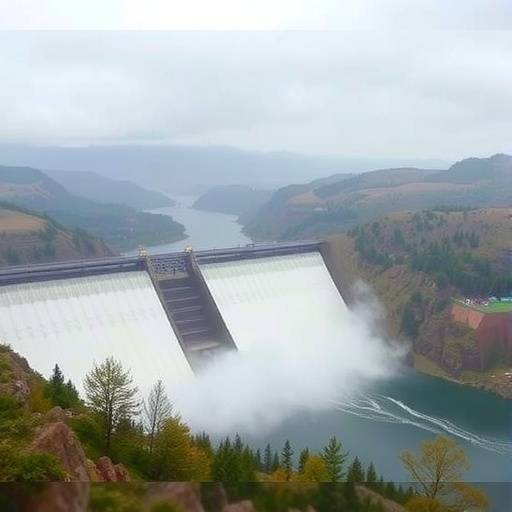
A recent groundbreaking study has unveiled alarming trends in the safety and resilience of dams across the United States, revealing that the probability of overtopping—a perilous event where water levels exceed dam heights—has undergone significant historical changes. This revelation carries profound implications for infrastructure security, community preparedness, and disaster mitigation strategies in an era marked by changing climate patterns and increasing hydrological extremes.
Dams have long served as critical infrastructure for water storage, flood control, hydroelectric power generation, and irrigation. However, their structural integrity and operational safety are continually challenged by extreme weather events that test design limits. Overtopping, one of the most dangerous failure modes for dams, occurs when water flows uncontrollably over the dam crest, often leading to severe downstream flooding and catastrophic damage. Despite its critical importance, our understanding of how overtopping probabilities vary over time, particularly in response to changing climatic forcing, has remained incomplete—until now.
The study in question conducted a comprehensive analysis covering a historically unprecedented scope of US dams, leveraging extensive hydrological data sets, structural characteristics, and advanced statistical modeling techniques. Authors Cho, Ahmadisharaf, Villarini, and colleagues synthesized decades-long records of precipitation, river discharge, reservoir levels, and dam specifications to estimate the evolution of overtopping probabilities from past decades to the present day. This approach allowed them to detect subtle yet significant shifts in risk profiles that had previously escaped scrutiny.
One of the study’s key insights is that the probability of overtopping is not static but has exhibited clear temporal variability linked to changing hydrometeorological conditions and human interventions. In particular, certain regions of the United States have experienced notable increases in overtopping risk, signaling that existing dam safety protocols and flood management frameworks may require urgent reassessment. These risk escalations coincide with periods of intensified rainfall, prolonged droughts followed by sudden storm events, and rising reservoir water demands.
Technical analysis within the investigation revealed that overtopping risks are especially pronounced for older dams built under earlier design criteria that predate modern hydrological knowledge and climate resilience standards. Many of these aging structures, often located in flood-prone or rapidly urbanizing watersheds, are now facing hazards they were not explicitly engineered to withstand. The statistical models employed incorporate probabilistic assessments of extreme events, accounting for nonstationarity in climate and hydrology, thus enhancing the precision of overtopping risk predictions.
The study’s methodology combines both non-parametric and parametric statistical tools, including extreme value theory models tailored to capture the frequency and magnitude of exceptional precipitation and flows. Importantly, the research team incorporated uncertainty quantification, recognizing the inherent variability in future climate projections and hydrological responses. This careful treatment ensures that decision-makers receive nuanced risk assessments rather than overly simplistic binary risk classifications.
Intriguingly, the authors highlighted that changes in land use within dam watersheds—such as urban expansion, deforestation, and agricultural intensification—have compounded overtopping risks. These anthropogenic modifications alter runoff generation patterns and sediment transport, potentially accelerating dam stress and reducing reservoir capacity. The interplay between evolving climate drivers and human land management emerges as a critical factor shaping the overtopping hazard landscape.
Another dimension explored by the study involves operational policies governing dam release and storage management. Historical data suggest that adaptive management practices, which adjust reservoir operations responsive to seasonal forecasts and extreme event likelihoods, have mitigated some overtopping risks. However, the increasing unpredictability and severity of storm events challenge the effectiveness of adaptive protocols, calling for further innovation in predictive hydrology and real-time dam operation technologies.
The implications of heightened overtopping probabilities extend beyond structural safety. Communities residing downstream face increased exposure to flash flooding, infrastructure damage, economic losses, and, tragically, potential loss of life. Policymakers are thus confronted with the complex task of balancing infrastructure investment, emergency planning, and environmental conservation to enhance regional resilience against dam-related hazards.
In light of these findings, the study’s authors advocate for a systemic overhaul in dam safety assessment paradigms. They recommend integrating up-to-date hydrological risk models, climate adaptation frameworks, and rigorous monitoring systems into dam management strategies. Enhancing cross-agency collaboration and public transparency around dam safety data also emerge as vital steps to safeguard populations and ecosystems dependent on dam-regulated water resources.
The research further underscores the necessity for increased funding and prioritization of dam infrastructure modernization efforts. Retrofitting aging dams with spillway enlargements, improved embankment materials, and automated control systems can substantially reduce overtopping risk. Moreover, incorporating ecological considerations, such as sediment flow restoration and fish passage facilitation, aligns dam upgrades with broader sustainability goals.
As extreme weather events continue to intensify, insights from this research resonate with urgency across global contexts. While focused on the United States, the methodological advances and risk metrics developed offer transferable frameworks for assessing dam safety under climate change worldwide. They serve as a wake-up call urging integrated approaches combining engineering, environmental science, and policy innovation to confront evolving infrastructure vulnerabilities.
In conclusion, the study by Cho et al. delivers a critical contribution to understanding and anticipating dam overtopping risk dynamics in the contemporary climate era. By exposing historical trends and underlying drivers of risk shifts, it empowers engineers, hydrologists, planners, and decision-makers to proactively enhance safety and resilience of vital water infrastructures. The continuation and expansion of such research efforts are essential as humanity adapts to the compounded challenges posed by environmental change and infrastructure aging.
Cite Scienmag News
Violet Maxwell. (July 31, 2025). Rising Overtopping Risks for U.S. Dams Revealed. Scienmag. https://scienmag.com/rising-overtopping-risks-for-u-s-dams-revealed/
Violet Maxwell. "Rising Overtopping Risks for U.S. Dams Revealed." Scienmag, 31 July 2025, https://scienmag.com/rising-overtopping-risks-for-u-s-dams-revealed/. Accessed 4 September 2026.
Violet Maxwell. "Rising Overtopping Risks for U.S. Dams Revealed." Scienmag. July 31, 2025. https://scienmag.com/rising-overtopping-risks-for-u-s-dams-revealed/


