


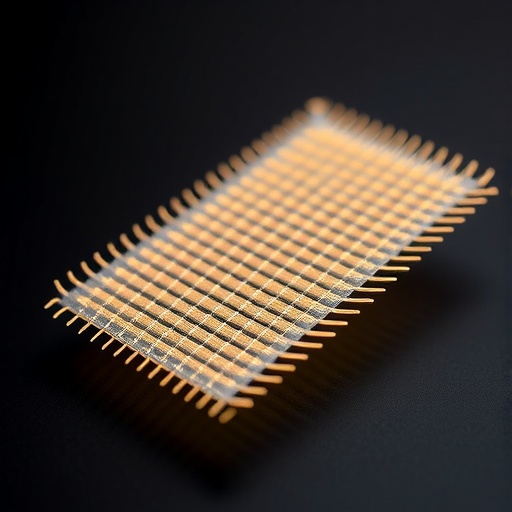
PULLMAN, Wash. – In an exciting advancement in wireless technology, a team of researchers from Washington State University has developed a groundbreaking chip-sized processor coupled with innovative 3D printed antenna arrays. This prototype technology is set to revolutionize flexible and wearable wireless systems, enhancing electronic communication capabilities across various industries such as automotive, aviation, and space exploration. The culmination of this research is documented in the esteemed journal Nature Communications, showcasing the promising potential of these developments for future applications.
The team employed a unique combination of 3D printing technology and copper nanoparticles to fabricate flexible antenna arrays that promise to outperform traditional stiff antennas. The key advantage of this approach lies in its ability to maintain performance stability under dynamic conditions, even when subjected to bending, humidity, and temperature changes. Sreeni Poolakkal, a Ph.D. student in WSU’s School of Electrical Engineering and Computer Science and co-first author of the study, expressed optimism about the prototype’s implications for smart textiles and communication systems in drones and aircraft.
Traditional antenna designs have been limited by their rigidity and bulk, which restricts their use in modern technologies that demand flexibility and lightweight solutions. This new 3D-printed technology offers a viable alternative, allowing for the creation of conformal antenna arrays that can be seamlessly integrated into the structure of various vehicles. For instance, utilizing these antennas in drones could potentially enhance operational efficiency and communication range, making them a sought-after solution in the industry.
Historically, the production of flexible wireless systems has faced challenges primarily due to high manufacturing costs and subpar performance compared to conventional antenna technologies. The unique properties of these antenna arrays, developed from a specialized copper nanoparticle ink, address many of these issues. Collaborators from the University of Maryland and Boeing played an integral role in creating the ink, which boasts enhanced conductivity and durability, thereby delivering improved performance vital for high-frequency communications.
The researchers’ innovative approach integrates not only advanced materials but also a processor chip capable of real-time signal correction. This technology is crucial because maintaining fidelity in wireless signals requires overcoming potential disruptions caused by the physical properties of the materials used. The ability to dynamically address these disturbances enhances the robustness of the wireless communication systems being developed.
Subhanshu Gupta, an associate professor at WSU and a co-author of the study, highlighted the significance of using the specially formulated nanoparticle ink in the 3D printing process. By leveraging this advanced material, the team was able to develop antennas that maintain consistent performance even when subjected to various environmental stresses, a common issue in traditional antenna designs. The introduction of real-time correction mechanisms further sets this technology apart, ensuring that signal integrity is preserved under challenging operational conditions.
The successful construction and testing of a lightweight, flexible array featuring four operational antennas represent a notable achievement. These antenna arrays could send and receive signals even during the movement and flexing of the materials, showcasing their practical application in real-world scenarios. The low power consumption of the small antennas allows for scalable deployment, making them an attractive option for various devices. The modular design also facilitates the construction of larger antenna arrays, with individual processor chips functioning independently to manage the signals effectively.
The research received funding from notable organizations, including the Air Force Research Laboratory, the Washington Research Foundation, and the M.J. Murdock Charitable Trust Foundation, underscoring the potential military and civilian applications of this technology. Inclusively, the research team comprises a diverse group of experts, including Shrestha Bansal and Arpit Rao from WSU, Abdullah Islam, Zhongxuan Wang, and Shenqiang Ren from the University of Maryland, as well as representatives from Boeing Research and Technology.
As industries continue to seek innovations that provide lighter and more efficient technology, these new developments in chip-scale RF signal processing and 3D printed antennas hold great promise. With applications across various fields from aviation to personal electronics, the implications of this research could redefine the landscape of wireless communication, making it more efficient, reliable, and adaptable to the needs of modern technology.
This pioneering research not only illustrates the confluence of advanced materials science and electronic engineering but also highlights a future where such innovations can significantly impact our daily lives and industries alike. The vision of seamless, integrated wireless communication is moving closer to reality as research endeavors like this pave the way for smarter, more adaptable systems able to thrive in dynamic environments.
As the project continues to evolve, the WSU-led team is looking forward to refining and scaling their technology to meet the needs of various sectors. The collaboration between the academic institutions and industry partners is a testament to the importance of interdisciplinary research, combining theoretical and practical insights to propel innovation forward. The next stages of this research will focus on increasing the capabilities of the antennas and processors further, ultimately leading to widespread adoption across numerous applications.
In conclusion, as we stand on the brink of new advancements in wireless communications, the integration of chip-scale processors with 3D printed antennas symbolizes a critical step towards achieving more effective and adaptable wireless systems. The future looks promising, and as this technology matures, it is expected to significantly reshape how we think about connectivity in both personal and professional contexts.
Keywords
Wireless technology, flexible antennas, 3D printing, chip-scale processor, electronic communication, nanoparticle ink, smart textiles, aviation, automotive, signal correction, real-time stabilization.
Cite Scienmag News
Grant Pearson. (October 20, 2025). Revolutionizing Wireless Technology: Flexible 3D Printed Antenna Arrays Unveiled. Scienmag. https://scienmag.com/revolutionizing-wireless-technology-flexible-3d-printed-antenna-arrays-unveiled/
Grant Pearson. "Revolutionizing Wireless Technology: Flexible 3D Printed Antenna Arrays Unveiled." Scienmag, 20 October 2025, https://scienmag.com/revolutionizing-wireless-technology-flexible-3d-printed-antenna-arrays-unveiled/. Accessed 4 September 2026.
Grant Pearson. "Revolutionizing Wireless Technology: Flexible 3D Printed Antenna Arrays Unveiled." Scienmag. October 20, 2025. https://scienmag.com/revolutionizing-wireless-technology-flexible-3d-printed-antenna-arrays-unveiled/


