


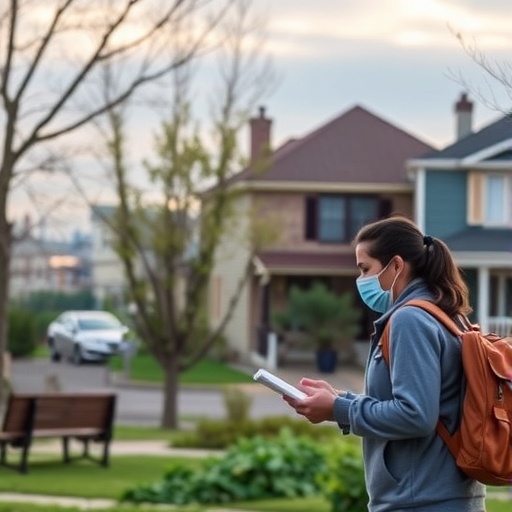
In a groundbreaking study published in Environmental Science and Pollution Research, researchers have introduced an innovative methodology aimed at enhancing the precision and granularity of spatiotemporal analysis in air pollution monitoring. This research, orchestrated by scientists O. Unsal, U. Alver-Sahin, and P. Kumar, aims to revolutionize our understanding of air quality at the neighborhood level, an area that has remained underexplored despite the mounting evidence linking air pollution to numerous health outcomes.
Air pollution remains a pressing global public health concern, impacting millions of lives, particularly in urban settings where emissions from vehicles, industrial activities, and residential heating amplify exposure levels. The existing traditional models of air quality assessment often deliver a broad perspective, which, while useful, falls short when addressing localized variability and its associated health implications. The researchers argue that such models lack the fine detail necessary for community-specific interventions, making their transformative research indispensable in the fight against pollution.
Utilizing advanced remote sensing technologies and sophisticated statistical modeling techniques, this study seeks to bridge the gap between aggregate air quality data and localized air pollution patterns. The researchers employed a high-resolution grid framework, which enables a more nuanced understanding of pollutant distribution as it varies throughout neighborhoods at different times of the day and across various seasons. This methodological shift allows for real-time monitoring, providing crucial insights into the changing dynamics of urban air quality.
The methodology involves integrating satellite and ground-level data to generate high-resolution maps depicting air pollutant concentrations over time. Such maps not only reveal the extent of pollution but also identify hotspots of poor air quality. This detailed visualization can serve as a critical tool for policymakers, allowing for targeted interventions that prioritize areas in utmost need of remedial action. Community leaders and urban planners can utilize these insights to enact localized policies aimed at reducing emissions and improving public health outcomes.
Moreover, the innovative spatiotemporal analysis opens pathways to community-level engagement. Residents equipped with accurate information about their immediate air quality can make informed decisions about outdoor activities, particularly vulnerability during high pollution periods. This empowerment enables communities to adapt proactively rather than reactively to their environmental conditions, fostering a culture of awareness and resilience against air pollution.
One particularly interesting aspect of this study is its potential implications for future research. The researchers suggest that a high-resolution approach to analyzing air pollutants not only informs public health efforts but also contributes to a growing body of knowledge on environmental justice. Historically marginalized communities often bear the brunt of environmental hazards, and pinpointing the specific areas suffering from high pollution levels adds robustness to arguments advocating for equity in environmental health resources.
The study also examined the implications of seasonal variations, noting how air pollution patterns fluctuate between summer and winter months. In areas where heating is predominant during colder months, pollutants linked to combustion can rise significantly. Such insights underline the importance of timing in intervention strategies. Environmental programs must not only consider the sources of pollution but also when they are most potent, allowing for a more proactive approach in mitigating health risks associated with air quality.
By weaving together complex data sets and local knowledge, the findings of this study have the potential to spark new discussions surrounding urban air quality management. For instance, cities might consider implementing real-time air monitoring systems, potentially utilizing data provided by citizens themselves. Crowdsourced pollution data could lead to heightened awareness and responsibility, as individuals would actively participate in combating air quality issues. In this light, the research opens avenues for collaboration between citizens, scientists, and local governments.
Moreover, as urbanization continues to rise, the implications of this research extend far beyond a local context. Globally, cities can adopt the high-resolution approach as a standard for air quality assessment, leading to coordinated international efforts to tackle this pervasive problem. The ability to benchmark air quality data against a more meticulous framework allows for comparisons that can elucidate broader trends, driving public advocacy and international policy.
As the authors of the study conclude, this new approach for high-resolution spatiotemporal analysis of air pollutants is not merely a research advance but a clarion call for societal action. Urging scientists, policymakers, and communities to work in tandem, they highlight the necessity for focused attention to the air we breathe. By integrating cutting-edge technology with an understanding of local contexts, the battle against air pollution can be fought with precision, urgency, and ultimately, greater effectiveness.
In conclusion, the research authored by Unsal, Alver-Sahin, and Kumar stands as a pivotal advancement in the domain of environmental science. Offering a clearer picture of air pollution dynamics at the neighborhood level, this collaborative effort emphasizes the importance of data in shaping public health initiatives and policies. The high-resolution methodology empowers communities, inspires future research, and encourages the implementation of targeted strategies focused on improving air quality and, by extension, public health.
As we move forward into an era acknowledging the profound influence of environmental factors on health, the insights gleaned from this research will undeniably shape the discourse on air quality and public health. Informed decisions backed by empirically robust data could very well forge a path towards healthier and more equitable urban environments for generations to come.
Cite Scienmag News
Russell Cooper. (January 20, 2026). Revolutionizing Neighborhood Air Quality Analysis Methods. Scienmag. https://scienmag.com/revolutionizing-neighborhood-air-quality-analysis-methods/
Russell Cooper. "Revolutionizing Neighborhood Air Quality Analysis Methods." Scienmag, 20 January 2026, https://scienmag.com/revolutionizing-neighborhood-air-quality-analysis-methods/. Accessed 3 September 2026.
Russell Cooper. "Revolutionizing Neighborhood Air Quality Analysis Methods." Scienmag. January 20, 2026. https://scienmag.com/revolutionizing-neighborhood-air-quality-analysis-methods/


