


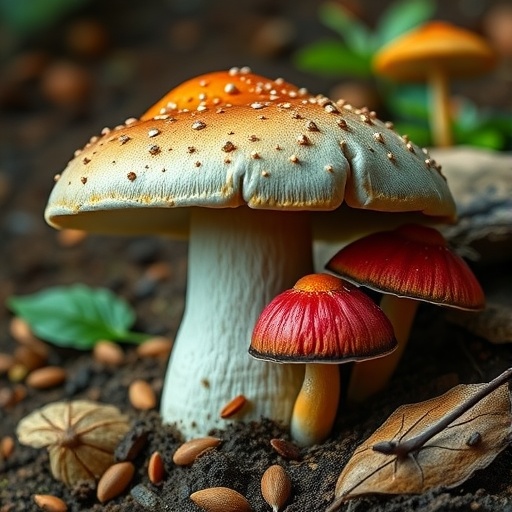
In a groundbreaking advance in the field of machine learning and artificial intelligence, recent research has unveiled the potential of convolutional block attention-based deep neural networks for the classification of mushrooms. This significant study conducted by Chakraborty, Mukherjee, and Mandal offers a fresh perspective on utilizing advanced neural network architectures, leveraging attention mechanisms to enhance classification accuracy for various mushroom species. With the increasing interest in mycological studies, this research represents a remarkable merging of technology and biology, paving the way for more precise classifications in the field.
The focus on mushroom classification arises from the importance of fungi in ecosystems, cuisine, and medicine. As a vital component of biodiversity, accurate identification of mushroom species is essential for ecological studies, culinary applications, and the development of new pharmaceuticals. However, manual classification by experts can be a daunting and time-consuming task. The introduction of automated methods using deep learning technologies presents a compelling solution to this challenge, making the research conducted by Chakraborty and colleagues incredibly relevant.
Central to the research is the innovative use of convolutional block attention mechanisms within deep neural networks. Typically, convolutional neural networks (CNNs) have been widely adopted in image classification tasks due to their ability to automatically learn hierarchical features from raw pixel data. The introduction of attention-based mechanisms allows the model to focus on relevant features while disregarding background noise. This selective focus mimics cognitive processes observed in human perception, significantly improving the model’s ability to distinguish between subtle variations in mushroom morphology.
In their study, the researchers utilized a comprehensive dataset comprising images of various mushroom species, each meticulously labeled to facilitate training and evaluation. This dataset served as the foundation for the convolutional block attention network, which was designed to enhance the network’s focus on salient features, such as cap shape, gill arrangement, and spore texture—traits critical for accurate classification. The proposed model stood out among existing methods due to its ability to achieve remarkable precision in classifying species that are often misidentified.
The significance of this research extends beyond mere accuracy in classification; it provides a demonstration of how state-of-the-art deep learning techniques can adapt to specialized domains. For mycologists and nature enthusiasts, the potential to develop mobile applications for real-time mushroom identification could revolutionize how individuals engage with the natural world. Imagine walking through a forest and using a smartphone app powered by this cutting-edge neural network to accurately identify edible and poisonous mushrooms within seconds.
Additionally, the implications of this research stretch into environmental monitoring and conservation efforts. With a growing concern over the decline in biodiversity, accurately cataloging various species becomes essential for conservation strategies. A deep learning model capable of reliably classifying mushrooms can assist researchers in tracking species distribution and changes over time. Such information not only supports ecological stability but also enriches our understanding of fungal diversity in various habitats.
One of the core strengths of the convolutional block attention-based approach is its scalability. The architecture allows for improved performance as additional training data becomes available. As more images are collected and annotated, the model can refine its classification capabilities, adapting over time to identify new species or variations within existing classifications. This scalability promises an evolving resource that can keep pace with expanding knowledge in the realm of mycology.
The research not only focuses on technical advancements but also emphasizes the ethical considerations surrounding the use of artificial intelligence in biodiversity studies. The authors advocate for a collaborative approach, encouraging the involvement of ecologists, mycologists, and AI specialists from the initial stages of model development. This interdisciplinary cooperation is crucial for addressing potential biases in the training datasets, ensuring that the model is equitable and representative of varied mushroom species across different geographical regions.
Looking ahead, the authors propose further enhancements to their model, such as incorporating multi-modal data inputs beyond just images. For instance, combining spectral data with visual images could yield richer insights, allowing the model to differentiate between species based on biochemical characteristics as well. This represents a forward-thinking approach, where future iterations of the model become more comprehensive and robust in identifying mushrooms.
The adoption of such advanced technologies is indicative of a larger trend within scientific research: the convergence of artificial intelligence and traditional domains of study. As researchers continue to harness the power of deep learning, we may witness even broader applications that extend from agriculture and ecology to healthcare and pharmaceutical research. The marriage of computational prowess with biological sciences is set to redefine how knowledge is produced and disseminated.
In conclusion, the research conducted by Chakraborty, Mukherjee, and Mandal illuminates the path forward for mushroom classification and highlights the versatility of convolutional block attention-based deep neural networks. By embracing AI for precise identification, we open doors to a myriad of applications that promise to enhance our understanding and appreciation of mushrooms, a crucial but often overlooked component of our ecosystems. As we stand on the brink of this exciting frontier, it is clear that the future of mycology—and indeed many other fields—will be profoundly shaped by advancements in artificial intelligence.
The implications are not only limited to ecological studies but also resonate within culinary traditions and medicinal applications, reflecting the diverse roles that mushrooms play in our lives. As this research garners attention, one can only wonder how the intersection of technology and biology will further evolve, delivering unforeseen benefits for both humanity and the natural world.
Chakraborty, B., Mukherjee, R. & Mandal, S. Convolutional block attention-based deep neural network for mushroom classification.
Discov Artif Intell 5, 252 (2025). https://doi.org/10.1007/s44163-025-00488-2
Cite Scienmag News
Blake Davidson. (September 30, 2025). Revolutionizing Mushroom Classification with Attention-Based CNNs. Scienmag. https://scienmag.com/revolutionizing-mushroom-classification-with-attention-based-cnns/
Blake Davidson. "Revolutionizing Mushroom Classification with Attention-Based CNNs." Scienmag, 30 September 2025, https://scienmag.com/revolutionizing-mushroom-classification-with-attention-based-cnns/. Accessed 4 September 2026.
Blake Davidson. "Revolutionizing Mushroom Classification with Attention-Based CNNs." Scienmag. September 30, 2025. https://scienmag.com/revolutionizing-mushroom-classification-with-attention-based-cnns/


