

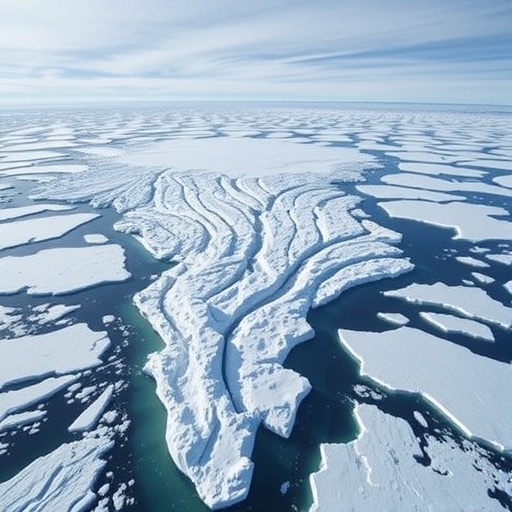
In the vast, frigid realms where Earth’s glaciers meet the ocean, marine ice sheets wield a profound influence over global climate and sea level rise. These colossal ice masses, grounded below sea level yet extending onto the continents, are not merely passive entities; they are dynamic systems intricately intertwined with the atmosphere, oceans, and underlying lithosphere. Historically, the scientific narrative around marine ice sheets has pivoted on the marine ice-sheet instability hypothesis, a framework asserting that their stability hinges principally on the slope of the bed at the grounding line — the critical juncture where ice transitions from resting on bedrock to floating on seawater. While this hypothesis has offered a foundational lens for understanding ice sheet behavior, its elegant simplicity belies the intricate and multifaceted nature of these icy giants.
Recent research advocates for a paradigm shift — an approach that transcends the reductive focus on grounding line bed slope and embraces the complex physics of mass and energy exchanges that govern marine ice sheet dynamics. This emerging perspective situates ice sheets firmly within the wider Earth system, highlighting their intrinsic variability as inseparable from their environmental context. Rather than viewing ice sheets as static bodies reacting predictably to external forcings, this new framework recognizes them as nonlinear systems, governed by internal heterogeneities and feedback loops operating over diverse spatial and temporal scales.
Central to this reconceptualization is an acknowledgment of the numerous, interwoven processes operating within ice sheets themselves. Spatial heterogeneity manifests in varying ice thicknesses, temperature gradients, and subglacial topography, while temporal heterogeneity emerges through seasonal melting cycles, episodic calving events, and long-term climate oscillations. These internal variabilities are not mere noise but are fundamental to understanding the emergent modes of behavior observed in recent satellite data and field measurements.
Moreover, the marine ice sheets engage in continuous mass and energy exchanges with their oceanic counterparts. Warm ocean currents erode ice shelves from below, modulating buttressing forces that stabilize grounded ice inland. Conversely, the freshening and cooling effect of meltwater influence ocean stratification and circulation patterns, feeding back into climatic and oceanographic systems. The atmosphere adds another layer of complexity through its control over surface melting, sublimation, and precipitation, essential in defining the mass balance of ice sheets.
The lithosphere beneath these titanic ice masses is not a passive foundation but an active participant in their dynamics. Glacial loading depresses the Earth’s crust, which subsequently rebounds when ice retreats, altering local topography and gravitational fields. This viscoelastic response introduces time-dependent feedback mechanisms that can either stabilize or destabilize ice sheet grounding lines.
Importantly, the interplay between these systems generates nonlinear feedbacks that can amplify or dampen ice sheet responses to climatic perturbations. For example, a small increase in ocean heat transport can trigger enhanced basal melting, leading to grounding line retreat—a key feature of marine ice-sheet instability. However, this retreat can be modulated or slowed by internal ice dynamics such as ice shelf buttressing or subglacial hydrology changes, underscoring the system’s complexity.
This comprehensive Earth-system perspective also sheds light on observed intrinsic variability in ice sheet behavior, which previous models based solely on bed slope gradient struggled to explain. Satellite observations reveal episodes of rapid flow acceleration, grounding line jumps, and transient halts that reflect the interplay of processes internal to the ice sheet and its environment. Understanding these events requires models capable of capturing the coupled physics of ice, ocean, atmosphere, and solid Earth interactions.
The broader implications of this new paradigm are profound for projections of future sea level rise and climate feedbacks. Marine ice sheets hold the potential to contribute meters to global sea levels, but accurately forecasting their evolution demands an integrative approach that accounts for their complex, emergent behavior. Conventional models neglecting this interplay risk underestimating variability and abrupt changes, with potentially devastating ramifications for coastal communities worldwide.
Advancing this understanding calls for enhanced observational campaigns — deploying in situ sensors and satellite missions attuned to detecting subtle shifts in mass, energy fluxes, and internal deformation patterns. Coupled with improved computational models incorporating nonlinear feedbacks and fully coupled Earth system interactions, these efforts promise a more robust framework to anticipate ice sheet response under various climate scenarios.
This approach also acknowledges the challenges posed by the inherent irreducibility of some ice sheet processes, where internal dynamics generate variability independent of climate forcing. Recognizing this intrinsic variability is crucial for correctly attributing observed changes and for developing probabilistic forecasts that embrace uncertainty rather than obscure it.
In evaluating feedbacks, attention turns to the role of ice shelf fracturing and calving dynamics, which influence buttressing strength and grounding line stability. The complexity of fracture mechanics within ice shelves, alongside basal hydrology and sediment deformation beneath grounded ice, requires detailed physical representation to capture their impact on large-scale ice sheet evolution.
Furthermore, the new paradigm informs interdisciplinary collaborations spanning glaciology, oceanography, climate science, geology, and geophysics. Understanding marine ice sheets as integral Earth system entities mandates breaking down traditional disciplinary silos to achieve holistic insights and innovate adaptation and mitigation strategies.
Intriguingly, emergent behavior within marine ice sheets could exhibit characteristic timescales distinct from forcing timescales, generating unpredictable episodes in ice dynamics and attendant sea level contributions. This aspect challenges deterministic forecasting and encourages developing frameworks that leverage systems theory and nonlinear dynamics.
Finally, this comprehensive rethinking not only advances scientific knowledge but heightens societal awareness of the urgent complexities associated with polar ice mass loss. It deepens the narrative beyond linear trends and catastrophe warnings, inviting nuanced appreciation of Earth system interdependencies shaping our planet’s future.
In summary, marine ice sheets stand at the confluence of intricate internal physics and multifaceted Earth system interactions. Moving beyond the classical marine ice-sheet instability hypothesis, the new perspective embraces complexity, variability, and feedbacks integral to these ice masses. By advancing integrated observations, theory, and modeling, the scientific community is poised to develop a transformative understanding critical for predicting and responding to global change in coming decades.
Subject of Research: Marine Ice Sheets, Earth System Interactions, Ice Dynamics
Article Title: A new paradigm for understanding Earth’s marine ice sheets
Article References:
Sergienko, O., Haseloff, M., Robel, A. et al. A new paradigm for understanding Earth’s marine ice sheets. Nat. Geosci. (2026). https://doi.org/10.1038/s41561-026-01941-2
Image Credits: AI Generated


