


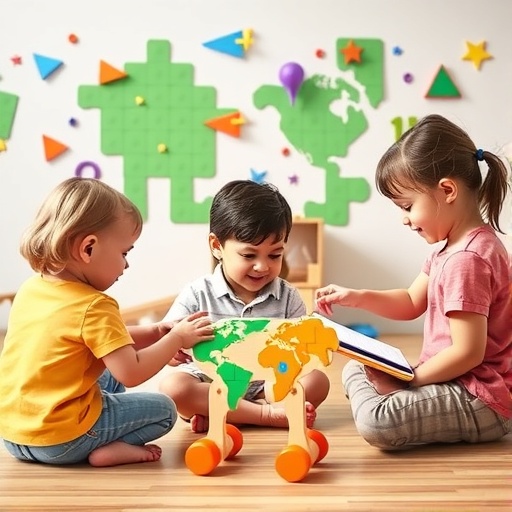
In recent years, researchers have increasingly focused on the intricate interplay between play and learning, particularly as it pertains to early childhood education. A pivotal study by Chen, Disney, and Li (2025) delves into the profound impact of imaginary play on children’s mathematical skills as they transition into formal schooling. This investigation emphasizes the necessity of reevaluating traditional pedagogical approaches, highlighting how a conceptual framework of play can facilitate deeper learning and engagement.
Imaginary or pretend play has long been recognized as a vital component of childhood development. However, its specific role in cultivating mathematical capabilities in young learners is often overlooked. This research sheds light on how imaginative scenarios can stimulate cognitive processes involved in mathematical reasoning. Engaging children in narratives and role-playing not only aids in the retention of mathematical concepts but also makes learning interactive, allowing children to experiment with numbers and problem-solving in a playful context.
The study introduces the innovative concept of the PlayWorld, a structured environment where children can engage in imaginative play while simultaneously exploring mathematical contexts. This approach transforms mundane learning experiences into rich, interactive scenarios that resonate with children’s interests and innate curiosity. Through the intervention of PlayWorld, children are encouraged to manipulate their environments, utilize math in real-world scenarios, and make connections that traditional teaching methods often fail to establish.
As children navigate through their PlayWorld, they encounter various mathematical challenges that encourage critical thinking and collaboration. The environment is designed to mimic realistic settings while integrating mathematical concepts seamlessly, such as counting, measuring, and recognizing patterns. The researchers observed that children engaged in these playful interactions demonstrated improved problem-solving skills, a heightened understanding of mathematical concepts, and a greater enthusiasm for learning.
One of the remarkable findings of the study is the significant decrease in math anxiety among children participating in the PlayWorld activities. Traditional teaching methods can often create a pressure-laden atmosphere, leading to hesitance or fear surrounding mathematical tasks. In contrast, the playful nature of the PlayWorld encourages a sense of safety and exploration, thus fostering a positive attitude towards math. This shift in emotional response is crucial as it lays a foundation for lifelong learning habits and attitudes towards mathematical endeavors.
The role of educators in facilitating this transition cannot be understated. The study advocates for teachers to adopt a more dynamic role as facilitators rather than mere transmitters of knowledge. By creating a supportive and enriching environment, educators can help children navigate their mathematical journeys through play. Training teachers to recognize the value of play and to incorporate these methodologies into their curricula is essential for the successful implementation of the PlayWorld concept.
Moreover, parental involvement emerges as a pivotal aspect of this pedagogical shift. When parents engage with children in their learning processes, especially through play, it nurtures a home environment where mathematics can be celebrated rather than just absorbed. Encouraging parents to play alongside their children with a focus on math provides a dual benefit; it enhances the cognitive development of children while also strengthening family bonds through shared experiences.
The implications of this study extend well beyond the classroom. As society increasingly recognizes the importance of STEM (Science, Technology, Engineering, and Mathematics) education, incorporating imaginative play into learning strategies paves the way for innovations in how these concepts are presented to young learners. The insights from this research could lead to greater educational reforms that prioritize engaging and dynamic learning environments in early childhood education.
Furthermore, the study raises significant questions about the broader educational policies governing methodologies in early childhood learning. If play is fundamentally linked to learning, then educational systems must adapt to prioritize such experiences. Investment in training educators and promoting the integration of play into formal curricula will prove invaluable in fostering a generation of learners who are not only proficient in mathematics but also enthusiastic about discovering new concepts.
Community partnerships, where local organizations may facilitate after-school or weekend programs focused on playful mathematical exploration, can amplify the benefits of the PlayWorld model. By extending these learning experiences beyond the traditional school setting, children will have more opportunities to engage with mathematics in meaningful and playful ways, further solidifying their understanding and appreciation for the subject.
In conclusion, the research conducted by Chen, Disney, and Li opens up a provocative dialogue about the nature of learning in early childhood—particularly the seamless integration of imaginary play as a means to facilitate mathematical understanding. The transformative potential of establishing a PlayWorld paradigm invites educators, parents, and policymakers alike to reconsider their approaches to teaching math, forever altering how children engage with one of the most fundamental skills necessary for personal and academic success. The paradigm shift toward valuing play in education may well be the key to unlocking a brighter future, where children approach challenges with creativity, resilience, and confidence.
As the landscape of educational practices continues to evolve, the findings from this study resonate deeply within the realms of both academic scholarship and practical application. Implementing these strategies can ignite a shift in pedagogical focus — proving that concise, structured learning can coexist with imagination, ensuring that math becomes a source of joy rather than dread in the hearts of future generations.
Chen, H., Disney, L. & Li, L. Embracing Imaginary Play: A Pedagogical Shift in Supporting Children’s Mathematical Transition To School Through the Intervention of Conceptual PlayWorld.
Early Childhood Educ J (2025). https://doi.org/10.1007/s10643-025-02020-8
Cite Scienmag News
Courtney Benton. (October 22, 2025). Revolutionizing Early Math Learning with Conceptual PlayWorlds. Scienmag. https://scienmag.com/revolutionizing-early-math-learning-with-conceptual-playworlds/
Courtney Benton. "Revolutionizing Early Math Learning with Conceptual PlayWorlds." Scienmag, 22 October 2025, https://scienmag.com/revolutionizing-early-math-learning-with-conceptual-playworlds/. Accessed 4 September 2026.
Courtney Benton. "Revolutionizing Early Math Learning with Conceptual PlayWorlds." Scienmag. October 22, 2025. https://scienmag.com/revolutionizing-early-math-learning-with-conceptual-playworlds/


