


In the ongoing battle against climate change, capturing carbon dioxide (CO₂) emitted from industrial sources has emerged as a critical solution. However, existing carbon capture techniques, such as chemical absorption, are often prohibitively expensive and require significant energy, making them impractical for widespread adoption. Researchers have long looked to graphene, a revolutionary material known for its extraordinary properties, as a potential game-changer in the field of gas separation. Despite its promise, the challenge of producing large-area, efficient graphene membranes has hindered progress.
A remarkable breakthrough has recently unfolded at the École Polytechnique Fédérale de Lausanne (EPFL), where a team led by Professor Kumar Agrawal has developed an innovative, scalable technique for creating porous graphene membranes. Their research focuses on the selective filtration of CO₂ from gas mixtures, which holds tremendous potential for revolutionizing carbon capture technology. The team’s approach not only dramatically reduces production costs but also enhances the performance and quality of graphene membranes, creating pathways for real-world applications in carbon capture and potentially other fields.
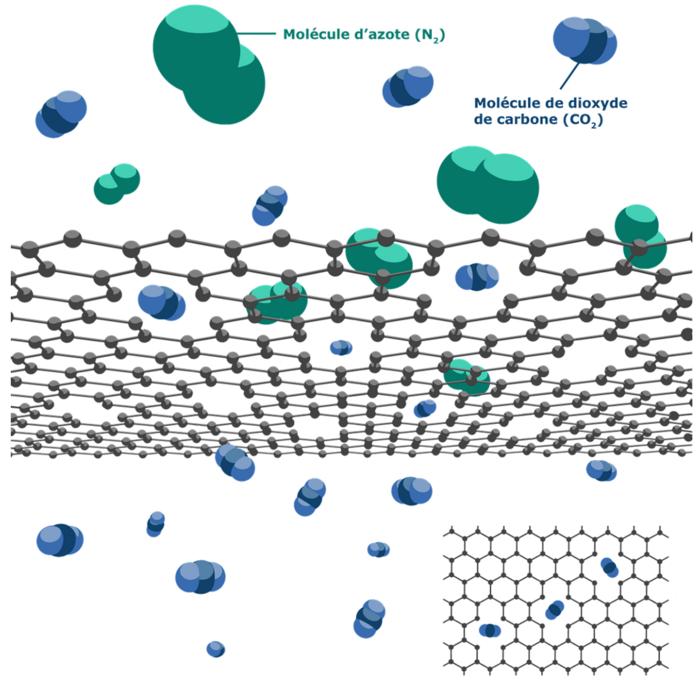
Graphene membranes possess unique capabilities for gas separation due to their ability to be engineered with meticulously sized pores. These pores can be tailored to allow CO₂ molecules to pass through while effectively blocking larger molecules, such as nitrogen. This selective permeability positions graphene membranes as ideal candidates for capturing CO₂ emissions from power plants and various industrial processes. However, the widespread implementation of these membranes has been stymied by the challenges associated with manufacturing them at a reasonable cost and scale.
Historically, the production of high-quality graphene membranes has relied heavily on utilizing costly copper foils for growth. Additionally, the delicate handling required during the manufacturing process often introduces flaws and cracks within the membranes, leading to reduced efficiency. Thus, the quest for a more cost-effective, reproducible method for producing large, high-quality graphene membranes has been a daunting challenge for researchers.
The EPFL research team made significant strides in overcoming these barriers. Their first step involved developing a novel method to grow high-quality graphene on low-cost copper foils. This innovative adjustment significantly cut down on material costs, making the process much more accessible and feasible for scaling up production. Building on this progress, the researchers refined a chemical etching process that utilizes ozone (O₃) to create tiny pores in the graphene. This intentional pore formation enables specific CO₂ filtration, enhancing the membrane’s selectivity.
An essential aspect of their success lies in improving the interactions between gas and graphene, ensuring that pores form uniformly across large surface areas. Achieving uniform pore distribution is vital for scalability, particularly in industrial applications where consistency is key. The team also addressed the inherent fragility of graphene membranes, which has long been a significant limitation on their utility. Previous transfer methodologies often involved floating the fragile graphene films onto supports, risking the introduction of cracks. Thus, the team innovated a direct transfer technique that occurs within the membrane module itself, effectively eliminating handling challenges and reducing the potential for failure.
Their innovative techniques yielded impressive results, enabling the successful creation of 50 cm² graphene membranes—substantially larger than previous iterations that were possible. These membranes exhibited near-perfect structural integrity while demonstrating excellent CO₂ selectivity and high gas permeance, allowing for rapid CO₂ transport while blocking other unwanted gases. These outcomes mark an important milestone in the ongoing quest for effective carbon capture technologies that are both efficient and economically viable.
Furthermore, the researchers optimized the oxidation process, which allowed them to increase the density of CO₂-selective pores within the membranes. This enhancement directly contributed to improved performance, showcasing the intricate balance of chemical engineering and material science that underpins this innovation. Alongside empirical results, computational simulations confirmed that optimizing gas flow across the membranes played a fundamental role in achieving these advancements.
The implications of this groundbreaking work extend far beyond carbon capture. Traditional carbon capture technologies, reliant on energy-intensive chemical processes, can often be complex and economically restrictive for broader application. In contrast, graphene membranes operate using simple pressure-driven filtration, significantly reducing energy requirements, and paving the way for their integration into existing industrial infrastructures.
Beyond the immediacy of CO₂ capture, the newly developed method for producing graphene membranes holds promise for other gas separation applications, such as hydrogen purification and oxygen production—both critical components in the shift toward a sustainable, low-carbon economy. With their cost-effective materials and scalable production processes, the EPFL team’s innovations bring graphene membranes closer to practical commercial use, reshaping the landscape of gas separation technologies in pivotal ways.
In summary, the development of scalable, CO₂-selective porous single-layer graphene membranes at EPFL heralds a new chapter in the pursuit of effective carbon capture. The research team’s dedication to overcoming existing manufacturing challenges has not only marked a substantial scientific achievement but has also introduced a pathway for real-world applications that could combat climate change on a significant scale. This breakthrough highlights the vital intersection of advanced materials science and actionable climate solutions, representing a significant advancement toward a more sustainable future.
Keywords
Graphene membranes, CO₂ capture, gas separation, carbon capture technology, scalable production, porous materials.
Cite Scienmag News
Sloane Callahan. (April 11, 2025). Revolutionary Scalable Graphene Membranes: A Breakthrough in Carbon Capture Technology. Scienmag. https://scienmag.com/revolutionary-scalable-graphene-membranes-a-breakthrough-in-carbon-capture-technology/
Sloane Callahan. "Revolutionary Scalable Graphene Membranes: A Breakthrough in Carbon Capture Technology." Scienmag, 11 April 2025, https://scienmag.com/revolutionary-scalable-graphene-membranes-a-breakthrough-in-carbon-capture-technology/. Accessed 4 September 2026.
Sloane Callahan. "Revolutionary Scalable Graphene Membranes: A Breakthrough in Carbon Capture Technology." Scienmag. April 11, 2025. https://scienmag.com/revolutionary-scalable-graphene-membranes-a-breakthrough-in-carbon-capture-technology/


