


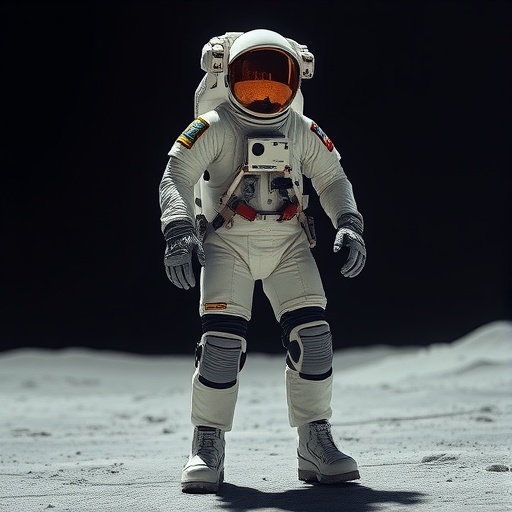
Researchers at the University of Bristol have embarked on a groundbreaking journey to enhance astronaut mobility through the development of a soft robotic exosuit. This innovative piece of technology, designed to be worn beneath traditional spacesuits, significantly augments the abilities of astronauts, enabling them to move with greater ease and efficiency. The exosuit utilizes a unique construction of fabric materials integrated with advanced artificial muscle technology, setting a new standard in space exploration gear.
The exosuit is engineered to provide optimal support without restricting natural movements, which is critical for astronauts conducting extravehicular activities on the Moon and Mars. As the demands of space missions escalate, maintaining physical stamina becomes paramount. This soft robotic exosuit aims to reduce muscular fatigue, ensuring that astronauts can perform tasks with reduced strain on their bodies, thus prolonging their effectiveness throughout the mission.
In a recent achievement, Dr. Emanuele Pulvirenti, a Research Associate in the Soft Robotics Lab at the University of Bristol, took the exosuit to the University of Adelaide in Australia for testing. This location is home to the Exterres CRATER facility, known for being the largest simulated lunar environment in the Southern Hemisphere. Here, the exosuit was put through its paces in a meticulously designed international proof-of-concept space mission, dubbed the ‘World’s Biggest Analog,’ organized by the Austrian Space Forum.
The mission attracted the participation of 200 scientists from 25 nations who collaborated on various experimental and operational simulations. This cooperative effort allowed researchers to share data and insights in real-time, communicating back to the mission control located in Austria. Such collaborative frameworks are vital for fostering advancements in space exploration technologies, which will be essential for future long-duration extraterrestrial missions.
Dr. Pulvirenti’s innovative work with the exosuit represents a significant advancement in robotics and wearables. His hands-on approach to development included personally crafting the exosuit, a task he undertook after teaching himself to sew, guided by advice from his grandmother, a former tailor. This dedication to the craft reflects the passion and drive behind the project, which aims to blend state-of-the-art technology with practical applications for both astronauts and individuals with mobility challenges on Earth.
The exosuit itself features a sophisticated design that encompasses two primary layers of material. The outer layer is made from durable nylon, providing resilience against external elements, while the inner layer consists of thermoplastic material capable of airtight inflation. This innovative design allows the exosuit to mimic the function of biological muscles, supporting the wearer’s movements without impeding natural locomotion. Furthermore, the components responsible for anchoring the suit in place, such as the waistband and knee straps, are constructed from Kevlar, which is known for its high strength and resistance to tension.
One of the crucial aspects of this technology is its dual functionality. The exosuit is categorized as assistive, enhancing lower-limb muscle performance, thereby alleviating fatigue during strenuous tasks. In parallel, a resistive version of the suit has also been conceived, which applies load to the body to help maintain muscle mass. This builds a compelling narrative around the technology as not just a space exploration tool, but as a potential asset in physical rehabilitation settings on Earth.
Dr. Pulvirenti expressed his aspirations for further development of the exosuit technology, indicating a strong desire to test it aboard the International Space Station in the near future. The notion that such advancements could lead to practical applications for individuals with mobility impairments presents a dual benefit that could reshape how assistive technologies are perceived and utilized.
The future trajectory of exosuit development includes ambitious plans to create a hybrid version of the suit. This innovative model would have the capability to switch between assistance and resistance modes according to the wearer’s needs, making it a versatile tool for those undergoing physical rehabilitation. Such advancements not only present a remarkable potential to improve astronaut performance but can also significantly enhance the quality of life for individuals seeking mobility support.
As the landscape of both space exploration and rehabilitation technologies continues to evolve, the implications of this research resonate far beyond traditional boundaries. The efforts spearheaded by Dr. Pulvirenti and his team mark a pivotal step toward a future where robotic assistive devices could seamlessly integrate into both space and terrestrial environments, empowering users in previously unimaginable ways.
In summary, the development of the soft robotic exosuit illustrates the intersection of advanced engineering, human physiology, and space exploration. By addressing the needs of astronauts and individuals with physical challenges alike, researchers are laying the groundwork for a new era of mobility technology that could redefine the boundaries of human capability.
For media inquiries or to arrange an interview with Dr. Emanuele Pulvirenti, please reach out to Steve Salter through the University of Bristol News and Content team.
Keywords
Soft robotics, exosuit, astronaut mobility, assistive technology, space exploration, rehabilitation technology, artificial muscles, lunar missions, Mars exploration, Bioengineering, human-robot interaction.
Cite Scienmag News
Grant Pearson. (November 4, 2025). Revolutionary Robotic Exosuit Trousers Enhance Astronaut Mobility for Space Missions. Scienmag. https://scienmag.com/revolutionary-robotic-exosuit-trousers-enhance-astronaut-mobility-for-space-missions/
Grant Pearson. "Revolutionary Robotic Exosuit Trousers Enhance Astronaut Mobility for Space Missions." Scienmag, 4 November 2025, https://scienmag.com/revolutionary-robotic-exosuit-trousers-enhance-astronaut-mobility-for-space-missions/. Accessed 4 September 2026.
Grant Pearson. "Revolutionary Robotic Exosuit Trousers Enhance Astronaut Mobility for Space Missions." Scienmag. November 4, 2025. https://scienmag.com/revolutionary-robotic-exosuit-trousers-enhance-astronaut-mobility-for-space-missions/


