


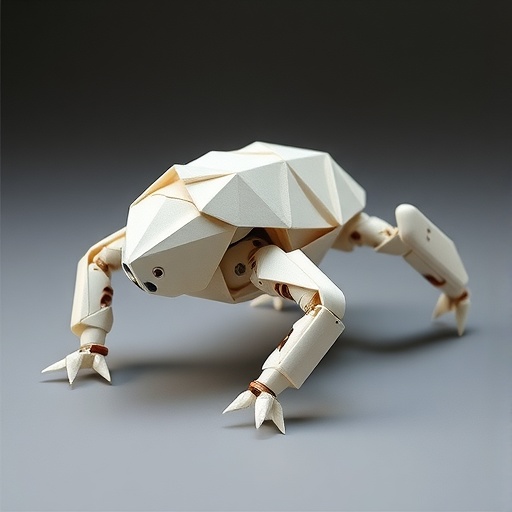
In the realm of soft robotics, the quest for innovative designs that emulate the movement of limbless animals has led to remarkable advancements. Researchers have recently unveiled a cutting-edge multimodal crawling robot, specifically engineered to replicate the efficient locomotion patterns observed in nature. This state-of-the-art soft robot harnesses the principles of biomechanics and engineering, merging deformable structures with sophisticated actuation mechanisms to achieve unparalleled mobility across various terrains. The introduction of a foldable kirigami skin marks a significant leap forward in robotic design, enhancing the robot’s performance while maintaining its lightweight characteristics.
At the heart of this design is the functionality derived from three primary elements that characterize the locomotion of limbless creatures. Firstly, the robot is equipped with a highly deformable soft body that can undergo significant shape changes. This soft body is strategically designed with anterior and posterior segments, interconnected by 3D-printed rigid couplers, which house pairs of fiber-reinforced antagonistic pneumatic muscles. Collectively, these elements enable a rhythmic extension and bending of the structure, allowing the robot to move seamlessly across flat surfaces. Secondly, the incorporation of proximity sensors ensures that the robot can interact with its environment dynamically, adjusting its movements in response to obstacles and varying surface conditions. Thirdly, the innovative use of kirigami skin offers a unique friction modulation capability that is crucial for effective propulsion and steering.
Prior attempts to engineer soft robots capable of crawling have typically focused on specific functions such as body-shape actuation and anchoring mechanisms. Nonetheless, this new platform distinguishes itself as a fully integrated solution that concurrently addresses deformation, friction coupling, and steering. One of the most significant challenges in previous designs has been the propensity for kirigami skins to wrinkle during deformation, which adversely affects frictional properties essential for movement. However, this newly developed robot circumvents this limitation with its advanced kirigami design, allowing it to maintain a stable frictional anisotropy even under substantial deformations.
The remarkable structure of the robot, which features precise creases and cuts, allows it to adapt to varying external pressures without sacrificing performance. These characteristics enable the kirigami skin to maintain grip on surfaces as it bends and contracts, facilitating smooth motion transition from straight crawling to agile steering maneuvers. This coordination between body motion and skin interaction is critical for ensuring that the robot can perform effectively in diverse environments, such as tight spaces or irregular terrains, which are often encountered during search-and-rescue missions or infrastructure inspections.
Testing has demonstrated that this robot performs impressively in various scenarios, achieving peak speeds of up to 10.83 mm/s on different polyurethane foams. The robot’s actuator performance highlights the correlation between speed and friction, elucidating how the design serves to enhance propulsion efficiency. Detailed traction experiments confirmed that the robot’s pull force significantly increases on surfaces designed for testing, showcasing its adaptability to different conditions. This successful blending of speed, force, and mobility reaffirms the potential of this robot in practical, real-world applications where agility is paramount.
As the researchers delve deeper into the design and performance testing, they also identified critical areas for future optimization. For instance, the robot currently relies on an off-board power supply for its pneumatic actuation, which restricts its operational range and autonomy. Looking forward, the team aims to innovate solutions for integrating onboard systems that utilize miniaturized sensors, enabling more comprehensive environmental awareness. This enhancement would facilitate expanded functionalities for the robot, allowing it to traverse increasingly complex terrains autonomously without a tether to an external power source.
Beyond simply enhancing the robot’s mobility, the design’s collaboration with advanced control systems promises further improvements. Incorporating adaptive navigation algorithms will enable the robot to learn and adjust to its environment dynamically. Such upgrades could significantly transform how soft robots function in unpredictable environments, paving the way for breakthrough applications in various fields, from disaster response scenarios to environmental monitoring.
In-depth dynamic analyses articulated the operational strategies that yield the most efficient thrust generation. For instance, the timing of muscle inflation plays a crucial role in optimizing movement, with specific sequences leading to more effective anchoring and thrust capabilities. This nuance in control not only improves the robot’s performance during locomotion but also underscores the sophisticated integration of hardware and software in modern robotic designs.
The implications of this technology extend beyond mere academic curiosity; they encompass significant potential for practical implementations in hazardous conditions. As rescue operations in confined spaces become increasingly prevalent, such as during building collapses or natural disasters, this robot’s ability to navigate through tight and obstructed passages can be invaluable.
Additionally, the accurate feedback loop provided by the onboard sensors allows the robot to operate effectively in real-time. This closed-loop control system, which integrates data from the sensors with a user interface, ensures reliable obstacle avoidance and path planning, making essential contributions to the robot’s operational reliability.
While the current version of the robot marks a significant advancement, opportunities for refinement remain abundant. Enhancing the wear resistance of the kirigami materials, improving sensor capabilities, and experimenting with varying surface roughness are all areas identified for further development. Moreover, achieving untethered operation by integrating wireless power sources could enable unprecedented freedom for applications ranging from routine inspections to emergencies.
In summary, this multimodal limbless crawling robot exemplifies a significant leap in soft robotics, combining bioinspired designs with innovative engineering solutions to address real-world challenges. The harmonious interplay between its kirigami skin and antagonistic pneumatic muscles allows for a range of movements, redefining mobility in complex environments. The potential applications are vast, promising a future where robots like this take center stage in critical operations that demand flexibility and adaptability.
Despite the progress made, the journey toward fully autonomous and highly agile soft robots continues, filled with challenges and opportunities for exploration and innovation. The prospect of creating lightweight, flexible robots capable of navigating complex terrains opens up new frontiers in robotics.
These advancements offer intriguing possibilities for future research, as scientists and engineers seek to bridge the gap between biological inspiration and engineered capability, blurring the lines between nature and technology.
Keywords
Research methods, Applied sciences and engineering, Mathematics
Cite Scienmag News
Denise Maddox. (September 26, 2025). Revolutionary Multimodal Limbless Crawling Soft Robot Features Innovative Kirigami Skin. Scienmag. https://scienmag.com/revolutionary-multimodal-limbless-crawling-soft-robot-features-innovative-kirigami-skin/
Denise Maddox. "Revolutionary Multimodal Limbless Crawling Soft Robot Features Innovative Kirigami Skin." Scienmag, 26 September 2025, https://scienmag.com/revolutionary-multimodal-limbless-crawling-soft-robot-features-innovative-kirigami-skin/. Accessed 4 September 2026.
Denise Maddox. "Revolutionary Multimodal Limbless Crawling Soft Robot Features Innovative Kirigami Skin." Scienmag. September 26, 2025. https://scienmag.com/revolutionary-multimodal-limbless-crawling-soft-robot-features-innovative-kirigami-skin/


