

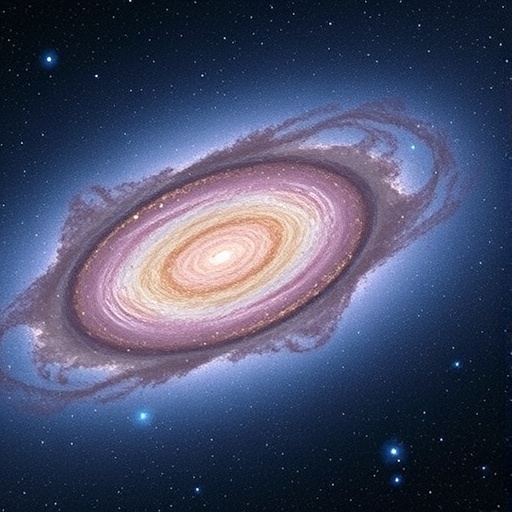
A groundbreaking new research initiative led by scientists at UBC Okanagan has opened the door to an unparalleled understanding of the Milky Way’s magnetic field, revealing its unexpected complexity and structure. Utilizing the impressive capabilities of the Dominion Radio Astrophysical Observatory (DRAO)’s 15-metre telescope, the research team has developed a comprehensive broadband map of Faraday rotation, a phenomenon critical for tracking the intricate magnetic fields throughout the northern sky.
The project, coined the Dominion Radio Astrophysical Observatory GMIMS of the northern sky (DRAGONS), marked a significant advancement in astrophysical observations by enabling researchers to detect and analyze polarized radio emissions at varying frequencies. This innovative approach allows for the visualization of magnetic field structures that were previously hidden from view. As Dr. Alex Hill—one of the leading figures in the project—describes, the capability to observe these structures represents a notable leap forward in understanding the magnetic complexities that shape our galaxy.
With this new dataset, the level of detail in observing polarized emissions has significantly improved. Dr. Anna Ordog, who led the project during her time as a postdoctoral researcher at UBCO, highlighted that DRAGONS is the first survey to uncover such extensive complexity in the magnetic landscape of the northern sky. The implications of this finding are profound, as it challenges previous notions about the uniformity of magnetic fields within our galaxy.
Historically, the necessity of advanced technological capabilities limited astronomers’ ability to observe the Milky Way’s magnetic field. The theoretical framework for such observations was laid down as early as 1966, when researchers proposed that polarized radio waves could yield insights into the three-dimensional organization and properties of magnetic fields. However, only with the advent of modern broadband telescopes like the DRAO 15m has this vision been made realizable.
This cutting-edge telescope was originally designed as a prototype for the Square Kilometre Array (SKA), an international radio telescope project currently under construction across Southern Africa and Western Australia. Its deployment in the DRAGONS study marks an exciting step forward, showcasing its potential in astronomical research. Dr. Ordog’s hands-on leadership in the project was supported by a dedicated team that included engineering experts from DRAO and students from both UBCO and the University of Calgary who contributed to various important aspects of the survey.
Hands-on involvement allowed students to take part in critical research processes, including analyzing initial signals from the telescope and developing algorithms to filter out human-made radio interference. Such experiences not only enriched their academic pursuits but also enhanced their practical skills in radio astronomy methodologies, drawing them closer to the heart of contemporary astrophysical research.
The findings from the DRAGONS survey, recently published in the prestigious journal The Astrophysical Journal Supplement Series, illustrate how polarized radio waves twist during their traversal through the galaxy. This twisting provides fertile ground for insights into the strength and vector of magnetic fields along the line of sight. A remarkable takeaway from the survey is the revelation that mere simplification in understanding these fields previously overlooked a rich and varied fabric of magnetic structures scattered across more than half of the observable sky.
Dr. Tom Landecker, a veteran astronomer at the DRAO, expressed his surprise at the scope of “Faraday complex” regions identified in the data, accumulating evidence that the magnetic field in the Milky Way is not the straightforward entity once believed. “We see much more structure than was detectable with earlier methodologies,” he points out, emphasizing the project’s potential to redefine our understanding of cosmic magnetic dynamics.
The magnetic fields present numerous influences, guiding processes like star formation as well as the evolutionary trajectories of galaxies. Dr. Hill adds that prior methods yielded merely oversimplified metrics of galactic magnetic fields—the newly acquired knowledge marks a pivotal shift in astrophysics, which is crucial for modeling the broader universe and its developmental history.
The potential applications of the DRAGONS data transcend a mere exploration of the Milky Way’s magnetism. One such example is a complementary study undertaken by a University of Calgary doctoral student, Rebecca Booth, investigating an enigmatic large-scale reversal in the galactic magnetic field. Her research signifies just one of many directions that the DRAGONS dataset can lead, emphasizing its value as a vital resource for continued inquiries into the fabric of our universe.
As part of a new generation of radio surveys, the DRAGONS project stands as a prominent Canadian contribution to the global astronomical landscape. Its comprehensive examination of the Milky Way’s three-dimensional magnetic field structure contributes meaningful perspectives to the broader realm of astrophysics, beckoning an era of renewed curiosity and investigation that could redefine the boundaries of our cosmic knowledge.
In conclusion, the discovery and mapping of the complexities of the Milky Way’s magnetic field through the DRAGONS survey not only augments our understanding of the enigmatic properties of our galaxy but also contributes to the wider scientific narrative surrounding the evolution of the universe. As this research continues to unfold, it promises to enrich our understanding of how cosmic structures interact and evolve over time.
Subject of Research: Not applicable
Article Title: GMIMS-DRAGONS: A Faraday Depth Survey of the Northern Sky Covering 350–1030 MHz
News Publication Date: 29-Jan-2026
Web References: DOI link
References: None
Image Credits: Credit: Luca Galler
Keywords
Milky Way, magnetic field, radio astronomy, Faraday rotation, radio emissions, DRAO, radio surveys, cosmic structures, astrophysics, DRAGONS, astronomical research, polarized waves.


