

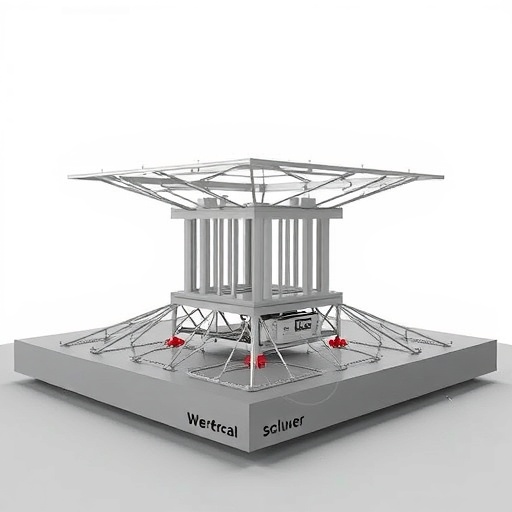
In an era marked by rapid advancements in materials science and engineering, researchers are increasingly drawn to innovative solutions for mitigating vibrations and enhancing structural integrity. A ground-breaking study from a team of scientists led by Gao et al. introduces a novel vibration isolation method anchored in the principles of local resonance theory. This inventive approach culminates in the development of a Local Resonance Periodic Structure Block (LRPB), which promises to revolutionize how we combat vibrations in various engineering applications.
Vibrations have significant implications across industries, particularly in aerospace, automotive, and civil engineering. The consequences of unimproved vibration control can lead to catastrophic failures in structures and machinery, necessitating ongoing research and development in the field. The introduction of the LRPB offers a promising avenue for advancing vibration isolation technologies, presenting a significant leap forward by utilizing the phenomenon of local resonance to achieve superior performance.
Local resonance theory has long fascinated engineers due to its potential to isolate frequencies without traditional damping systems. By creating prohibitive barriers to vibration waves, local resonant structures can trap energy and prevent it from traveling through materials. Gao and his colleagues have ingeniously harnessed this mechanism to design a block that exhibits enhanced vibration isolation characteristics, paving the way for safer and more resilient infrastructures.
The LRPB operates through a carefully designed arrangement of resonating units that interact with incoming vibrations. When subjected to external vibrational forces, these resonators effectively absorb and dissipate energy, significantly minimizing the amplitude of vibrations that propagate through the surrounding structure. This innovative methodology differs from conventional damping techniques, which often rely on passive absorption and can be limited in effectiveness under certain conditions.
In their study, the researchers employed a sophisticated mathematical framework to model the behavior of the LRPB under various vibrational scenarios. Through meticulous simulations and experimental validations, they demonstrated that the structure could significantly reduce resonance peaks in a defined frequency range. The effectiveness of the LRPB was particularly pronounced in applications involving dynamic loads, where conventional systems often falter, highlighting its potential as a game-changer in vibration control.
Beyond the immediate benefits of enhanced vibration reduction, the implications of deploying the LRPB are manifold. This innovative structure holds promise not only for traditional engineering fields but also for emerging technologies such as renewable energy systems and smart materials, which require resilient designs capable of withstanding dynamic forces. The versatility of the LRPB is one of its key strengths, allowing for its integration into various applications, including bridges, buildings, and even automotive designs.
One particularly exciting aspect of the LRPB is its ability to be tailored for specific applications through adjustable parameters. This adaptability enables engineers to fine-tune the structure for optimal performance, addressing the unique vibration profiles of different environments. Such customization is critical for achieving the ultimate goal of ensuring structural integrity and longevity, as each application presents its own distinct challenges in the realm of vibration management.
Moreover, the research team led by Gao recognizes the future of engineering lies in materials that not only perform optimally but do so sustainably. As the world increasingly turns its focus to environmentally conscious construction practices, the potential for the LRPB to be fabricated using sustainable materials presents a compelling argument for its widespread adoption. By integrating eco-friendly production methods with innovative design, the LRPB reflects a commitment to advancing technology without compromising environmental integrity.
The study highlights the importance of interdisciplinary collaboration in tackling complex engineering challenges. By uniting experts from fields such as physics, materials science, and engineering, Gao et al. exemplify how collaborative efforts can yield transformative solutions to age-old problems. Their work serves as a beacon for future research, encouraging scientists and engineers alike to explore the intersections of their disciplines in pursuit of innovative advancements.
As the field of vibration control continues to evolve, the research surrounding the LRPB stands at the forefront of this revolution. With a publication date set for 2025, the insights and findings shared by Gao and his team are bound to spark discussions and inspire further investigations into local resonance theories and their applications. As industries seek reliable solutions for vibration management, the LRPB may well emerge as a cornerstone technology in future designs.
Lastly, the broader implications of implementing the LRPB extend beyond mere vibration control. Enhanced safety and improved durability in structures can ultimately lead to reduced maintenance costs and longer lifespans for buildings and infrastructure. These benefits resonate through economies, enhancing readiness and resilience against natural and man-made disturbances.
In conclusion, the introduction of a Local Resonance Periodic Structure Block heralds a significant advancement in vibration isolation technology. By leveraging the principles of local resonance theory, Gao et al. present a structure that not only promises efficient vibration dampening but also embodies the future of sustainable engineering practices. As we move forward into an era defined by technological innovation, the potential of the LRPB positions it as a critical player in the ongoing quest for enhanced structural performance.
The research presented by Gao and colleagues is indicative of the innovative spirit that drives the field of engineering forward, ensuring that we continue to explore, discover, and implement solutions that will shape the infrastructures of tomorrow.
Subject of Research: Vibration Isolation Method based on Local Resonance Theory
Article Title: A vibration isolation method based on local resonance theory: A novel local resonance periodic structure block (LRPB)
Article References:
Gao, M., Tang, Z., Chen, Q. et al. A vibration isolation method based on local resonance theory: A novel local resonance periodic structure block (LRPB). Earthq. Eng. Eng. Vib. 24, 1125–1142 (2025). https://doi.org/10.1007/s11803-025-2349-x
Image Credits: AI Generated
DOI:
Keywords: Vibration isolation, local resonance theory, periodic structure, structural integrity, sustainable engineering


