


In recent years, the realm of materials science has witnessed a remarkable transformation, fueled by the exploration of two-dimensional (2D) materials. These materials, composed of single atomic layers, possess extraordinary properties that diverge significantly from their bulk counterparts. This intriguing field was sparked by the discovery of graphene, a substance that garnered significant attention and accolades, including a Nobel Prize. Building on this momentum, researchers at TU Wien in Vienna, in collaboration with esteemed partners CEST and AC2T, have focused their efforts on a new class of materials known as MXenes, pronounced "Maxenes," which primarily consist of titanium and carbon atoms.
MXenes are capturing the interest of scientists and industry alike; their remarkable properties suggest a myriad of potential applications. Ranging from electromagnetic shielding capabilities to energy storage solutions and innovative sensor technologies, MXenes offer both versatility and performance. Specifically, at TU Wien, researchers have uncovered the material’s surprising applicability as solid lubricants. This discovery holds promise, particularly in demanding environments such as space technology where conventional lubricants often fail. However, a significant hurdle remained: the production of MXenes has traditionally involved dangerous and toxic chemicals, complicating their industrial adoption.
Historically, researchers employed hydrofluoric acid in the etching process to isolate MXenes from MAX phases—materials composed of layered structures of aluminum, titanium, and carbon. This chemical process, while effective, carried substantial risks due to the toxicity and environmental hazards associated with hydrofluoric acid. Furthermore, its handling necessitated specialized laboratory facilities and stringent protocols, resulting in considerable operational costs. These barriers have impeded the transition of MXenes into mainstream industrial applications, prompting researchers like Pierluigi Bilotto from TU Wien to seek safer alternatives for the production of these promising materials.
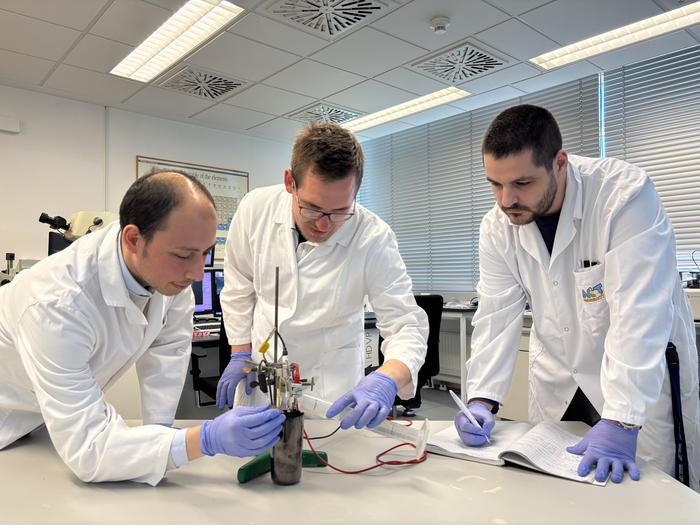
Collaborating with a multidisciplinary team including experts such as Prof. Carsten Gachot and Prof. Markus Valtiner, as well as Dr. Markus Ostermann from CEST and Marko Piljevic from AC2T, Bilotto has pioneered an innovative approach that leverages electrochemistry. This new methodology circumvents the need for toxic acids, utilizing an electric current to break the aluminum bonds in the MAX phases and facilitate the production of MXenes. By applying a specific voltage, researchers can fine-tune the electrochemical reactions, selectively eliminating aluminum atoms while generating electrochemical MXenes (EC-MXenes) without the associated risks of traditional methods.
The revolutionary findings from this research indicate that employing precise electrochemical techniques, including well-controlled pulsing of electric current, enhances the etching process and the overall quality of the generated MXenes. As opposed to conventional methods where reactivity declines rapidly, this approach encourages consistent formation of small hydrogen bubbles on the surface of MAX phase materials. These bubbles not only clean the surface but also sustain the electrochemical reactions over extended periods, resulting in larger quantities of high-quality EC-MXenes.
Advanced characterization techniques have been employed to analyze the properties of these newly synthesized materials. Techniques such as Atomic Force Microscopy, Scanning and Transmission Electron Microscopy, and Raman spectroscopy were utilized to confirm that the mechanical and electrical properties of the EC-MXenes are on par with MXenes derived from hydrofluoric acid. This breakthrough holds the potential to flatten the learning curve for producing MXenes, with Bilotto expressing aspirations that these materials could be synthesized by anyone, even in a home kitchen environment.
The implications of this research are tremendous. A safe and straightforward production method for MXenes could accelerate their adoption in various industries, thereby unlocking a range of innovative applications. Notably, industries focused on electronics, automotive, and aerospace could benefit immensely from the enhanced properties and performance derived from these 2D materials. The ability to utilize MXenes in contexts previously deemed unfeasible due to toxicity concerns presents a significant leap forward in material science and engineering.
As this research continues to develop, the promise for both scientific exploration and commercial viability remains bright. The ability to produce MXenes without the daunting costs associated with hazardous chemicals will likely lead to increased investment, enabling further advancements in the field. In a world increasingly oriented toward sustainability and safety, the economic and environmental advantages provided by this new synthesis route cannot be overstated.
This groundbreaking work has recently been published in the prestigious journal Small. It marks a significant step towards establishing MXenes as a mainstream material in technological applications. With ongoing research and optimization, the potential for further innovations in the production and application of this material class is beginning to take shape, perhaps signaling the dawn of a new era in materials science.
Ultimately, the pursuit of developing MXenes through a safe and sustainable synthesis method signifies a vital progression in materials science. By addressing the inherent challenges associated with traditional production methods, researchers are paving the way for broader applications of these remarkable materials. The evolution of MXenes could resonate well beyond the laboratory, influencing numerous commercial sectors in the coming years.
Keywords
MXenes, 2D materials, Electrochemistry, Sustainable synthesis, Materials science, TU Wien, Lubricants, Hydrofluoric acid, Pulsed current, Advanced materials, Technology innovation.
Cite Scienmag News
Grant Pearson. (April 14, 2025). Revolutionary Eco-Friendly Synthesis Method for the Groundbreaking MXene Material. Scienmag. https://scienmag.com/revolutionary-eco-friendly-synthesis-method-for-the-groundbreaking-mxene-material/
Grant Pearson. "Revolutionary Eco-Friendly Synthesis Method for the Groundbreaking MXene Material." Scienmag, 14 April 2025, https://scienmag.com/revolutionary-eco-friendly-synthesis-method-for-the-groundbreaking-mxene-material/. Accessed 4 September 2026.
Grant Pearson. "Revolutionary Eco-Friendly Synthesis Method for the Groundbreaking MXene Material." Scienmag. April 14, 2025. https://scienmag.com/revolutionary-eco-friendly-synthesis-method-for-the-groundbreaking-mxene-material/


