


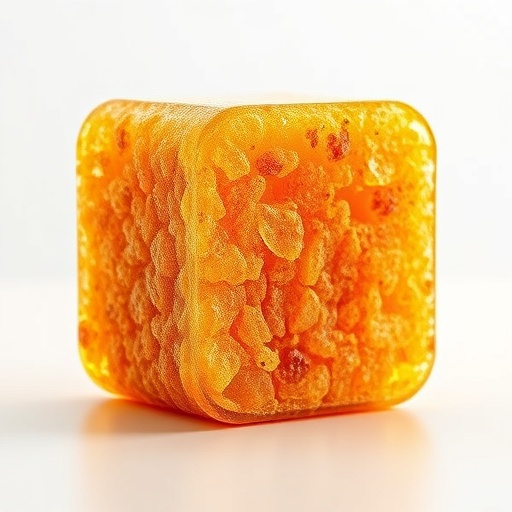
In a groundbreaking advancement in the field of material science, mechanical engineers at the University of Wisconsin–Madison have introduced a forward-thinking design framework focused on shock-absorbing foam materials. This innovative approach aims to revamp the typical methodologies employed in creating protective materials like those used in sports helmets and military equipment. By enhancing the design process for foams, the researchers are not only accelerating improvements in performance but also enabling more effective management of weight and bulkiness in material design. Their study sheds light on a prime area of material and engineering research that has implications across multiple sectors.
Traditionally, the development of shock-absorbing foams has heavily relied on achieving mechanical properties that support a constant stress plateau during impact. This conventional design philosophy has limited the scope of material optimization as it often overlooks critical factors such as foam thickness and area. The iterative design processes generally lead to prolonging timescales filled with experimental trial and error, creating inefficiencies in material development. However, the team’s novel perspective challenges this status quo by integrating both mechanical properties and geometric parameters into the design process.
The lead researcher, Ramathasan Thevamaran, an associate professor of mechanical engineering at UW–Madison, has been at the forefront of this research initiative. Thevamaran’s team discovered unexpected potential in materials that demonstrate a nonlinear stress-strain response under impact. Through rigorous testing and analysis, they revealed that, under specific conditions, these foams can outperform traditionally regarded “ideal absorbers” that maintain a constant stress level. This revelation significantly broadens the potential applications of shock-absorbing materials across various industries, from aerospace engineering to sports safety gear.
The implications of this research are profound. In particular, it offers designers greater freedom to customize materials to meet stringent performance requirements without compromising on space or weight. For industries that demand high levels of protection while maintaining rigorous design constraints, such as aerospace, military, and sports gear manufacturing, this advancement could lead to the development of safer and more efficient products. The incorporation of a dimensional analysis-guided approach allows engineers to generate a comprehensive design map that indicates the optimum configurations for shock-absorbing materials, paving the way for future innovations.
Moreover, the researchers’ findings have attracted significant attention not only for their methodological contributions but also for their potential to disrupt existing paradigms in material science. They highlight the necessity of moving beyond conventional wisdom which prioritizes uniformity in stress responses in favor of exploring more complex and dynamic material behaviors. This shift encourages interdisciplinary collaboration, inviting professionals from various sectors, including mechanical engineering, materials science, and applied physics, to engage with these new concepts.
A defining feature of the new framework developed by the UW–Madison research team is its ability to provide explicit design criteria tailored for maximizing energy absorption. The framework accounts for multiple critical variables, including the thickness and area of the foam pads, along with distinct material properties. By defining thresholds for acceleration and stress levels during particular impact scenarios, the engineers ensure that the data can be utilized effectively across different applications. This attention to detail allows for the fine-tuning of materials to achieve desired performance characteristics accurately, thus simplifying the designers’ task.
The effectiveness of the proposed framework has been validated through practical experiments, including its application to architected vertically aligned carbon nanotube foams developed by the research team. Results indicate that structuring materials at the nanoscale can further enhance their energy absorption capabilities, aligning well with their theoretical predictions. Such breakthroughs contribute significantly to the growing field of metamaterials and their application in protective technologies.
In addition to the theoretical contributions of this study, the researchers are dedicated to making their findings accessible to wider audiences. They have freely shared their innovative framework online, emphasizing the importance of transparency and collaboration in scientific research. By democratizing access to this design tool, the UW–Madison team enhances opportunities for further research and application by other researchers, engineers, and industry practitioners. This openness could lead to rapid advancements across multiple fields leveraging shock-absorbing materials.
As the research community continues to grapple with the challenges posed by conventional materials, the work of Thevamaran’s team offers a refreshing approach that could spur a wave of new designs and applications. The introduction of dynamic modeling techniques married to comprehensive design parameters represents a significant leap forward in the quest for more efficient and effective protective materials, and its potential reach is boundless. Upcoming research and projects may very well expand on these findings, optimizing existing technologies while paving the way for groundbreaking innovations in material science.
The implications extend beyond just absorbing shocks; they touch on the larger narrative of enhancing safety and technology in daily life. As advancements surge forward, industries ranging from automotive to personal protective equipment stand to benefit from these tailored materials. The work performed by the UW–Madison team encapsulates both the spirit of inquiry that fuels scientific advancement and the practical benefits that can improve the quality of life in a myriad of ways.
In conclusion, the breakthrough achieved by the University of Wisconsin–Madison’s mechanical engineering team marks a pivotal moment in the realm of protective materials. Their exploration into the interplay of material properties, geometrical design, and innovate methodologies distinguishes their research as a vital contribution to ongoing advancements. The implications of this work are profound, establishing a new paradigm for researchers and professionals alike while encouraging further exploration in the optimization of shock-absorbing foam materials for the future.
Keywords
Shock-absorbing materials, mechanical engineering, material design, nonlinear stress-strain response, carbon nanotubes, protective equipment, dimensional analysis, aerospace, materials science.
Cite Scienmag News
Denise Maddox. (September 3, 2025). Revolutionary Design Framework Simplifies Development of Custom Shock-Absorbing Materials. Scienmag. https://scienmag.com/revolutionary-design-framework-simplifies-development-of-custom-shock-absorbing-materials/
Denise Maddox. "Revolutionary Design Framework Simplifies Development of Custom Shock-Absorbing Materials." Scienmag, 3 September 2025, https://scienmag.com/revolutionary-design-framework-simplifies-development-of-custom-shock-absorbing-materials/. Accessed 4 September 2026.
Denise Maddox. "Revolutionary Design Framework Simplifies Development of Custom Shock-Absorbing Materials." Scienmag. September 3, 2025. https://scienmag.com/revolutionary-design-framework-simplifies-development-of-custom-shock-absorbing-materials/


