

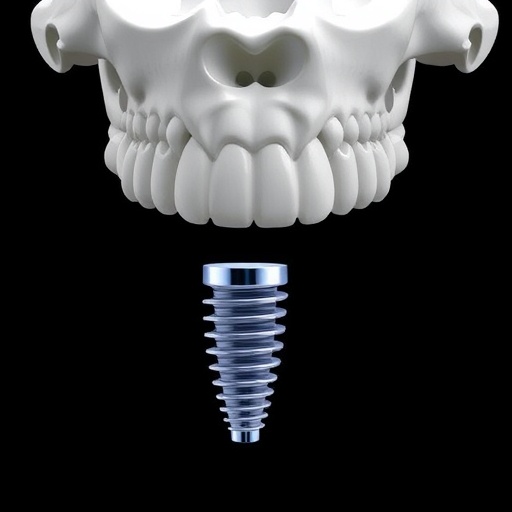
In the realm of medical technology, advancements often hinge on the integration of sophisticated algorithms and personalized care strategies. A recent breakthrough from a research team led by Nayak, A. has introduced an innovative algorithm that significantly enhances the process of designing patient-specific implants for jaw reconstruction. This cutting-edge approach underscores the growing importance of data-driven techniques in contemporary surgical practices and heralds a new era of tailored treatment frameworks that prioritize the unique anatomical considerations of each patient.
The rise of 3D printing technology has already begun to transform surgical methodologies, particularly in the field of reconstructive surgery. Traditionally, the crafting of implants has been a labor-intensive process that often involves imperfect guesses and generalized templates. These methods can result in misalignments and prolonged recovery times for patients. The novel algorithm proposed by Nayak and colleagues addresses these common pitfalls by streamlining the design process, thereby allowing surgeons to create precise, customized implant solutions that align more accurately with a patient’s specific anatomical structure.
Central to the algorithm’s efficacy is its ability to harness patient data to inform decision-making. By assimilating a wealth of information from imaging techniques such as CT scans or MRIs, the algorithm constructs highly personalized models that reflect the unique attributes of a patient’s jaw. This individualization not only improves the fit and function of the implant but also enhances the overall outcome of the reconstructive procedure, making it less invasive and significantly more efficient. The research team demonstrated that their algorithm could analyze these complex datasets rapidly, thereby facilitating a quicker turnaround from diagnosis to treatment.
Moreover, one of the compelling aspects of this algorithm is its potential for scalability. While currently applied within the context of jaw reconstruction, the principles underlying the design process can be adapted for other areas of orthopedic and reconstructive surgery. This universality could pave the way for a broader application of such personalized implant designs, impacting a wide range of surgical practices from craniofacial reconstruction to spinal surgery. The implications of adopting this technology across various medical domains could lead to increased surgical accuracy and improved patient satisfaction.
The algorithm’s design prioritizes not only patient-specific considerations but also surgeon preferences. It empowers medical professionals by allowing them to remain in control of the design process, ensuring that their expertise and insights directly influence the final product. This collaborative approach between algorithm and surgeon minimizes the potential disconnect often found in automated systems, where the medical professional may feel sidelined. The user-friendly interface of this novel system promotes seamless interaction, enabling surgeons to easily navigate through design options and make modifications as needed.
Another important aspect of this research lies in its potential to reduce costs associated with implant production. Traditional implant manufacturing processes can be labor-intensive and carry significant expenses, which may ultimately be passed on to patients. By streamlining the design and production phases, the algorithm may help lower these costs while maintaining high-quality standards. Such efficiency not only benefits healthcare systems by optimizing resource allocation but also enhances accessibility for patients who require surgical intervention.
As advancements in technology continue to reshape the landscape of healthcare, the introduction of this innovative algorithm exemplifies the confluence of medicine and engineering. The study conducted by Nayak et al. serves as a testament to how interdisciplinary research can result in groundbreaking outcomes that directly impact patient care. The resulting implants stand to redefine the benchmarks of success in jaw reconstruction surgery, with the potential to increase surgical success rates dramatically.
The team’s findings are compounded by extensive testing and validation, demonstrating the algorithm’s reliability in various scenarios. The trials involved rigorous comparisons between traditional design methods and the new algorithm-based approach, showcasing notable differences in performance metrics. Surgeons reported increased confidence in surgical outcomes, citing improved precision and predictability when utilizing the personalized implants designed through this advanced system.
In light of the rising demand for custom medical solutions in an increasingly diverse patient population, this novel algorithm aligns perfectly with the paradigms of modern medicine. The trend towards personalization, particularly in surgical contexts, is about more than merely enhancing patient outcomes; it reflects a fundamental shift towards patient-centered care. By directly involving surgical teams in the design process, the algorithm fosters a more collaborative healthcare environment that values the insights of frontline professionals.
Looking ahead, the implications of this research extend beyond the immediate application of jaw reconstruction. The underlying principles can inspire the development of further innovations in bioprinting materials, which may someday allow for implants that integrate more seamlessly with biological tissues. Such advancements would not only speed up recovery times but could also minimize the risk of implant rejection—a major hurdle in the field of prosthetics.
In conclusion, this groundbreaking research led by Nayak and his team not only elucidates the power of artificial intelligence in enhancing surgical practices but also emphasizes the necessity for ongoing collaboration between engineers and medical practitioners. As we navigate the complexities of healthcare in a technologically driven age, embracing such innovations will be critical in advancing patient safety, surgical precision, and overall satisfaction.
The journey towards widespread adoption of such advanced algorithms is one that requires continuous refinement, rigorous testing, and a commitment to education among medical professionals. As this technology matures, we can expect further developments in the sphere of personalized medicine, whereby the integration of academic research and clinical expertise leads to a healthier, more resilient population.
This new wave of research propels us into a future where surgical outcomes are not only improved but are also safer and more tailored to individual needs—reminding us that at the heart of every technological advancement lies the desire to improve human lives.
Subject of Research: Patient-specific implant design in computer-assisted jaw reconstruction.
Article Title: A novel algorithm for streamlined surgeon-dominated patient-specific implant design in computer-assisted jaw reconstruction.
Article References:
Nayak, A., PU, J.J., YU, X. et al. A novel algorithm for streamlined surgeon-dominated patient-specific implant design in computer-assisted jaw reconstruction. 3D Print Med 11, 12 (2025). https://doi.org/10.1186/s41205-025-00260-3
Image Credits: AI Generated
DOI: https://doi.org/10.1186/s41205-025-00260-3
Keywords: Personalized medicine, jaw reconstruction, 3D printing, surgical implants, artificial intelligence, patient-centered care, algorithm development.


