


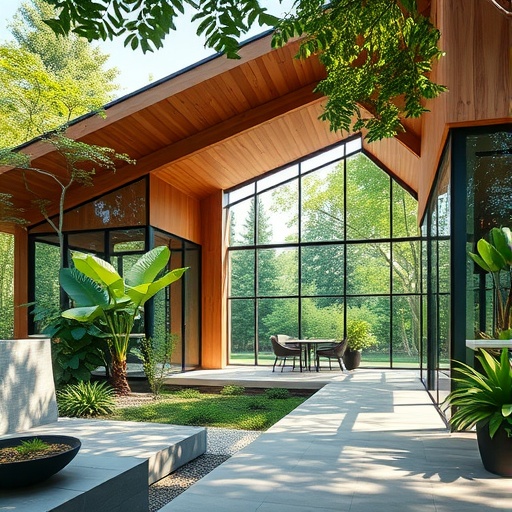
NORMAN, OKLA. – For modern structural engineers, the allure of nature is more than aesthetic; it is a critical resource that holds the key to sustainable infrastructure development. With examples ranging from the iconic Supertree Grove in Singapore to the innovative Skydance Bridge in Oklahoma City, the integration of natural elements into architectural design is showcasing nature’s potential to reshape urban landscapes. Dr. Robert W. Nairn, Ph.D., who leads the Center for Restoration of Ecosystems and Watersheds at the University of Oklahoma’s Gallogly College of Engineering, is at the forefront of exploring how nature can be an essential component in the planning and construction of infrastructure.
Dr. Nairn posits that infrastructure transcends the traditional definitions of roads, bridges, and dams. He argues compellingly that natural features such as wetlands, rivers, and forests are equally pivotal in defining our infrastructural landscape. He has emphasized the importance of understanding how these ecosystems contribute essential services to society, thereby reinforcing the need for a holistic approach to engineering that acknowledges the intrinsic value of natural systems.
In a groundbreaking move, Dr. Nairn’s research has secured a new five-year, $3 million grant from the U.S. Army Corps of Engineers through their Engineering with Nature program. This funding will facilitate a comprehensive evaluation of the long-term benefits of integrating these natural systems into infrastructure planning. As the urgency for sustainable infrastructure becomes more pronounced due to climate change and aging constructions, this research aims not only to study natural infrastructure but also to quantify its advantages with empirical rigor.
Natural infrastructure offers a plethora of services that benefit communities, including improved flood control, enhanced water and air quality, and increased biodiversity. These benefits are often rendered in more sustainable and economically viable manners compared to traditional engineering solutions, such as concrete dams and levees. By examining the interplay between natural and engineered systems, Dr. Nairn aims to unlock a new paradigm of benefits that can arise from collaborative approaches rather than adversarial ones.
The novelty of this research lies in its methodological approach. Traditional engineering has often overlooked ecosystem monitoring and the quantification of the benefits provided by natural infrastructure systems. The new research under Dr. Nairn will focus on developing and deploying highly sophisticated tools and techniques to measure the ecological functions of these systems. The research plans to leverage cutting-edge technology, including unmanned aerial systems equipped with advanced sensors, to capture detailed environmental data.
Through these advanced methods, researchers can gather crucial information about local flora, such as the health of native vegetation, on incredibly intricate scales, down to centimeter-level granularity. This capability enables a more nuanced understanding of how plant communities interact with their environment, providing valuable insights into biodiversity conservation and carbon cycling processes. These technological advancements are integral to reshaping our perception of infrastructure and the role nature plays in enhancing societal resilience.
The concept of designing with nature is not a novel idea; civilizations have long recognized the benefits of integrating natural elements into their architectures, as evidenced by historical examples from the Hanging Gardens of Babylon to the use of turf roofs by ancient Norse settlers. However, the convergence of modern engineering principles with ecological insight has not been extensively explored until now. Renowned ecosystem ecologist H.T. Odum, in his seminal work, “A Prosperous Way Down,” called for a reevaluation of societal structures to align more closely with ecological principles, urging us to rethink our interactions with the environment.
The recent uptick in recognition of nature-based solutions is timely, especially as extreme weather events escalate and existing infrastructure systems show their limits. The growing advocacy for integrating natural infrastructure methods reflects a shift in political and economic support for more sustainable strategies in infrastructure development. Dr. Nairn’s research specifically aims to address systems within the Great Plains, including inland rivers, streams, and multipurpose reservoirs, aided by a scientific focus on quantifiable performance metrics.
To achieve meaningful advancements, the research will encompass a variety of methodologies, including field experiments and laboratory simulations. By generating temporally and spatially explicit data, Dr. Nairn aims to create a comprehensive understanding of how built environments and natural systems can coexist harmoniously. The outcomes of this work promise to foster a culture of resilience in engineering, ultimately paving the way for future generations to inherit infrastructure that works in concert with nature.
The urgency for this research cannot be overstated. As Dr. Dayton M. Dorman, a postdoctoral researcher in Dr. Nairn’s lab, highlights, the current landscape of U.S. infrastructure is at a crucial juncture where many systems are poised for replacement. The pressing question arises: do we persist with outdated methodologies, or do we allow dynamic natural solutions to inform and augment these failing constructs? Building resilience emerges as a primary objective of this investigation.
In conclusion, Dr. Nairn envisions a future where natural infrastructure takes its rightful place within the engineering toolkit, not as an afterthought but as a central component of planning and design processes. By harnessing the power of nature, we have the opportunity to craft a sustainable and prosperous trajectory for infrastructure development. The echoes of environmental stewardship, economic sustainability, and social equity resonate in his call for a profound paradigm shift: a move to work alongside nature rather than against it.
Keywords
Applied Sciences, Natural Resources Management, Sustainability, Environmental Sciences, Engineering, Ecosystem Benefits, Natural Infrastructure Solutions, Climate Change Resilience.
Cite Scienmag News
Denise Maddox. (August 20, 2025). Revealing the Advantages of Nature-Inspired Construction. Scienmag. https://scienmag.com/revealing-the-advantages-of-nature-inspired-construction/
Denise Maddox. "Revealing the Advantages of Nature-Inspired Construction." Scienmag, 20 August 2025, https://scienmag.com/revealing-the-advantages-of-nature-inspired-construction/. Accessed 4 September 2026.
Denise Maddox. "Revealing the Advantages of Nature-Inspired Construction." Scienmag. August 20, 2025. https://scienmag.com/revealing-the-advantages-of-nature-inspired-construction/


