

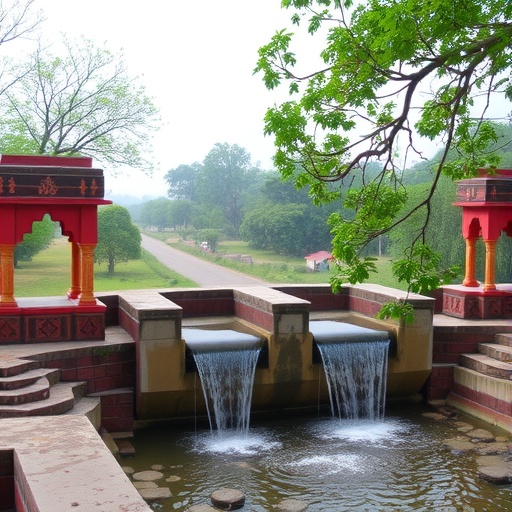
In the heartland of India, the Braj region emerges as a compelling case study where the intersections of cultural heritage and ecological responsibility converge through its ancient water infrastructures. Recent scholarship by Bharti (2025) has unveiled a dynamic narrative that challenges conventional views of heritage as static and purely historical, instead positioning living heritage as a mechanism to reclaim both socio-cultural and ecological connections mediated by traditional water systems. This research not only underscores the profound significance of these water infrastructures in sustaining communities but also highlights their role in preserving biodiversity and promoting sustainable water management practices, creating a vital framework for contemporary environmental governance.
The Braj region, historically known for its religious and cultural prominence, is renowned for a network of water bodies—lakes, canals, ponds, and stepwells—that were engineered centuries ago. These infrastructures were not merely utilitarian systems but were embedded within complex socio-spiritual practices, religion, and community life. Bharti’s comprehensive study decodes how these water infrastructures constitute a form of “living heritage,” actively maintained and revered by successive generations, which is crucial in understanding how heritage can be mobilized to address current ecological challenges.
Contrary to the common view that modern infrastructure replaces traditional methods, the Braj case reveals a hybrid model where modernity and tradition coexist, inform, and enrich each other. The research documents the adaptive capacities of these water bodies, reflecting indigenous knowledge systems capable of responding to climatic fluctuations. Bharti demonstrates that these infrastructures foster resilience through decentralized water management, enabling local communities to collectively manage resources, reduce vulnerability to drought, and maintain water cycles critical for agriculture and urban consumption.
Ecologically, the water infrastructure in Braj serves as a habitat for a vast assemblage of flora and fauna, promoting biodiversity conservation in an otherwise densely populated and anthropogenically altered landscape. The interlinked water systems support wetlands and riparian ecosystems that harbor migratory birds, aquatic species, and endemic plants. Bharti’s ethnographic approach reveals how ecological stewardship is interwoven with ritualistic practices, thus enabling conservation to be embedded within cultural expressions and everyday life.
By reclaiming these hydrological networks as living heritage, the communities in Braj challenge the dichotomy that pits development against conservation. Bharti’s analysis depicts these infrastructures as active agents in socio-economic regeneration by facilitating livelihoods such as fishing, farming, and pilgrimage-related tourism. Furthermore, the study underscores the empowerment narrative, particularly of women and marginalized groups, who play a pivotal role in maintaining these water systems and transmitting knowledge, illustrating how heritage can become a vector of social inclusion and equity.
The study further critiques the problematic legacy of colonial and post-colonial water policies in India, which often disregarded traditional systems in favor of centralized, industrialized water management. By spotlighting the resilience and sustainability embedded in the Braj water infrastructures, Bharti advocates for the reconsideration of indigenous technologies and governance models within contemporary policy frameworks. This approach disrupts hegemonic narratives that prioritize large-scale infrastructure and aligns with global calls for decolonizing environmental management.
Technically, the water infrastructures in Braj are marvels of pre-modern engineering, employing gravity-fed channels, check dams, and percolation tanks that exemplify sustainable hydrological practices. These forms of water capture and storage optimize the natural topography and soil permeability to recharge groundwater. Bharti’s fieldwork combines remote sensing data with traditional ecological knowledge to map these features and assess their condition, revealing intricate maintenance regimes supported by community participation and customary law.
The concept of “living heritage” articulated in the study challenges heritage conservation paradigms that isolate artifacts and monuments from their social contexts. Instead, Bharti presents the water infrastructures as evolving entities shaped by continuous human interaction and environmental dynamics. This fluidity enables the systems to adapt to changing climatic and socio-political conditions, ensuring their relevance and utility across centuries. It invites a rethinking of heritage management to include active stewardship and community engagement as fundamental components.
Culturally, Braj’s water infrastructures are not neutral utilities but are imbued with symbolic meanings and mythologies associated with Hindu deities and local traditions. Rituals conducted at these sites reinforce collective identity and social cohesion, facilitating intergenerational transmission of values connected to water conservation and respect for nature. Bharti’s cross-disciplinary approach elucidates how cultural narratives and ecological practices coalesce, providing a model for integrated heritage and environmental management.
The practical implications of this research extend beyond Braj, offering lessons for global water management challenges. As climate change intensifies hydrological uncertainty, traditional water systems like those in Braj represent pragmatic, low-cost, and community-controlled alternatives conducive to sustainable development goals. Bharti advocates for policies that recognize and reintegrate these systems into broader water governance, highlighting their potential to complement modern technologies and reduce dependency on large-scale infrastructures.
Moreover, Bharti’s work highlights the importance of participatory approaches in safeguarding living heritage. The empowerment of local stakeholders through recognition of their knowledge and rights is fundamental to sustaining these systems. Encouraging inclusive governance frameworks and fostering collaborations between scientists, policymakers, and communities can enhance resilience and ensure equitable resource distribution, aligning heritage conservation with social justice principles.
The study also foregrounds the challenges of urbanization and environmental degradation threatening the sustainability of traditional water infrastructures in Braj. Encroachment, pollution, and unsystematic development jeopardize the delicate ecological balances and the socio-cultural fabric that sustains these systems. Bharti calls for urgent interventions—including legal protections, capacity building, and awareness campaigns—to prevent irreversible loss and to promote regeneration efforts grounded in community-led initiatives.
From a methodological standpoint, Bharti’s integration of ethnographic research with geospatial technologies exemplifies innovative approaches to studying living heritage. This interdisciplinary methodology allows for a holistic understanding of the complex interactions between society, culture, and environment, capturing temporal and spatial dynamics often overlooked in conventional heritage or environmental studies. Such approaches are critical for informing adaptive management strategies in heritage and natural resource conservation.
In conclusion, the research illuminates how the Braj water infrastructures epitomize an indispensable link between living heritage and ecological sustainability. By reclaiming these interconnected socio-natural systems, communities in Braj not only preserve their cultural identities but also reinforce ecological resilience and social equity. Bharti’s findings make a compelling case for re-envisioning heritage as an active, participatory force that sustains both human and environmental well-being, offering valuable paradigms for heritage conservation and sustainable development worldwide.
Subject of Research: Living heritage and traditional water infrastructures in Braj region, India
Article Title: Living heritage and water infrastructures in Braj: Reclaiming socio-cultural and ecological connections
Article References:
Bharti, A. Living heritage and water infrastructures in Braj: Reclaiming socio-cultural and ecological connections. Int. J. Anthropol. Ethnol. 9, 25 (2025). https://doi.org/10.1186/s41257-025-00145-7
Image Credits: AI Generated
DOI: 10.1186/s41257-025-00145-7 (Published 29 December 2025)


