

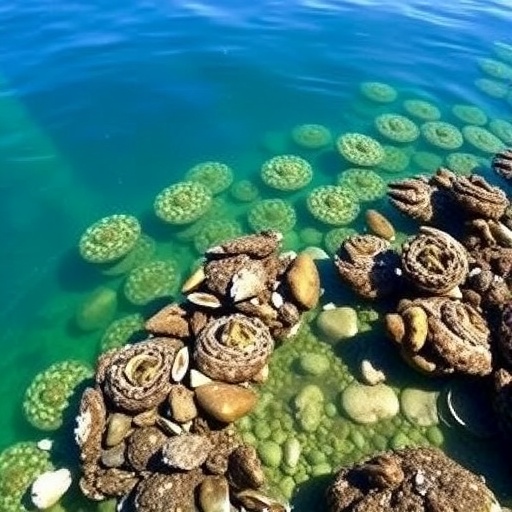
Oyster reefs have long been recognized as vital components of coastal ecosystems, serving as natural water filters, storm surge barriers, and habitats for diverse marine life. However, groundbreaking new research out of the United States has revealed that oyster reefs on the Atlantic coast perform a far more significant function than previously understood—they play a major role in the removal and burial of nitrogen in sediment, a critical process for maintaining water quality and supporting marine biodiversity. Published in PLOS One, this study not only advances ecological science but also highlights the potential for oyster reef restoration to combat nitrogen pollution, an escalating problem globally.
Eastern oysters (Crassostrea virginica), a native species inhabiting the Atlantic seaboard, construct three-dimensional reef structures that have now been demonstrated to enhance nitrogen burial in underlying sediments substantially. Nitrogen, largely from agricultural runoff and wastewater, often accumulates in coastal waters, driving eutrophication and harmful algal blooms that devastate aquatic ecosystems. The researchers found that restored oyster reefs increase sediment nitrogen burial beyond prior estimates, offering a robust natural mechanism to mitigate these anthropogenic impacts.
The investigation was conducted across diverse habitat contexts, revealing that the ability of oyster reefs to sequester nitrogen is highly dependent on the environmental conditions surrounding the reef. Factors such as sediment type, hydrodynamics, and surrounding biota influence nitrogen burial rates, suggesting that oyster reef restoration projects must be carefully tailored to local habitat characteristics to optimize ecological outcomes.
At the core of this research was meticulous sediment sampling and nitrogen flux analyses. The team quantified both organic and inorganic nitrogen forms within sediment layers, utilizing isotope tracing techniques to discern the fate of nitrogen processed by oysters and the reef system. Their data indicate that live oyster clusters sequester nitrogen through multiple pathways—filtration of particulate nitrogen, promotion of microbial denitrification processes within sediments, and enhanced sedimentation rates due to reef architecture.
Of particular note, the researchers documented how reef restoration accelerates sediment accretion, which in turn traps and permanently buries nitrogen compounds. This burial effectively removes nitrogen from the water column, mitigating eutrophication risks. The findings suggest that oyster reef restoration could be strategically deployed as a natural, cost-effective solution to water quality impairment in coastal zones facing excessive nutrient loading.
Beyond environmental implications, the economic valuation of enhanced nitrogen removal services by oyster reefs offers new insights into ecosystem service accounting. When factoring in the augmented nitrogen burial functions discovered, oyster reefs’ economic benefits rise significantly, supporting stronger economic incentives for coastal restoration funding and policy prioritization. This dual benefit to ecology and economy underscores oyster reefs’ critical role as a nexus of environmental and fiscal sustainability.
The study’s breadth is underpinned by multi-institutional collaboration and comprehensive funding from entities including the National Science Foundation and North Carolina Sea Grant. This robust support enabled advanced methodological approaches combining fieldwork, laboratory experimentation, and ecological modeling, culminating in a nuanced understanding of nitrogen biogeochemistry within oyster reef ecosystems.
Moreover, the research highlights the complexity of feedback mechanisms between benthic organisms and sediment chemistry. Live oysters facilitate microbial communities involved in nitrogen cycling, enhancing denitrification—the microbial conversion of bioavailable nitrogen into inert N2 gas. This biological synergy functions as a natural nitrogen sink, reinforcing the argument for habitat conservation.
Crucially, the paper underscores that habitat context is paramount; identical reef structures in different environmental settings can exhibit considerable variability in nitrogen burial efficacy. This spatial heterogeneity calls for adaptive management strategies in restoration planning, emphasizing local sediment characteristics, water flow regimes, and existing biotic communities to maximize nitrogen sequestration outcomes.
In the face of mounting coastal eutrophication and declining oyster populations, these findings offer a beacon of hope and practical guidance. Restoring oyster reefs is not merely about rescuing an imperiled species but represents a strategic intervention to restore nitrogen balance and enhance overall marine ecosystem resilience. Importantly, this ecological intervention complements regulatory and technological efforts targeting nutrient pollution.
From a broader perspective, this research contributes to a paradigm shift in coastal management, advocating for nature-based solutions rooted in ecosystem functionality rather than solely engineered approaches. Understanding the nuanced interactions between habitat structure and biogeochemical cycles allows for more informed decision-making that aligns ecological restoration with environmental policy.
In conclusion, the study provides compelling evidence that restored Eastern Oyster reefs along the U.S. Atlantic coast are potent natural allies in mitigating nitrogen pollution through enhanced sediment nitrogen burial. The implications for water quality improvement, coupled with newfound economic valuation, position oyster reef restoration as a critical tool for sustainable coastal management in the 21st century.
Subject of Research:
Nitrogen burial processes in sediments influenced by restored Eastern Oyster reefs
Article Title:
Habitat context affects sediment nitrogen burial by restored Eastern Oyster reefs
News Publication Date:
25-Mar-2026
Web References:
http://dx.doi.org/10.1371/journal.pone.0344310
Image Credits:
Johnny Andrews/UNC-Chapel Hill, CC-BY 4.0
Keywords:
Eastern oysters, nitrogen burial, sediment biogeochemistry, oyster reef restoration, eutrophication mitigation, nitrogen cycling, sediment accretion, denitrification, ecosystem services, coastal water quality, marine ecosystems, habitat context


