


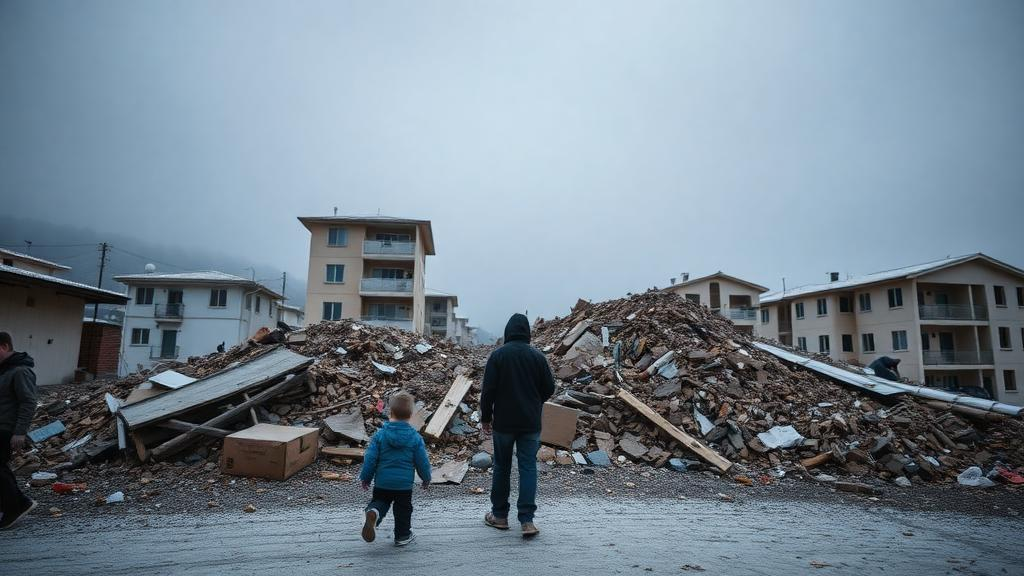
When two powerful earthquakes struck southern Türkiye on 6 February 2023, centered near Kahramanmaraş, they killed tens of thousands of people and displaced more than 850,000 children within the first month, according to UNICEF figures cited by the researchers. The disaster was one of the deadliest in the country’s modern history, and its psychological aftershocks are still being measured. A new cross-sectional study published in Current Psychology by Semiha Cömertoğlu Arslan, Hatice Altun, and colleagues at Kahramanmaraş Sütçü İmam University offers one of the clearest clinical snapshots yet of how adolescents are coping nine months after the disaster, and it arrives at a finding that challenges a common assumption in disaster mental health: that perceived social support is the key protective factor shielding young survivors from post-traumatic stress.
The research team recruited 180 adolescents aged 12 to 17 who presented to a child and adolescent psychiatry clinic in the earthquake-affected region roughly nine months after the tremors. Because the participants were clinically referred rather than drawn from the general population, the sample offers an unusually detailed picture of the most distressed segment of the affected youth. Each adolescent underwent a structured diagnostic interview using the K-SADS-PL-DSM-5, the Turkish adaptation of a widely validated semi-structured schedule for childhood psychiatric diagnoses. Severity of post-traumatic stress symptoms was measured with the Child Posttraumatic Stress Reaction Index, perceived social support with the Social Support Appraisals Scale for Children, and psychological resilience with the Child and Youth Resilience Measure, a brief 12-item instrument developed to capture personal, relational, and contextual resources for coping.
The headline numbers are sobering. Nearly seven in ten participants, 69.4 percent, showed moderate to very severe post-traumatic stress symptoms on the rating scale, yet only 8.8 percent met the full formal diagnostic criteria for post-traumatic stress disorder. That gap between dimensional symptom burden and categorical diagnosis is one of the study’s most striking and consequential observations. It suggests that screening instruments designed to gauge symptom intensity can flag far more young people as struggling than formal diagnostic interviews would classify as disordered, a discrepancy with real implications for how post-disaster mental health resources are triaged in the months and years after a catastrophe.
At the bivariate level, the pattern of associations read like a map of who was most vulnerable. Higher symptom scores were linked to being female, having experienced a prior traumatic event, sustaining an earthquake-related injury, and reporting extreme panic or fear during the earthquake itself. Conversely, higher perceived social support and higher psychological resilience were each associated with lower symptom severity. These correlates align with a substantial international literature. Meta-analyses of earthquake survivors, including work by Dai and colleagues on earthquake-related PTSD incidence and Tang and colleagues on risk factors after earthquakes, have consistently identified female gender, physical injury, and subjective life threat among the strongest predictors of post-traumatic stress in both adults and children.
The gender effect deserves particular scrutiny. Reviews of child and adolescent PTSD, such as the analysis by Garza and Jovanovic, note that girls consistently show elevated rates of post-traumatic stress after trauma, a difference that has been attributed to a complex interplay of biological and psychosocial mechanisms, including differences in fear extinction learning and the social construction of emotional expression. Research on estrogen and the consolidation and extinction of fear memories, summarized by Glover and colleagues, has proposed neuroendocrine pathways that may help explain why female survivors appear more susceptible. The current study’s finding that female gender remained an independent predictor in the multivariable model is consistent with this broader body of evidence.
The study’s most provocative result, however, emerged from the multivariable regression. When all predictors were entered simultaneously, the model was highly significant, F(24, 154) = 13.22, p < .001, and accounted for a remarkable 67.3 percent of the variance in symptom scores. Within that model, female gender, earthquake-related injury, and extreme panic or fear during the earthquake were independently associated with higher symptom severity, while psychological resilience was independently associated with lower severity. Perceived social support, by contrast, lost its statistical significance once psychological resilience and trauma exposure were taken into account. In other words, resilience appeared to be the more robust correlate of PTSD symptoms in this clinical sample, while the apparent protective effect of social support at the bivariate level may have operated through, or been absorbed by, other variables.
Why would social support fade while resilience endured? One plausible interpretation, consistent with the conceptual framing in the resilience literature, is that resilience functions as a broader, more integrative construct. The Child and Youth Resilience Measure taps not only interpersonal resources but also individual capacities and a sense of belonging to one’s community and culture. Perceived social support, as captured by the Social Support Appraisals Scale, focuses narrowly on how supported a child feels by family, friends, and teachers. If felt support contributes to resilience, or if resilience partially determines how supported a young person feels, the two constructs are not independent, and a regression model that includes both will attribute shared explanatory power to whichever variable can better account for the outcome. The authors are careful to note that these are associations, not causal claims, and that the cross-sectional design cannot disentangle whether low resilience precedes symptom escalation or follows from it.
The trauma exposure findings reinforce a lesson from decades of disaster research, including influential work by Pynoos and colleagues showing that subjective life threat during an event is a potent driver of later post-traumatic stress in children. In the Kahramanmaraş cohort, adolescents who sustained injuries or experienced overwhelming terror during the quake carried substantially higher symptom loads nine months later, even after accounting for psychological and social resources. This convergence of objective injury and subjective fear as risk markers echoes the diathesis-stress framing of PTSD articulated by McKeever and Huff and the umbrella review of risk factors by Tortella-Feliu and colleagues, which place peritraumatic fear and physical harm among the most reliable predictors of the disorder. For screening purposes, the practical implication is direct: adolescents who were hurt or who felt their lives were in danger should be prioritized for early mental health follow-up.
The study also situates itself within a specific epidemiological tradition. Türkiye has a long history of devastating seismic events, and earlier Turkish studies, including Başoğlu and colleagues’ epidemiological work on earthquake survivors, documented high rates of PTSD and comorbid depression in affected regions. More recent research in the subacute phase of the Kahramanmaraş earthquake by Yakşi and Eroğlu similarly examined determinants of PTSD among children and adolescents. The new study extends this line by comparing social support and resilience head-to-head within a single statistical model, a comparison that earlier earthquake studies, including work after China’s Wenchuan earthquake by Ying, Wu, and colleagues, had approached from different angles and with varying conclusions about which protective factor matters more.
The authors are explicit about the limitations that temper interpretation. The cross-sectional design captures a single moment in time, so no statement about temporal priority or causation can be made. The sample was clinically referred, which limits generalizability to community-dwelling adolescents, many of whom may carry significant symptoms without ever reaching a clinic. Data on symptom severity, support, and resilience came from self-report instruments, and clinical data were kept confidential rather than publicly deposited, with access possible upon reasonable request reviewed by a study steering committee. The investigators call for longitudinal studies to clarify how PTSD symptoms, perceived social support, and psychological resilience influence one another over time. Still, the study’s central message is hard to ignore: in the aftermath of catastrophe, the internal and ecological resources that make a young person resilient may matter more, statistically and clinically, than how supported they say they feel, and post-disaster screening systems should look closely at both symptom scales and diagnostic interviews before deciding who needs help.
Subject of Research: Post-traumatic stress symptoms, perceived social support, and psychological resilience in adolescents after the 2023 Kahramanmaraş earthquakes in Türkiye
Article Title: The relationship between post-traumatic stress disorder symptoms, perceived social support, and psychological resilience in adolescents following the Kahramanmaraş earthquake: a cross-sectional study
Article References: The relationship between post-traumatic stress disorder symptoms, perceived social support, and psychological resilience in adolescents following the Kahramanmaraş earthquake: a cross-sectional study. (n.d.). https://doi.org/10.1007/s12144-026-10135-3
Image Credits: AI Generated
DOI: 10.1007/s12144-026-10135-3
Keywords: PTSD, adolescents, Kahramanmaraş earthquake, psychological resilience, social support, disaster mental health, trauma, Türkiye, child psychiatry, post-disaster screening, cross-sectional study, Current Psychology
Cite Scienmag News
Glenn Wilkins. (October 14, 2026). Resilience, Not Social Support, Tracks Teen PTSD Symptoms After Türkiye’s Devastating Earthquake. Scienmag. https://scienmag.com/resilience-not-social-support-tracks-teen-ptsd-symptoms-after-turkiyes-devastating-earthquake/
Glenn Wilkins. "Resilience, Not Social Support, Tracks Teen PTSD Symptoms After Türkiye’s Devastating Earthquake." Scienmag, 14 October 2026, https://scienmag.com/resilience-not-social-support-tracks-teen-ptsd-symptoms-after-turkiyes-devastating-earthquake/. Accessed 14 October 2026.
Glenn Wilkins. "Resilience, Not Social Support, Tracks Teen PTSD Symptoms After Türkiye’s Devastating Earthquake." Scienmag. October 14, 2026. https://scienmag.com/resilience-not-social-support-tracks-teen-ptsd-symptoms-after-turkiyes-devastating-earthquake/


