


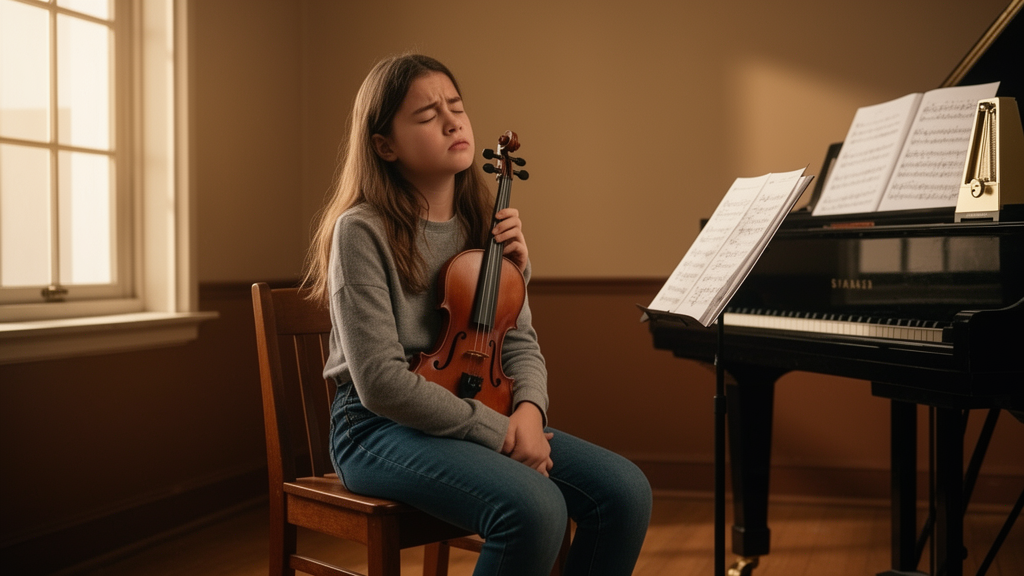
Music performance students spend years training under intense evaluation, playing and singing for juries, teachers, and audiences whose judgments can shape their careers. A new cross-sectional study from China examines how that pressure relates to how these students feel about their lives, and it finds that performance anxiety is negatively associated with subjective well-being. The research, conducted by Xiong Gao and Pingting Li of Zhangjiajie College and published in the journal Frontiers in Psychology, also identifies psychological resilience as a statistical pathway that accounts for part of that association.
The survey included 946 university music performance students. Because the design was cross-sectional, capturing a single moment in time, the results describe associations rather than proven causal effects. The researchers used two statistical modeling approaches from the PROCESS toolkit: Model 4, which tested whether resilience indirectly linked anxiety and well-being, and Model 72, which tested how two forms of perfectionism moderated the relationships among the three variables.
The core finding was straightforward. Students who reported higher performance anxiety reported lower subjective well-being. When resilience was added to the model, a significant indirect association emerged: performance anxiety was linked to lower resilience, which in turn was linked to lower well-being.
In other words, resilience statistically accounted for part of the connection between stage fright and life satisfaction, though the study cannot establish that anxiety actually erodes resilience over time. The perfectionism analysis added a layer of nuance. In this study, each dimension separately moderated the association between performance anxiety and resilience, meaning the strength of that link depended on a student's perfectionism profile.
What the two dimensions did not do, at least for that first link, was interact. The three-way interaction among performance anxiety, adaptive perfectionism, and maladaptive perfectionism on the anxiety-resilience association was not significant. Whatever joint patterns the two perfectionism dimensions produce, they did not show up in how anxiety related to resilience in this sample.
The picture changed for the second focal association. Both perfectionism dimensions also moderated the positive association between resilience and subjective well-being, and here the three-way interaction was significant and negative. That means the combined levels of adaptive and maladaptive perfectionism jointly shaped how strongly resilience translated into well-being, a conditional pattern that did not appear anywhere else in the models.
Importantly, the researchers report that the resilience-well-being association remained positive across all examined combinations of perfectionism. Higher resilience went with higher well-being regardless of where a student fell on the perfectionism dimensions; perfectionism changed the strength of that association, not its direction. The authors conclude that adaptive and maladaptive perfectionism show distinct separate and joint conditional patterns across the two focal associations examined in the study.
The findings arrive with clear limitations. The sample consisted of music performance students in China, and the data were self-reported at one point in time, so the results may not generalize to other populations, cultures, or conservatory systems, and no causal claims can be drawn. The article's final formatted version was still forthcoming at the time of the abstract's release, with the study received in August 2026 and accepted in October 2026.
Even so, the work offers a measured contribution to positive psychology: it maps how anxiety, resilience, and two faces of perfectionism are wired together in a high-stakes training environment, suggesting that resilience may be a meaningful statistical link between the pressure of performance and how students experience their lives.
Subject of Research: Associations among performance anxiety, psychological resilience, perfectionism, and subjective well-being in university music performance students
Article Title: Exploring the relationship between performance anxiety and subjective well-being in music performance students: the role of psychological resilience and perfectionism
Article References: Gao, X., & Li, P. (2026). Exploring the relationship between performance anxiety and subjective well-being in music performance students: the role of psychological resilience and perfectionism. Frontiers in Psychology, 17, Article 1967733. https://doi.org/10.3389/fpsyg.2026.1967733
Image Credits: AI Generated
DOI: 10.3389/fpsyg.2026.1967733
Keywords: performance anxiety, subjective well-being, psychological resilience, adaptive perfectionism, maladaptive perfectionism, music students, cross-sectional study, moderation analysis, positive psychology, China, Exploring, relationship
Cite Scienmag News
Glenn Wilkins. (October 27, 2026). Resilience Links Performance Anxiety to Lower Well-Being in Music Students. Scienmag. https://scienmag.com/resilience-links-performance-anxiety-to-lower-well-being-in-music-students/
Glenn Wilkins. "Resilience Links Performance Anxiety to Lower Well-Being in Music Students." Scienmag, 27 October 2026, https://scienmag.com/resilience-links-performance-anxiety-to-lower-well-being-in-music-students/. Accessed 27 October 2026.
Glenn Wilkins. "Resilience Links Performance Anxiety to Lower Well-Being in Music Students." Scienmag. October 27, 2026. https://scienmag.com/resilience-links-performance-anxiety-to-lower-well-being-in-music-students/


