


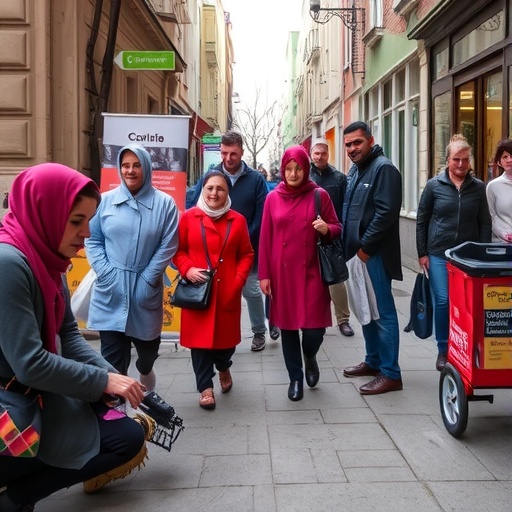
In a groundbreaking study published in the journal Genus, researchers D. Mendola and A. Busetta delve into the nuanced dynamics shaping refugee health in Germany, emphasizing the interplay between resilience and discrimination. Their analysis, situated at the intersection of demography, social science, and public health, offers a comprehensive examination of how socio-political forces affect the well-being of displaced populations.
The refugee crisis has increasingly put a spotlight on the health vulnerabilities faced by those seeking asylum. However, Mendola and Busetta challenge simplistic narratives that frame refugee health solely as a matter of vulnerability. Instead, they propose a multifaceted framework that considers resilience as an active, complex process. Resilience, in this context, is not merely an individual trait but an adaptive response influenced by systemic factors, social networks, and institutional practices.
Central to the study is the recognition that discrimination remains a pervasive and insidious determinant of health outcomes among refugees. The authors argue that discriminatory experiences not only directly undermine mental and physical health but also erode the social fabric that sustains resilience. Through their analysis, they reveal how structural barriers in healthcare access, employment, housing, and social integration potentiate health disparities among refugee communities.
The methodology employed by Mendola and Busetta integrates quantitative and qualitative data, privileging a holistic view of health. By leveraging demographic data combined with ethnographic insights, they map the contours of health disparities while providing voices to refugees’ lived experiences. This mixed-methods approach underscores the heterogeneous nature of resilience, shaped by intersecting vulnerabilities such as gender, age, and legal status.
One of the study’s compelling findings is how resilience manifests differently based on individual and contextual configurations. While some refugees demonstrate remarkable psychological endurance despite traumatic histories, others face cumulative stressors exacerbated by hostile societal conditions. The research highlights that resilience is not uniformly distributed but contingent upon access to supportive social structures and institutional recognition.
Furthermore, Mendola and Busetta illuminate the role of policy environments in either facilitating or hindering resilience-building efforts. The German context serves as a critical case study where progressive integration policies coexist with instances of xenophobia and bureaucratic obstacles. The authors posit that enhancing refugee health outcomes necessitates dismantling discriminatory practices embedded within healthcare systems and fostering inclusive policy frameworks.
The psychological ramifications of discrimination emerge as a central theme, with impacts ranging from chronic stress to diminished self-worth among refugees. These mental health challenges often remain unaddressed due to language barriers, cultural dissonance, and stigma around seeking psychiatric care. The study advocates for culturally sensitive health interventions that recognize the traumatic legacy of displacement and the ongoing societal exclusion.
Importantly, the research identifies community resilience as a pivotal resource. Informal networks of mutual aid, cultural organizations, and faith-based groups function as vital buffers against social isolation and discrimination. Such grassroots resilience mechanisms enhance coping capacities and offer symbolic and material support, underscoring the need for public health strategies to engage with and bolster these community assets.
The authors also shed light on the intersectionality of discrimination, explicating how refugees of different ethnicities, religions, and social backgrounds experience health inequities in distinct ways. This layered analysis reveals how systemic racism and social prejudice complicate access to essential services and exacerbate health vulnerabilities. Recognizing such heterogeneity is essential for tailoring interventions that address specific needs within refugee populations.
Crucially, the study critiques dominant paradigms in refugee health research that often cast refugees as passive recipients of aid. Mendola and Busetta challenge this view by highlighting agency, resilience, and the capacity for self-determination within these communities. Their perspective calls for a paradigm shift towards empowering refugees as active participants in shaping their health trajectories.
In terms of implications, the research offers valuable insights for policymakers, healthcare providers, and civil society actors. It advocates for integrated approaches that combine anti-discriminatory measures, mental health support, and socio-economic inclusion. By fostering an environment where resilience can thrive, Germany and other host nations can improve long-term health outcomes for refugees and enhance social cohesion.
The study also opens avenues for future research into the mechanisms by which resilience is cultivated and eroded in varying socio-political contexts. Comparative analyses across different host countries and refugee groups could further illuminate best practices and potential pitfalls in refugee health governance.
Technically, the authors employ robust statistical analyses to quantify the prevalence and impact of discrimination on health markers, while qualitative narratives elucidate the subjective experiences behind the data. This methodological rigor contributes to a comprehensive understanding that transcends reductionist approaches often seen in public health literature.
Ultimately, Mendola and Busetta’s work serves as a clarion call to acknowledge the complex, layered realities of refugee health. It stresses the need to balance recognition of adversity with appreciation for resilience, advocating for policies and practices informed by empathy, evidence, and equity.
In an era marked by global displacement and rising nationalist sentiments, this research provides a timely, critical lens on the societal responsibilities toward one of the most vulnerable groups. By unpacking the multifaceted nature of resilience amid discrimination, it charts a path forward that humanizes refugees beyond statistics and fosters healthier, more inclusive societies.
Cite Scienmag News
Courtney Benton. (November 27, 2025). Resilience and Discrimination Shape Refugee Health in Germany. Scienmag. https://scienmag.com/resilience-and-discrimination-shape-refugee-health-in-germany-2/
Courtney Benton. "Resilience and Discrimination Shape Refugee Health in Germany." Scienmag, 27 November 2025, https://scienmag.com/resilience-and-discrimination-shape-refugee-health-in-germany-2/. Accessed 5 September 2026.
Courtney Benton. "Resilience and Discrimination Shape Refugee Health in Germany." Scienmag. November 27, 2025. https://scienmag.com/resilience-and-discrimination-shape-refugee-health-in-germany-2/


