


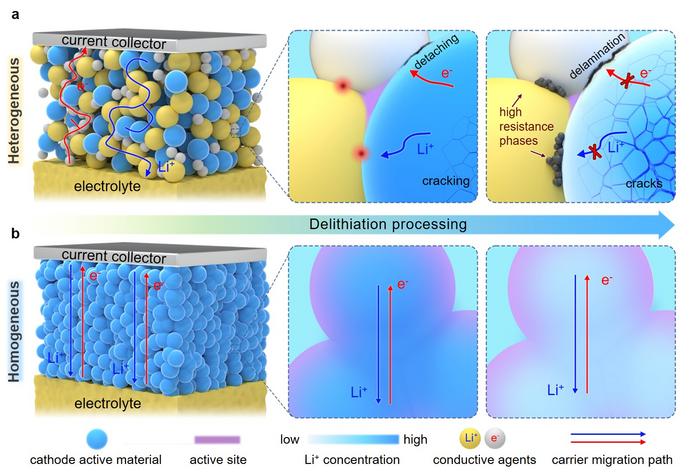
Researchers at the Qingdao Institute of Bioenergy and Bioprocess Technology (QIBEBT) of the Chinese Academy of Sciences, along with collaborators from leading international institutions, have introduced an innovative cathode homogenization strategy for all-solid-state lithium batteries (ASLBs).

Credit: Image by QIBEBT
Researchers at the Qingdao Institute of Bioenergy and Bioprocess Technology (QIBEBT) of the Chinese Academy of Sciences, along with collaborators from leading international institutions, have introduced an innovative cathode homogenization strategy for all-solid-state lithium batteries (ASLBs).
This new approach, detailed in their recent publication in Nature Energy on July 31, significantly improves the cycle life and energy density of ASLBs, representing an important advancement in energy storage technology.
Current ASLBs face challenges due to heterogeneous composite cathodes, which require electrochemically inactive additives to enhance conduction. These additives, while necessary, reduce the batteries’ energy density and cycle life due to their incompatibility with the layered oxide cathodes, which undergo substantial volume changes during operation.
Researchers have developed a solution: a cathode homogenization strategy utilizing a zero-strain material, Li1.75Ti2(Ge0.25P0.75S3.8Se0.2)3 (LTG0.25PSSe0.2). This material exhibits excellent mixed ionic and electronic conductivity, ensuring efficient charge transport throughout the (dis)charge process without the need for additional conductive additives.
The LTG0.25PSSe0.2 material shows impressive performance metrics, including a specific capacity of 250 mAh g–1 and minimal volume change of just 1.2%. A homogeneous cathode made entirely of LTG0.25PSSe0.2 enables room-temperature ASLBs to achieve over 20,000 cycles of stable operation and a high energy density of 390 Wh kg−1 at the cell level.
“Our cathode homogenization strategy challenges the conventional heterogeneous cathode design,” said Dr. CUI Longfei, co-first author of the study from Solid Energy System Technology Center (SERGY) at QIBEBT. “By eliminating the need for inactive additives, we enhance energy density and extend the battery’s cycle life.”
“This approach is a game-changer for ASLBs,” remarked Dr. ZHANG Shu, co-first author of the study from SERGY. “The combination of high energy density and extended cycle life opens up new possibilities for the future of energy storage.”
Prof. JU jiangwei, co-corresponding author of the study from SERGY, added, “The material’s stability and performance metrics are impressive, making it a strong candidate for commercial applications in electric vehicles and large-scale energy storage systems.”
This advancement is supported by extensive testing and theoretical calculations. These analyses confirm the electrochemical and mechanical stability of the homogeneous cathodes, showing no adverse chemical reactions or significant resistance increases after prolonged cycling.
Beyond ASLBs, other battery types, including solid-state sodium batteries, lithium-ion batteries, lithium-sulfur batteries, sodium-ion batteries, and fuel cells, also face challenges with heterogeneous electrodes. These systems often suffer from mechanochemical and electrochemical incompatibilities, creating significant bottlenecks and degrading overall battery performance.
“The commercialization potential for high-energy-density ASLBs is now more achievable,” added Prof. CUI Guanglei, head of SERGY. “Our universal strategy for designing multifunctional homogeneous cathodes can overcome the energy, power, and lifespan barriers in energy storage, paving the way for real-world applications.”
By addressing key challenges in ASLBs, this strategy sets a foundation for future innovations in energy storage technology. The team plans to further explore the scalability of the LTG0.25PSSe0.2 material and its integration into practical battery systems.
This work represents a significant milestone in battery technology and offers a promising outlook for future advancements. The team’s innovative approach is expected to influence future research and development in the field of energy storage, providing a strong foundation for the next generation of high-performance batteries.
Journal
Nature Energy
Article Title
A cathode homogenization strategy for enabling long-cycle-life all-solid-state lithium batteries
Article Publication Date
31-Jul-2024
Cite Scienmag News
Denise Maddox. (July 31, 2024). Researchers pioneer new approach to enhance all-solid-state lithium batteries. Scienmag. https://scienmag.com/researchers-pioneer-new-approach-to-enhance-all-solid-state-lithium-batteries/
Denise Maddox. "Researchers pioneer new approach to enhance all-solid-state lithium batteries." Scienmag, 31 July 2024, https://scienmag.com/researchers-pioneer-new-approach-to-enhance-all-solid-state-lithium-batteries/. Accessed 3 September 2026.
Denise Maddox. "Researchers pioneer new approach to enhance all-solid-state lithium batteries." Scienmag. July 31, 2024. https://scienmag.com/researchers-pioneer-new-approach-to-enhance-all-solid-state-lithium-batteries/

