


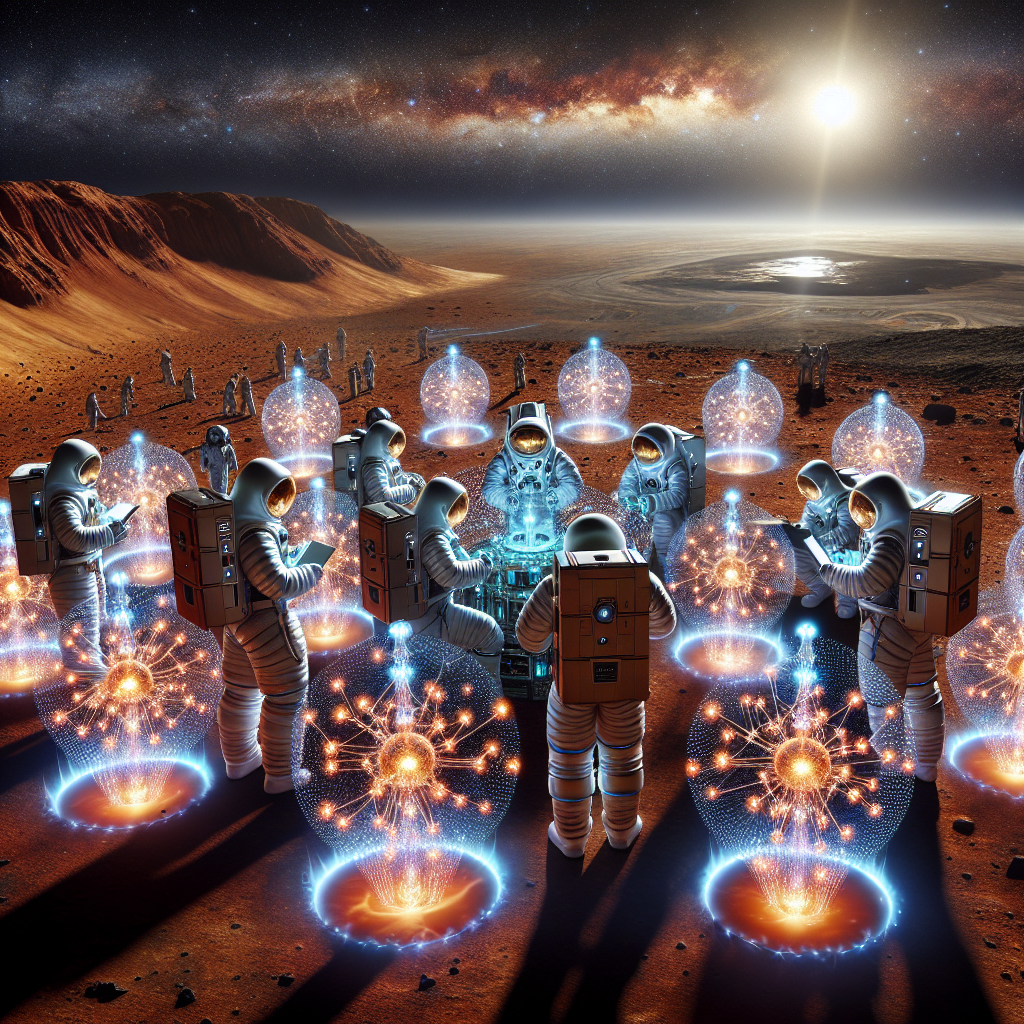
Abu Dhabi, August 23, 2024: Researchers have identified specific materials, including certain plastics, rubber, and synthetic fibers, as well as Martian soil (regolith), which would effectively protect astronauts by blocking harmful space radiation on Mars. These findings could inform the design of protective habitats and spacesuits, making long-duration Mars missions more feasible. Because Mars lacks Earth’s thick atmosphere and magnetic field, astronauts exploring the planet would be exposed to dangerous levels of radiation.
Abu Dhabi, August 23, 2024: Researchers have identified specific materials, including certain plastics, rubber, and synthetic fibers, as well as Martian soil (regolith), which would effectively protect astronauts by blocking harmful space radiation on Mars. These findings could inform the design of protective habitats and spacesuits, making long-duration Mars missions more feasible. Because Mars lacks Earth’s thick atmosphere and magnetic field, astronauts exploring the planet would be exposed to dangerous levels of radiation.
Dimitra Atri, Investigator, Center for Astrophysics and Space Science and Group Leader of the Mars Research Group at NYU Abu Dhabi’s Center for Astrophysics and Space Science, and lead author Dionysios Gakis from the University of Patras in Greece, report these new findings in “Modeling the effectiveness of radiation shielding materials for astronaut protection on Mars,” appearing in the journal The European Physical Journal Plus.
Using computer modeling to simulate the radiation conditions on Mars, the researchers tested various standard and novel materials to see which best shielded cosmic radiation and determined that compound materials like certain plastics, rubber, and synthetic fibers would all perform well. Martian soil (regolith) was also somewhat effective and could be used as an extra layer of protection. In addition, they demonstrated that the most widely used aluminum could also be helpful when combined with other low atomic number materials. The study also used real Mars data from NASA’s Curiosity rover to confirm these findings.
“This breakthrough enhances astronaut safety and makes long-term Mars missions a more realistic possibility,” said Atri. “It supports the future of human space exploration and potential establishment of human bases on Mars, including the UAE’s Mars 2117 project and its goal of establishing a city on Mars by the year 2117.”
“Several materials were specifically tested in a simulated Martian environment, making our results directly applicable to future missions and optimizing the combination of advanced materials with the natural resources available on Mars,” Gakis added.
ENDS
About NYU Abu Dhabi
www.nyuad.nyu.edu
NYU Abu Dhabi is the first comprehensive liberal arts and research campus in the Middle East to be operated abroad by a major American research university. Times Higher Education ranks NYU among the top 30 universities in the world, making NYU Abu Dhabi the highest-ranked university in the UAE and MENA region. NYU Abu Dhabi has integrated a highly selective undergraduate curriculum across the disciplines with a world center for advanced research and scholarship. The university enables its students in the sciences, engineering, social sciences, humanities, and arts to succeed in an increasingly interdependent world and advance cooperation and progress on humanity’s shared challenges. NYU Abu Dhabi’s high-achieving students have come from over 120 countries and speak over 100 languages. Together, NYU’s campuses in New York, Abu Dhabi, and Shanghai form the backbone of a unique global university, giving faculty and students opportunities to experience varied learning environments and immersion in other cultures at one or more of the numerous study-abroad sites NYU maintains on six continents.
Journal
The European Physical Journal Plus
Article Title
Modeling the effectiveness of radiation shielding materials for astronaut protection on Mars
Article Publication Date
8-Aug-2024
Cite Scienmag News
Bethany Barker. (August 23, 2024). Researchers identify effective materials for protecting astronauts from harmful cosmic radiation on Mars. Scienmag. https://scienmag.com/researchers-identify-effective-materials-for-protecting-astronauts-from-harmful-cosmic-radiation-on-mars/
Bethany Barker. "Researchers identify effective materials for protecting astronauts from harmful cosmic radiation on Mars." Scienmag, 23 August 2024, https://scienmag.com/researchers-identify-effective-materials-for-protecting-astronauts-from-harmful-cosmic-radiation-on-mars/. Accessed 3 September 2026.
Bethany Barker. "Researchers identify effective materials for protecting astronauts from harmful cosmic radiation on Mars." Scienmag. August 23, 2024. https://scienmag.com/researchers-identify-effective-materials-for-protecting-astronauts-from-harmful-cosmic-radiation-on-mars/


