
Sunday, March 1, 2026
Science
No Result
View All Result
  • Login
  • HOME
  • SCIENCE NEWS
  • CONTACT US
  • HOME
  • SCIENCE NEWS
  • CONTACT US
No Result
View All Result
Scienmag
No Result
View All Result
Home Science News Social Science

Researchers developed a model that allows a computer to understand human emotions

June 4, 2024
in Social Science
Reading Time: 3 mins read
0
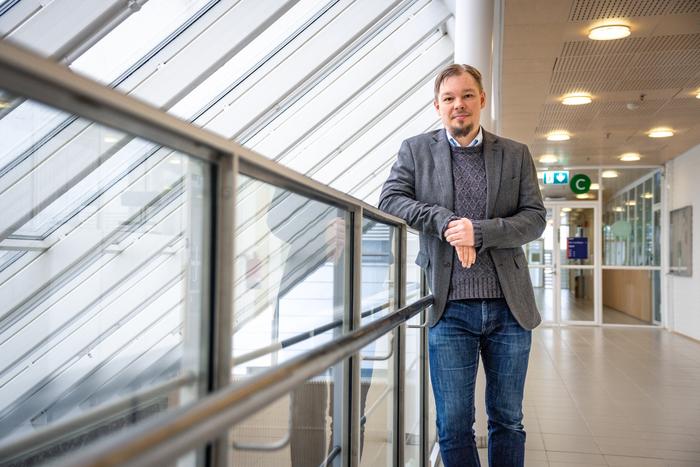
Assistant Professor Jussi Jokinen
66
SHARES
599
VIEWS
Share on FacebookShare on Twitter
ADVERTISEMENT

Researchers at the University of Jyväskylä, Finland, have developed a model that enables computers to interpret and understand human emotions, utilizing principles of mathematical psychology. This advancement could significantly improve the interface between humans and smart technologies, including artificial intelligence systems, making them more intuitive and responsive to user feelings.

Assistant Professor Jussi Jokinen

Credit: Teemu Rahikka / University of Jyväskylä

Researchers at the University of Jyväskylä, Finland, have developed a model that enables computers to interpret and understand human emotions, utilizing principles of mathematical psychology. This advancement could significantly improve the interface between humans and smart technologies, including artificial intelligence systems, making them more intuitive and responsive to user feelings.

According to Jussi Jokinen, Associate Professor of Cognitive Science, the model could be used by a computer in the future to predict, for example, when a user will become annoyed or anxious. In such situations, the computer could, for example, give the user additional instructions or redirect the interaction.

In everyday interactions with computers, users commonly experience emotions such as joy, irritation, and boredom. Despite the growing prevalence of artificial intelligence, current technologies often fail to acknowledge these user emotions.

The model developed in Jyväskylä can currently predict if the user has feelings of happiness, boredom, irritation, rage, despair and anxiety.

“Humans naturally interpret and react to each other’s emotions, a capability that machines fundamentally lack,” Jokinen explains. “This discrepancy can make interactions with computers frustrating, especially if the machine remains oblivious to the user’s emotional state.”

The research project led by Jokinen uses mathematical psychology to find solutions to the problem of misalignment between intelligent computer systems and their users.

“Our model can be integrated into AI systems, granting them the ability to psychologically understand emotions and thus better relate to their users.” Jokinen says.

Research is based on emotional theory – the next step is to influence the user’s emotions

The research is anchored in a theory postulating that emotions are generated when human cognition evaluates events from various perspectives.

Jokinen elaborates: “Consider a computer error during a critical task. This event is assessed by the user’s cognition as being counterproductive. An inexperienced user might react with anxiety and fear due to uncertainty on how to resolve the error, whereas an experienced user might feel irritation, annoyed at having to waste time resolving the issue. Our model predicts the user’s emotional response by simulating this cognitive evaluation process.”

The next phase of this project will explore potential applications of this emotional understanding.

“With our model, a computer could preemptively predict user distress and attempt to mitigate negative emotions,” Jokinen suggests.

“This proactive approach could be utilized in various settings, from office environments to social media platforms, improving user experience by sensitively managing emotional dynamics.”

The implications of such technology are profound, offering a glimpse into a future where computers are not merely tools, but empathetic partners in user interaction.


DOI

10.1145/3613904

Method of Research

Computational simulation/modeling

Subject of Research

People

Article Title

Simulating Emotions With an Integrated Computational Model of Appraisal and Reinforcement Learning

Article Publication Date

11-May-2024

Share26Tweet17
Previous Post

New study shows eating beans and chickpeas is linked to better diet quality in American adults

Next Post

Small, but smart: How symbiotic bacteria adapt to big environmental changes

Related Posts

blank
Social Science

Science Uncovers Why You Crave Snacks Even When You’re Fully Satiated

March 1, 2026
blank
Social Science

$3 Million NIH Grant Funds Nationwide Study on Medicare Advantage’s Expansion into Social Support Benefits

February 28, 2026
blank
Social Science

New Study Reveals Habitual Repetition Has Greater Impact on Decision-Making Than Previously Believed

February 27, 2026
blank
Social Science

Study Finds Boys Exhibit Higher Motivation, While Girls Show Greater Compassion

February 27, 2026
blank
Social Science

Semantic Memory Disorganization Impacts Schizophrenia Social Functioning

February 27, 2026
blank
Social Science

When You Stumble, Laughter Triumphs Over Embarrassment

February 27, 2026
Next Post
Fieldwork in Panama

Small, but smart: How symbiotic bacteria adapt to big environmental changes

  • Mothers who receive childcare support from maternal grandparents show more parental warmth, finds NTU Singapore study

    Mothers who receive childcare support from maternal grandparents show more parental warmth, finds NTU Singapore study

    27618 shares
    Share 11044 Tweet 6902
  • University of Seville Breaks 120-Year-Old Mystery, Revises a Key Einstein Concept

    1022 shares
    Share 409 Tweet 256
  • Bee body mass, pathogens and local climate influence heat tolerance

    665 shares
    Share 266 Tweet 166
  • Researchers record first-ever images and data of a shark experiencing a boat strike

    532 shares
    Share 213 Tweet 133
  • Groundbreaking Clinical Trial Reveals Lubiprostone Enhances Kidney Function

    517 shares
    Share 207 Tweet 129
Science

Embark on a thrilling journey of discovery with Scienmag.com—your ultimate source for cutting-edge breakthroughs. Immerse yourself in a world where curiosity knows no limits and tomorrow’s possibilities become today’s reality!

RECENT NEWS

  • Graphene Microtube Resonators Enable Polarization-Sensitive Optics
  • Feeding Tube Risks After Head, Neck Cancer Surgery
  • Synchronizing Complex Spatio-Temporal Laser Dynamics
  • Post-Treatment SIV Control Tied to Viral Persistence

Categories

  • Agriculture
  • Anthropology
  • Archaeology
  • Athmospheric
  • Biology
  • Biotechnology
  • Blog
  • Bussines
  • Cancer
  • Chemistry
  • Climate
  • Earth Science
  • Editorial Policy
  • Marine
  • Mathematics
  • Medicine
  • Pediatry
  • Policy
  • Psychology & Psychiatry
  • Science Education
  • Social Science
  • Space
  • Technology and Engineering

Subscribe to Blog via Email

Success! An email was just sent to confirm your subscription. Please find the email now and click 'Confirm Follow' to start subscribing.

Join 5,190 other subscribers

© 2025 Scienmag - Science Magazine

Welcome Back!

Login to your account below

Forgotten Password?

Retrieve your password

Please enter your username or email address to reset your password.

Log In
No Result
View All Result
  • HOME
  • SCIENCE NEWS
  • CONTACT US

© 2025 Scienmag - Science Magazine